Glacier National Park’s Chief Mountain

Chief Mountain - M.R. Campbell, 1963

About 5 miles south of the Canadian border, his grandmother nudged him awake.

“Nináistko,” she said, pointing to an imposing limestone monolith, thrust like the broken end of a giant’s club into a rolling ridge on the eastern edge of the mountain range.

“I don’t like it grandma,” he told her.

She pinched the back of his neck.

“Kyiopok, my little bear cub,” she whispered, “since I heard no spirits asking for your opinion, that mountain is where you must go. You must cry for your vision and find your great love.” –Garden of Heaven

The 9,080-foot Chief Mountain in Montana sits on the border of Glacier National Park and the Blackfeet Indian Reservation. Sacred to the Blackfeet, the mountain is a prominent landmark for tourists and others traveling betweeen Alberta and Montana on State Road 17.

Directions and Location

NPS Map

From a car, the east face of Chief Mountain can be easily viewed thirteen miles north of Babb, Montana about five and a half miles south of the Canadian border.

If you’re visiting the park by car, head north out of Babb on U. S. 89, and then about four miles out, bear to your left onto MT 17. This road is also known as the Blackfeet Highway and the Chief Mountain International Highway.

You can also see Chief Mountain by taking one of the park’s red buses between Many Glacier Hotel and the Prince of Wales Hotel at Waterton Lakes National Park in Alberta.

Vision Quests

Chief Mountain, known as a klippe, or rootless mountain, was reported by Peter Fidler of the Hudson’s Bay Company in 1792 and by Meriwether Lewis in 1805. Early explorers were told that Flathead, Kootenai and Blackfeet used the mountain for vision quests.

When Henry L. Stimson climbed Chief Mountain in 1892, he reportedly found the remnants of an old buffalo skull said to have been left there by a Native American on a vision quest. Billy Fox (the man’s exact name is disputed), who climbed with Stimson, called the skull “the old Flathead’s pillow.”

In my novel The Sun Singer, Robert Adams climbs this mountain in an alternate universe where it is named The Guardian. In Garden of Heaven, David Ward climbs this mountain, referring to it by its ancient Blackfeet name Nináistko. Both Adams and Ward climb the mountain for vision quests.

Both of them follow the East Face Route, described as “for experienced and patient rock climbers only” by Gordon Edwards in his widely known reference A Climber’s Guide to Glacier National Park. If you don’t have Edward’s book, Summit Post has basic climber’s information for Chief Mountain, including routes.

According to Jack Holterman, in his Place Names of Glacier/Waterton National Parks, the name “is both the name of the mountain and a personal and family name.” Nináistko (the Blackfeet name of Mountain Chief) was a prominent leader. His portrait was painted by artist George Catlin in 1832.

Geology

Chief Mountain is a pillar of Precambrian belt rock that was pushed some fifty miles east along the Lewis thrust fault. The fault itself can be seen in multiple locations throughout the park, perhaps most easily near Many Glacier Hotel. Chief, then, is an example of older rock sitting on top of the younger Cretaceous rock. The mountain displays good examples of Altyn limestone and Appekuny mudstone, two of the park’s more noticeable formations on the east side.

The Lewis Overthrust occurred 60 to 100 million years ago. While it’s fun to envision the mountains racing east as though they were on a roller coaster, the rock moved slowly over a long period of time; had there been a man to stand there and watch, he might not have noticed anything.

Personally, I like the Blackfeet story, as I note it in Garden of Heaven: Many said the great rocks that formed the backbone of the world were piled one upon the other and sculpted into shining mountains by Nápi, the Old Man who created the world from a ball of mud fetched up from the depths of the dark primordial waters by Muskrat.

The View
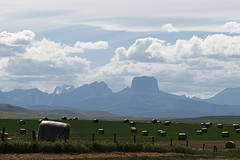
Chief Mountain (right) - Park Service Photo

A climber standing on the summit of Chief Mountain will be struck by the fact that the mountains of the Rocky Mountain front come to rather an abrupt end there they meet the plains. Westward, you’ll see Mount Merritt and Mount Cleveland. Slide Lake sits just southwest of Chief, and then farther away, Mount St. Nicholas, Red Eagle and Going to the Sun.

Eastward past the highway, you’re looking into the land of the Blackfeet Nation. On the horizon are the three main buttes of the so-called Sweetgrass Hills. According to legend, Nápi flung them out there. Geologists refer to them as island mountains.

A more accurate name would be Hills of Sweet Pines, the actual translation of the Blackfeet name Kâtoyísix. Unfortunately, the name “Sweet Grass” was inaccurately applied and is now pretty much engraved in stone.

Names

Early British maps called Chief Mountain “Kings Mountain.” Lewis called it “Tower Mountain.” For awhile, it was called Kaiser Mountain, probably after freight-hauler Lee Kaiser. The official name, comes from the Blackfeet Mountain of the Chief, or Old Chief.

In their book Waterton and Glacier in a Snap, Ray Djuff and Chris Morrison write that they believe “the best view of this impressive mountain, which resembles a chief’s head looking at the sky, can be had from Alberta.” About that, they just might be right.

–Malcolm

Malcolm R. Campbell
Author of hero’s journey novels

Available on Kindle for only $4.99

Glacier National Park’s Garden of Heaven

Section of current NPS map
The Garden of Heaven was a name suggested for a valley between Glacier National Park’s Morning Eagle Falls and Lake Josephine by naturalist Morton J. Elrod in 1924.

Elrod, who wrote the park’s NPS-approved hiking handbook called Elrod’s Guide and Book of Information of Glacier National Park described the Garden of Heaven as follows:

“The open narrow valley along Cataract creek for perhaps two miles below Morning Eagle Falls, beginning where the trail comes out into the open, is a very beautiful flower garden in July and August. At the foot of the towering Garden Wall, flanked on all sides but one by protective mountains, the writer has called it and wishes others might call it, ‘The Garden of Heaven.’ By wandering away from the trail and examining the mossy banks of the meandering streams, the fully beauty of the wonderful garden will be understood.”

Elrod’s guide was published in 1924 and revised in 1930. Unfortunately, the name for this valley on the trail to Piegan Pass didn’t make it into park naturalist George C. Ruhle’s Guide to Glacier National Park when it replaced the Elrod guide as the official park trail handbook in 1949.

Instrumental in forming the park’s ranger naturalist program, Elrod and Ruhle worked together. So, it’s probable that Ruhle was well aware of Elrod’s name for the valley. In fact, much of the information in the Ruhle guidebook–which went through three editions–closely approximated Elrod’s facts and descriptions.

I have found no other park reference to the Garden of Heaven other than in Jack Holterman’s encyclopedic 1985 Place Names of Glacier/Waterton National Parks, on which I worked as an editorial assistant at the Glacier Natural History Association. I have never found the name on a map or mentioned in any other park trail guide.

Elrod’s description is apt. The trail above Lake Josephine between Mt. Gould and Mt. Allen is a wonderful spot. The falls itself is a little over five miles from Many Glacier Hotel. Hikers can “cheat” on the walk by taking the Swiftcurrent Lake and Lake Josephine launches.

The rare, long out-of-print park guidebook by a prolific writer and photographer is the origin for the title of my 2010 novel Garden of Heaven: an Odyssey. (Some readers have thought that took the title from the 14th-century poet Hafiz’s poem by that name.)
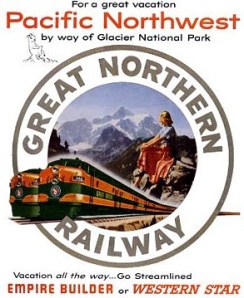
If anyone ever finds a postcard, guidebook, or trail map that refers to the park valley by this old name, I would appreciate hearing about it.

–Malcolm

Glacier Park hosts ‘Winter Nights’ moonlit ski trip

from NPS Glacier:

WEST GLACIER, MONT. – Ever wonder what’s going on during cold winter nights when the world seems still? On the evening of Saturday, February 19 the public is invited to join a free, four-mile, ranger-led cross country ski excursion into the winter night to discover how the park’s winter residents survive the cold and harsh months. This guided outing is suitable for intermediate-level skiers of all ages.

Supported by a grant from the Glacier National Park Fund, this moonlit cross country ski trip will be offered on February 19, the Saturday evening nearest the full moon in February (weather and snow conditions permitting). The ski excursion begins at 7 p.m.

In the event of severe weather or insufficient snow, individuals should call Apgar Visitor Center at 406-888-7939 to confirm the ski trip. All participants must bring their own cross country ski equipment as well as extra layers of clothing, a headlamp and water. Skis are available for rent at retail locations outside of Glacier National Park in West Glacier and other gateway communities.

The moonlit tour will begin at the Camas Road gate, a three-minute drive from the Apgar Visitor Center. There is no group size limit and no reservations are taken.

Park visitors are reminded that although this winter activity is free, valid park entry is required except when fees are waived. Even when entrance stations are not staffed, park entrance fees are required. Upon entering the park, visitors are directed to follow posted instructions to pay entrance fees at self-pay stations. Glacier’s winter entrance fee is $15 for vehicles and $10 for single entrants (hiker/bicyclist/motorcyclist) for a seven-day pass. Annual park passes, valid for unlimited visits to Glacier National Park for 12 months from the date of purchase, are also available for $35 and currently can be purchased on weekdays at the Backcountry Permit Office located in Apgar Village and on weekends from entrance stations when staffed.

For more information or to confirm the cross country ski program, please call the Apgar Visitor Center at 406-888-7939, on weekends, between 9 a.m. and 4:30 p.m.

All Aboard for Glacier National Park

When Glacier National Park, Montana, celebrated its centennial last year, 2.2 million visitors came to the park, setting a new attendance record. While Amtrak’s Empire Builder serves the park, most of today’s visitors arrived by plane and automobile.

The park’s hotels and early infrastructure were developed by James J. Hill’s Great Northern Railway (GN), now a part of the Burlington Northern Santa Fe (see downloadable history), as a means of increasing passenger rail traffic on the route between Minneapolis and Seattle. The route, which went through North Dakota, Montana and Idaho, is the northernmost transcontinental railroad in the United States. Hill and his railroad prided themselves in the fact that, unlike other transcontinental railroads, GN used no federal land grants to built the track.
Before Amtrak took over most U.S. intercity passenger rail service in 1971, Great Northern delivered visitors to East Glacier and West Glacier via many named trains over the years, the last of which were its premier Empire Builder and the Western Star. Considered a secondary passenger train, the Western Star (train #27) left Minneapolis daily for the west coast, arriving in East Glacier before breakfast the following day. When Amtrak took over passenger service on the route in 1971, it kept the Empire Builder and discontinued the Western Star which had been in operation since 1951.

Carol Guthrie’s All Aboard for Glacier National Park (2004) captures the heady days of passenger rail travel and the park.  Even though the trains are mostly gone, you can still see the Great Northern Railway’s influence throughout the park, especially in the hotels managed by Glacier Park, Inc. (The company was owned by the railroad until 1960.)

When I worked as a bellman at the park’s Many Glacier Hotel in the 1960s, I traveled from my home in Florida to the park by rail, and that included the Western Star. The railroad still offered hotel employees reduced-fare tickets even though most railroads’ passenger trains were, by then, operating at a loss. Since the train ride was part of my Glacier National Park experience, I couldn’t help but include the Great Northern Railway and the Western Star in my novel Garden of Heaven. (Now out of print.)

Garden of Heaven Excerpt

In the novel, my main character David Ward gets to do what I always wanted to do: run the Western Star for a few miles just east of Glacier National Park:

“Climb up, Mr. Ward, it’s only 24 miles, and I’ll be close by.”

“You run like a god damned freight engineer,” said Jim as he lit another cigarette, “and there will be hell to pay.”

“I won’t spill a drop of coffee,” said David.

They followed him up into the cab. Jim slouched in the fireman’s seat with his newspaper and Big Ed stood by silently while David sat, noted the positions of the brake handles and the needles on air gauges, then looked out the window at the track ahead of them. There was seldom any rust on these rails lying easy on the fine, well-drained roadbed, and now as the day wound down, the tracks were becoming a true hi-line into night. Ahead, in the middle distance, two tall trees stood equidistant from the center of track—the right bathed in full sun, the left now in shade—a gate to the future, all aboard for Blackfoot, Sundance, Cutbank, Shelby, and points east with connections to RTC Great Lakes and Vietnam. He stepped on the dead man’s pedal and looked back at Ed and said he was ready.

“It’s 5:12 and we are clear to proceed,” Ed said. “You won’t need the transition lever, go easy out of here and then one day tell your grandkids you ran the Western Star.” Ed punctuated the sentiment with two loud blasts of the horn.

He put the reverser lever in forward, pushed the throttle into notch 1 and felt the engines load as he carefully feathered off the independent brake.

“Good,” said Jim. “Big Ed didn’t leave any slack in the train.”

“Damn sure didn’t,” said Ed. “I care very deeply about those Pullman passengers and their eagle eyes conductor back there.”

David eased the throttle out a notch at a time, slowly, so far so good, he hadn’t jostled anybody, felt the automatic transition as they passed between the two trees and throttled back to avoid any wheel slip, then began easing the throttle forward again until they reached track speed.


SunSinger4coverMalcolm R. Campbell is the author of “Conjure woman’s Cat” and “The Sun Singer.” “The Sun Singer” is set in Glacier National Park.


‘The Wolverine Way’

“These animals’ off-the-charts strength and survival skills had become a source of inspiration for me by now. Even so, I was never going to get used to dealing with the intensity of a wolverine when it’s up close and cornered.” — Douglas Chadwick, National Parks Magazine, Winter 2011

Seven years ago, author and biologist Douglas Chadwick volunteered for The Wolverine project, a five-year study conducted in Glacier National Park by The Wolverine Foundation. Chadwick has compiled his experiences into The Wolverine Way, a 250-page book released in May by Pantagonia. (There’s a detailed story in the June18th issue of The Missoulian.)

Chadwick’s book and the related article in the current issue of National Parks may help dispel some of the myths and misunderstandings about this seldom-seen animal that is, as Chadwick says, “more complex than the legends that surround it.

As the non-profit Wolverine Foundation notes on its website, it is focusing on the wolverine not “because we feel the wolverine is in danger of extinction, but because it is in need of attention.” The site includes links to the growing database of wolverine information that will suit the needs of wildlife biologists and the general public.

The Wolverine Way is a nice addition to the library of those with a passion for Glacier National Park.

One can only stand in awe of an animal with a strategy that Chadwick suggests might sound like this:  “Go hard, and high, and steep, and never back down, not even from the biggest grizzly, and least of all from a mountain.”

Set partly in Glacier Park, the e-book edition of this novel is only $5.99

Glacier Artist-in-Residence Applications Due by February 15

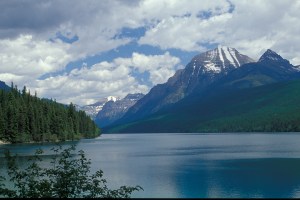
Bowman Lake - NPS photo

Glacier National Park’s artist-in-residence program is open to artists and writers who want to experience the wonder of the park for four weeks this coming summer and, while there, donate their time, inspiration and creative work in support of the park’s environmental education program.

Applicants for the summer of 2011 will be reviewed based on their ability to “produce children’s educational art and materials including scientific illustrations, drawings and graphics; poetry, prose and stories; puppet shows, plays, and song lyrics (for existing or original music); music; and educational lesson plans and resource information guides. These products must be about Glacier and its plants, animals, habitats, geology, natural processes, history and beauty and suitable for use with elementary and middle school children. Thus, the 2011 Artist-in-Residence Program is open to children’s artists, writers, poets, composers, song writers, musicians and academics with relevant experience and backgrounds.”

Applications must be postmarked by February 15, 2011. Click here for information and the address for submissions. The National Park Service will make its selection of one or two individuals for the program in March for residencies to be conducted between mid-June and Labor Day.

Malcolm

A Glacier Park Adventure Available on Kindle

Expanded Waterton-Glacier Watershed Protections Needed

from National Parks and Conservation Assn:

Former National Park Superintendents Call for Waterton-Glacier Expansion, Watershed Protections

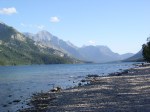
Waterton Lakes - Chris Phan photo

Whitefish, MT — An international coalition of retired superintendents from Waterton Lakes National Park in Canada and Glacier National Park in the United States has voiced their concern for the future of those parks and the need for immediate actions by both countries to complete park protection measures begun earlier this year.

“Waterton-Glacier International Peace Park is a treasure that we all share as North Americans,” said former Glacier Superintendent Mick Holm.  “In joining our voice with our Canadian counterparts, we’re hoping public officials in both countries will view our communication as a call to action on behalf of this globally significant World Heritage site.”

Waterton Lakes - Lesa Campbell photo

The letter, signed by nearly all of the parks’ former superintendents, comes in the closing days of Glacier’s centennial year, as Congress considers a bi-partisan public-lands omnibus bill (America’s Great Outdoors Act of 2010) that includes several key park-protection measures. The package legislation encompasses more than 110 individual bills, aimed at protecting the country’s land, water and wildlife resources. Senate Majority Leader Harry Reid has said he would like to see passage before Congress adjourns early in the New Year.

In their letter, the former superintendents endorse a long-standing proposal for Canada to expand Waterton Lakes National Park westward, into one-third of the British Columbian Flathead.  They also call for Canada to establish a wildlife management area connecting Waterton-Glacier to other Canadian Rocky Mountain parks, including Banff.

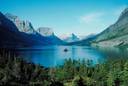
Glacier - St. Mary's Lake - NPS

The former superintendents noted the historic nature of recent steps taken by both countries to prohibit coal strip-mines, hard-rock mining, and oil and gas leases on public lands upstream from Waterton-Glacier, including action to protect 400,000 acres in Canada and the voluntary relinquishment of 200,000 acres of oil and gas leases by energy companies in the United States. They note, however, that legislation to finalize the mining and drilling ban has yet to become law in the United States, and urge prompt action on that front.

They also call for expanded environmental cooperation across the border, and a formal international agreement between both countries to protect Waterton-Glacier and the surrounding Crown of the Continent ecosystem in Montana, British Columbia, and Alberta.

“To have nearly every retired superintendent from Waterton and Glacier calling for these measures is beyond significant,” said Tim Stevens, Northern Rockies regional director of the National Parks Conservation Association.  “These individuals spent their entire careers managing protected areas.  They understand better than anyone what steps are needed to ensure the ecological integrity and clean headwaters of Waterton-Glacier.”

In 2009, proposed mining activities in the Canadian Flathead Valley gained the attention of the UNESCO World Heritage Committee, which voted unanimously to send an international team of scientists to investigate whether the negative impacts of proposed coal strip mines warranted listing Waterton-Glacier as a “World Heritage site in Danger.”  The UNESCO report concluded that the proposed strip-mine would result in environmental harm to the World Heritage site.

Only $3.99 on Kindle

Glacier’s Aspens Love Glacier’s Wolves

Healthy aspen trees are returning to Glacier National Park’s north fork after the Moose Fire of 2001 in part because of the presence of wolves.

Extensive research by conservation biologist Cristina Eisenberg suggests that wolves in the area are having a positive impact of the aspens. The relationship between predators, prey and plants is called trophic cascades.

Simply put, if there were no wolves, the park’s elk would have free access to the stands of aspen where they would eat so many buds of potential new trees that the trees would be stunted if they survived at all. When wolves are present, the elk are more circumspect, eating a little here and a little there.

Fear of wolves alone restricts some of the elk’s behavior, keeping them from “over-grazing” the forest. The presence of healthy aspens highly impacts the entire ecosystem leading to a domino-effect of positive benefits for other species even though a few of the elk may be killed by the wolves.

This is nature’s dynamic state of balance. You can learn more about trophic cascades in Eisenberg’s book “The Wolf’s Tooth.”

According to publisher IslandPress:  At their most fundamental level, trophic cascades are powerful stories about ecosystem processes—of predators and their prey, of what it takes to survive in a landscape, of the flow of nutrients. The Wolf’s Tooth is the first book to focus on the vital connection between trophic cascades and restoring biodiversity and habitats, and to do so in a way that is accessible to a diverse readership.

Congratulations to Jami Belt and her successful two-year High Country Citizen Science Project that trained 140 volunteers to help with the park’s mountain goat count. Best estimates are that there are between 1,700 and 2,300 mountain goats in the park. Avid Glacier hikers know from experience that mountain goats are not always easy to see. With persistence, you can find them–and even count them.

Malcolm

On sale on Kindle for only $3.99

Construction of New Dorm at Lake McDonald Begins

from NPS Glacier National Park

Lake McDonald Lodge - Lee Coursey photo
WEST GLACIER, MONT. – Construction has begun on a new dormitory near Lake McDonald Lodge in Glacier National Park. The dorm will include a new employee dining facility in the basement and dormitory rooms on the top two levels. Construction of this building near the new Lewis Dormitory is anticipated to be completed by May 2011. Construction started Tuesday, September 28 with excavation of the basement. As part of this project two abandoned dormitories (Hydro and Johnson) will be demolished and removed this fall.

This project is funded by Glacier Park, Inc.(GPI) and Swank Enterprises has been selected as the general contractor. The new employee dining facility will allow the transfer of that function away from its current location at the Lake McDonald Lodge making way for improvements to the working conditions in the main lodge kitchen and further separating guest and employee functions. Employees currently housed in Cobb House and Snyder dormitories will be relocated to this new facility allowing those historic buildings to be renovated as additional visitor lodging including some lower cost economy accommodations.

Park Superintendent Chas Cartwright says “Building this new dormitory will further implement the vision conceptualized and approved in the park’s 2004 Commercial Services Plan/Final Environmental Impact Statement (CSP/FEIS). This vision includes consolidating employee housing and moving employee housing away from the flood plain, upgrading housing conditions and improving separation of employee and guest functions. Visitor and employee parking will be addressed separately.”

The CSP/FEIS also planned for improving the range of visitor accommodations, improving the sense of arrival to the historic lodge and improving the visitor experience by providing a central, consolidated parking area away from the entry boulevard in the Lake McDonald developed area.

The new dorm is part of a larger concessioner-funded project begun in 2009 which relocated three dormitories from their former location near Snyder Creek to a site adjacent to the new Lewis Dormitory near the Lake McDonald Post Office and Going-to-the-Sun Road. The three buildings were improved to include new bathroom facilities and installation of fire suppression and alarm systems. A new water line and improved detention ponds for storm water were built to support the relocated buildings.

The Lake McDonald Historic District was listed in the National Register of Historic Places in 1978 and Lake McDonald Lodge was designated a National Historic Landmark in 1987.

Hero's journey novel set in Glacier

Glacier Centennial Activities

from NPS Glacier National Park

100 Years of Goats in Glacier

Thursday, September 2, 2010 (registration required)
Glacier Institute Course
The mountain goat, neither true goat nor sheep, now lives exclusively in North America. Despite increasing threats to their habitat, goats continue to thrive in what remains. Although mountain goats sometimes frequent lower elevations, their normal home is a stark alpine aerie above the timberline and sometimes as high as 10,000 feet above sea level. The rugged high country of Glacier National Park is part of that habitat.

Belton Chalet Employee Reunion

Sunday, September 5, 2010 (registration required)
Belton Chalet, West Glacier, MT

Calling all Belton Chalet alumni and employees! Join the Belton Chalet for a celebration of 100 years of history with generations of past employees- sharing stories, reviving old recipes and uniforms, and highlighting our tie to Glacier National Park and the Great Northern Railway.

Gear Jammer Reunion

Wednesday-Friday, September 8-10, 2010 (registration required)
Glacier Celebration and Gear Jammer Reunion
Glacier Park Lodge, East Glacier, MT

Red Bus tours have been an integral part of the Glacier experience for most of the 100 years Glacier has been a national park. Through sun, rain, snow, wind, bears, and adversity, Gearjammers have made sure that visitors have reached their destinations safely and provided them with a fun-filled informative commentary on the unsurpassed, gorgeous scenery. The unbroken history of gearjamming in Glacier is unique to the United States. To become one of the special breed of Red Bus drivers has always been a high honor.

This reunion affords former Gearjammers a Glacier revisit to recall their youth, renew old acquaintances, and a chance to revisit a park that was a pivotal point in their lives.

Rotary International Peace Park Ceremony

September 9-12, 2010 (registration required)
Hands Across the Border Rotary International Peace Park Ceremony Many Glacier Hotel, Glacier National Park, MT

Local Rotary Clubs on each side of the 49th parallel inspired the U.S. Congress and Canada’s Parliament to establish the world’s first International Peace Park in 1932. Rotarians, park managers, and school children reaffirm the peace with an annual hands across the border pledge. The conjoined park is now a United Nations World Heritage Site.

Great Northern Railway Historical Society Convention

September 12-15, 2010 (sold out)
September 12 (free open house)
Great Northern Railway Historical Society Convention Glacier Park Lodge, East Glacier, MT

No walk-in registrations will be accepted due to space considerations.

Glacier Park Lodge was built by the Great Northern Railway in 1912 on a site known as Midvale purchased from the Blackfeet Nation.

Each purchase of this mountain adventure novel benefits the park