Glacier’s Plants – Western Serviceberry

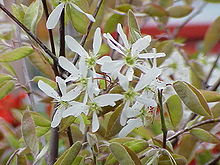
Serviceberry - Wikipedia photo

This rosaceous shrub is often divided into several poorly defined varieties, but the delicate white flowers make it easy to recognizee. The apple-like fruits are 3/8 t0 1/2 inch in diameter, becoming dark purple at maturity. — “Plants of Waterton-Glacier National Parks” by Richard J. Shaw and Danny On.

Like many Glacier Park hikers, I snagged hundreds of the more widely known huckleberries, ending up with purple fingers, and usually missed out on this highly versatile and widespread berry.

As Shaw and On suggest, you’ll find it called by multiple names throughout the country, including sarvis berry, sarviceberry, wild pear, chuckley pear, wild-plum, Saskatoon, Juneberry and shadbush. In Canada, Saskatoon, after an old Cree word, is the preferred name. In fact, Saskatoon, Saskatchewan is named after the berry. The variety in the park is Amelanchier alnifolia.

The berries were one of the traditional foods of the Blackfeet. They were mixed into pemmican with dried meat and eaten raw. You’ll find them referenced in the works of George Bird Grinnell (How the Blackfoot Lived), Walter McClintock (The Old North Trail), James Willard Schultz (My Life as an Indian) and other western writers.

In my old, dog-eared copy of The Old North Trail, I enjoy reading McClintock’s detailed accounts of Blackfeet stories and customs, including the sarvis berry information in chapter XXXXVI:

DURING my visit at Brings-down-the-Sun’s camp, the women were gathering their
winter supply of sarvis berries. The bushes, which the old chief so carefully
guarded, were loaded down with ripe fruit. Their method was to strike the bushes
with sticks, catching the berries in blankets, and then spreading them in the
sun to dry. Berry-bags for carrying them were made of small skins from deer
legs, wolf-pups or unborn calves of large animals such as the elk, or deer, or,
most often, of the buffalo. I saw a beautiful berry-bag made of a spotted fawn
skin and ornamented with coloured porcupine quills. Sarvis berries are a
favourite article of diet with all the plains-tribes. They are eaten raw or
cooked in soups and stews. My Indian friends warned me that the berries
sometimes make people very ill, who are not accustomed to eating them.

The berries work well in jams, pies, beer, cider and wine, though some people supplement them with huckleberries for color and taste. When you’re gathering them, you may have to fight off a few bears, squirrels and chipmunks. Moose and elk like the foliage.

In my contemporary fantasy, Sarabande, the native healer stirs flour, sugar and dried meat into a pot of boiled berries for a soup that can be eaten hot or cold. If you want to try the berries in pie, you’ll find two recipes here.  Here’s a pie recipe that includes rhubarb. For wine, check this site.

Since the serviceberry—under one name or another—can be found throughout Canda and the United States (except Hawaii), chances are you might enjoy a few tasty berries on your next summer hike.


Malcolm

contemporary fantasy set in Glacier Park

Free Lone Pine State Park Workshop for Early Childhood Educators

from NPS Glacier National Park:

WEST GLACIER, MONT. -Glacier National Park, in partnership with the Flathead Community of Resource Educators (CORE), and Project Learning Tree, is sponsoring a free one-day workshop for early childhood teachers and youth group leaders on Thursday, October 20, 2011.

The free workshop will be held at Lone Pine State Park Visitor Center, 300 Lone Pine Road, Kalispell, from 9am to 3:30pm. Teachers can receive six Office of Public Instruction renewal units for attending.

The training offers pre-school and elementary school teachers, daycare providers, home-school parents, 4-H leaders, Girl and Boy Scout leaders and others an opportunity to explore many of the educational trunks available for use in classrooms, at troop or group gatherings or outdoor education programs.

Educational trunks about forests and timber, wetlands, wolves, birds, bears, fire in the ecosystem and more will be featured at the workshop. In addition, Project Learning Tree (PLT) facilitators will be presenting activities from the new PLT Early Childhood Guidebook. All participants will receive a copy of the guidebook. There is no cost for the workshop due to sponsorship from Montana Department of Natural Resources and Conservation and Plum Creek Timber Company.

Participants must register in advance as there are only 20 slots available. Teachers can register for the workshop through PIRnet at http://www.kalnet.io-solutions.com/pir. Other youth group leaders may register by calling Patti Mason at 406-752-4220. For more information about the Flathead Community of Resource Educators (CORE) visit http://flatheadcd.org/

The USDA offices (NRCS & FSA) and the Flathead Conservation District are located behind Jo Ann Fabrics and the Sweetheart Bakery store in Evergreen off of LaSalle. The address is:  133 Interstate Lane, Kalispell, MT  59901. Click on Office Location to see where the new office is located, or call us for directions, 752-4220.

Conservation Districs (CDs) focus on Water Quality, Coordinated Resource Management and Planning/Watershed Planning, Education, Riparian Management and Urban/Suburban Activities.

Malcolm

contemporary fantasy set in Glacier Park

Breathing in the Land

Virginia Falls - NPS photo

During the summers I worked in Glacier National Park, I hiked the same trails many times, partly because they served as feeder trails to longer hikes, or somebody suggested going for an after breakfast walk, or the sky and the air seemed to be offering an invitation.

Over the course of three summers, I learned a lot about my favorite trails. Most of it was five-senses knowledge. The number of miles between one place and another. The steepest climbs. The best-tasting water. Mountain sheep meadows. Wildflowers. Birds. But, over time, a fair amount of what I picked up was intuitive knowledge. I came to know those trails the way one knows any good friend. And, like what we know about a good friend, that knowledge as in large measure a felt thing.
In earlier times before we became entertained and enslaved by such distractions as cars, cell phones and the Internet, people walked the same paths everyday to get to school, work, the high pasture, the fishing hole, or to buy supplies. While the walking was focused on the practical need to get somewhere and do something, it nonetheless became a ritual, supplying the individual with a great deal of felt knowledge over time.
Breathing in the Land
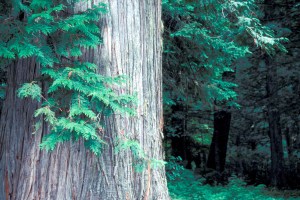
Glacier cedars - NPS photo

As a writer in love with symbols and metaphors, I like thinking of what I learn about the land as breathing it in. It takes time and commitment to breathe in anything or anyone. You don’t walk into the woods once and come away with a head full of knowledge any more than you learn everything about your prospective soul mate on the first date.

Anthropologist Mary Catherine Bateson calls this breathed-in-over-time knowledge a longitudinal epiphany. In her book Peripheral Visions: Learning along the Way, she likens this knowledge with what a husband and wife experience from taking time to have breakfast together every day for 40 years or in making it a habit to go somewhere and watch the autumn leaves falling every year.
Our attention spans have become too short for very much ritual whether it’s formal, as in a religious service or a meditation, or whether it’s informal as in eating dinner with one’s spouse every night or hiking between Many Glacier Hotel and Grinnell Glacier every morning while in the national park.
Bateson writes that “Rituals use repetition to create the experience of walking the same path again and again with the possibility of discovering new meaning that would otherwise be invisible.” One has to walk the path, I think, to gain the knowledge; you don’t learn it by reading what somebody else experienced on the path or by using MapQuest or Google Earth to look at the path.
A Favorite Tree or Meadow
One need not visit their favorite national park and can hike, for example, around Lake Josephine every evening at dusk or listen to the water at Virginia Falls at the break of day. Like the Glacier Park cedar in the photograph, the old oak tree in your backyard will work or, perhaps, a meadow, lake or stream in a nearby park.
Decide how much time you can spend, and then sit in or walk through or around this place once a day, once a week, or once a month. Listen, observe, smell, touch with nothing on your mind other than where you are and what you are breathing in with your five senses and your  intuition.
Don’t expect a psychic experience the first night that fills your head with a hundred years worth of history nobody knows about the place. Instead, experience the changes from visit to visit.In time, you will form a relationship with that place.
You will trust it and know it because you have made the commitment to go there and be there. In time, you will know that place through the loving ritual of your walking and your breathing in everything you encounter.
–Malcolm
contemporary fiction set in Glacier Park

Glacier’s Winter of Destruction

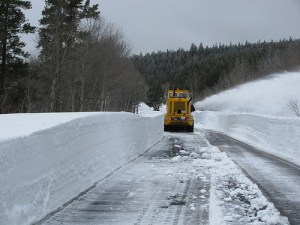
Plowing near Two Medicine in March - NPS photo

If you visited Glacier National Park this year, or if you live in northwest Montana where you see park news, then you know Glacier’s snowfall during the winterwas double the usual amount. Sperry Chalet sustained avalanche damage. Going to the Sun Road, chalets and hotels opened late.

The Daily InterLake reported that these late openings were partially responsible for the park’s reduced number of visitors this year, 20% lower than last year’s record highs. The paper noted that “Going-to-the-Sun Road’s July 13 opening over Logan Pass was the latest in park history.”
According to the Glacier National Park Fund, “Many of Glacier’s trails suffered from heightened fallen-tree damage and erosion with most of the high-country trails remaining impassable until late July or early August.” The Fund noted that in addition to the avalanche at Sperry, “significant damage” was found in other structures as well.
The Glacier Park National Park’s call to action campaign, which began with a July 15th fundraiser featuring former First Lady Laura Bush, is raising money to help pay for repairs to trails and historic structures. “Philanthropy has always played an important role in creating and maintaining our national parks and today that need is greater than ever,” Bush said.
So far, $50,000 has been raised. Another $100,000 is needed. If you would like to make a donation in support of this campaign, you can do so on the Fund’s website. The fund notes that “of the 1000 miles of trails 20 years ago, only a little more than 700 miles remain open today.” We don’t need to see more of those spectacular miles fading away during the next 20 years.
Malcolm R. Campbell is the author of three novels partially set in Glacier National Park, including his new contemporary fantasy Sarabande.

105,000 Americans tell Congress to stop cutting critical funding for national parks

from NPCA

Washington, DC – Today, the nonpartisan National Parks Conservation Association (NPCA) announced that more than 105,000 Americans have signed their petition calling on Congress to stop cutting critical funding for national parks. The signatures were gathered through NPCA’s National Parks Protection Project.

“As we approach the Centennial of the National Park Service, we must ensure our national parks receive adequate funding for our children and grandchildren to enjoy,” said NPCA President Tom Kiernan. “This is by far the most successful petition drive we’ve ever had – in nearly 100 years of operations – and it’s time for Congress to take notice of how many people have joined this effort.”

NPCA founded the National Parks Protection Project as an effort to show both Congress and the American people why it is important to adequately fund the national parks for our children and grandchildren.

Our national parks not only protect America’s heritage, they are important to local economies nationwide. Research shows that every federal dollar invested in national parks generates at least four dollars of economic value for the American people. National parks support more than $13 billion of local private-sector economic activity and nearly 270,000 private-sector jobs.

“The federal government has a responsibility to keep our national parks adequately funded,” said Kiernan. “The National Parks Protection Project is our effort to explain why and I am grateful to the more than 105,000 people across the country who joined our effort.”

Click here for more information.

Glacier National Parki, where my three fantasy novels are set, has been plagued with these cutbacks. Even normal maintenance on trails, signs, structures and other parts of the infrastructure has been postponed again and again. When I first went to Glacier in 1963, the park advertised 1000 miles of trails. Now it advertises 700 miles of trails. If we are going to protect the wilderness, we need to spend what it takes to do it.

Malcolm

Kindle edition

Apgar Bike Path Getting a Facelift

from NPS Glacier National Park

Apgar Village Lodge

WEST GLACIER, MT. – Apgar Bike Path, a popular paved hiking and biking trail that connects Apgar Village with West Glacier, is under construction to prune roots and repave the path.

Roots growing beneath the bike path have caused the paved trail to buckle and break open. A contractor will prune the roots, then remove and replace the pavement in those sections. Initial pruning and removal of pavement has been completed between the park headquarters area and the Going-to-the-Sun Road.

Work continues on the trail between Glacier Institute Field Camp and Apgar Village. Trail users are encouraged to use caution as they will encounter some off-trail detours, temporary closures and equipment along the trail. Before biking or hiking the trail, please check trail conditions by contacting a visitor center, ranger station or calling 406 888-7800.

Work is anticipated to be completed by early August.

Apgar Fast Fact: The village and mountain are named after early homesteader Milo B. Apgar who arrived in 1892. The famous artist Charlie Russell, who maintained a summer home in Apgar, was among the famous residents and visitors to the area.

–Malcolm

With my third Montana novel (“Sarabande”) coming out this fall, I have updated my website to show the connection between my fiction and Glacier National Park’s Swiftcurrent Valley.

Glacier Park Concessioner Acquires St. Mary Lodge

from Glacier Park, Inc.

St. Mary, Montana - NPS Photo

Columbia Falls, June 30, 2011–Glacier Park, Inc. (GPI), a subsidiary of Viad Corp, today announced the acquisition of St. Mary Lodge and Resort.

St. Mary Lodge and Resort is an upscale full-service motel and resort situated just outside Glacier National Park’s east entrance in St. Mary, Montana. With 115 guest rooms spread among six facilities, the propert features accommodations ranging from luxury lodge rooms and suites to rustic and relaxing cottages and motel rooms.

“The addition of St. Mary Lodge and Resort extends GPI’s current operations in and around Glacier and Waterton Lakes National Parks,” said Cindy Ognjanov, president and general manager. “We are very excited about this addition to our company.”

Glacier Park, Inc. is the lodging, retail, and dining concessioner in Glacier National Park for the Village Inn At Apgar, Lake McDonald Lodge, Rising Sun Motor Inn, Many Glacier Hotel, Swift Current Motor Inn and Cabins, Two Medicine Campstore, the East Side Shuttle, and park tours using a fleet of vintage red buses.

GPI also owns an operates Glacier Park Lodge at East Glacier and the Prince of Wales Hotel in Waterton Lakes National Park in Alberta.

As a former GPI seasonal employee during the days when there was a spirited competition between St. Mary employees and those at Many, East, PW and McD, I think it will be interesting to watch St. Mary Lodge grow into its new family.

Malcolm

99 cents

Malcolm R. Campbell is the author of the recently released Bears; Where they Fought: Life in Glacier Park’s Swiftcurrent Valley, a glimpse at the dramatic history of the most beautiful place on Earth. A Natural Wonderland… Amazing Animals… Early Pioneers…Native Peoples… A Great Flood… Kinnickinnick… Adventures… The Great Northern Railway.

“Give a month at least to this precious reserve.  The time will not be taken from the sum of your life. Instead of shortening, it will indefinitely lengthen it and will make you truly immortal. — John Muir, “Our National Parks,” 1901

Where do writers go when they write?

When I’m working on a novel, I’m not really here in the real world. That’s what my wife tells me.

I’m variously not present, not listening, forgetful, zoned out, in limbo, or in a cocoon.  When I emerge—hopefully with a completed manuscript for a book that will no doubt soar to the top of the New York Times Bestseller list—I hear what I’ve missed:

  • The neighborhood was taken over by rogue ground squirrels.
  • Iran and Iraq both filled out the paperwork to become U.S. states.
  • Jennifer Lopez appeared at the front door in her new snakeskin blouse and miniskirt and asked if Malcolm could go library and museum hopping with her.
  • All the known planets lined up, creating some interesting birth charts and a few more predictions about the end of the world and/or the end of good taste.

My wife is always the first to know when I type the words THE END on a major draft of a manuscript. I’m like a man who’s just come home from the war, amnesia or prison. And trust me, I have a lot of catching up to do.

Meanwhile, as I typed the words THE END on the manuscript for my newest Glacier National Park novel, Sarabande, today I felt like a child on Christmas morning. Those are very exciting words for an author even though they don’t mean the book, much less the work, is done.

They are a new beginning. The manuscript is fine-tuned. An editor takes a serious look at it, weeding out all the misspelled words, punctuation glitches and any inconsistencies the author hasn’t discovered yet. Cover artwork and release dates are discussed.  And, as I wondered when The Sun Singer and Garden of Heaven were in their about-to-emerge-from-the-cocoon status, I thought how will readers react?

After an author lives inside his story for a while, missing J. Lo’s visit to the front door and the ground squirrels romping through the yard, he hopes readers will also enjoy losing themselves in the story as soon as it appears as an e-book and a paperback.

I don’t put a warning label on it, though. You’re on your own recognizance. If you zone out and miss exciting international events or important wedding anniveraries and birthdays, don’t call me. I’ll be zoned out in another universe.

Malcolm

Malcolm R. Campbell is the author of the recently released Bears; Where they Fought: Life in Glacier Park’s Swiftcurrent Valley, a glimpse at the dramatic history of the most beautiful place on Earth. A Natural Wonderland… Amazing Animals… Early Pioneers…Native Peoples… A Great Flood… Kinnickinnick… Adventures… The Great Northern Railway.

“Give a month at least to this precious reserve.  The time will not be taken from the sum of your life. Instead of shortening, it will indefinitely lengthen it and will make you truly immortal. — John Muir, “Our National Parks,” 1901

New Glacier Park E-Book Explores Swiftcurrent Valley

Swiftcurrent Valley two months ago - NPS photo

“The road up to Swift Current in its present condition has been known to make a preacher curse, and I have my opinion of the man who makes the trip over this road (!) without breaking the 3rd commandment or perhaps all ten of them.” — Dupuyer, Montana “Acantha,” March 3, 1900

Bears; Where They Fought: Life in Glacier Park’s Swiftcurrent Valley, a new e-book by Malcolm R. Campbell, steps back in time to the short-lived mining boom town of Altyn that prospectors and developers believed would be Montana’s great center of copper and gold mining.

Today, the remains of Altyn sit at the bottom of Lake Sherburne less than a mile from the present-day location of Many Glacier Hotel. Altyn came and went as did the two grizzly bears whose fight attracted the attention of a Piegan hunting party about 1860 and lent a long-forgotten place name that came out of one of the valley’s many stories.

The new e-book, from Vanilla Heart Publishing, looks at some of the valley’s other milestones between those long-ago fighting bears and, the hotel’s construction and development by the Great Northern Railway and the floods of 1964 and 1975.

After employees saved Many Glacier Hotel from the Heaven’s Peak Fire in 1936 and wired the Great Northern that the structure survived, the railroad sent a telegram back with the word “Why?” Though the railroad was beginning to doubt the viability of its Glacier Park holdings, they owned an operated Many Glacier and other hotels and chalets in the park for almost another 30 years.

The hotel was saved in 1936 and, since then, it’s become a National Register property and another enduring legacy of a valley that stretches far back into the past in the land of shining mountains. I first walked into the Swiftcurrent Valley in 1963. Since then, I’ve gone back many times. Bears: Where They Fought is my way of capturing the spirit of the most beautiful country on the planet.

Bears; Where They Fought is available for 99 cents on Kindle and in multiple e-book formats (including PDF) at Smashwords.

“On a quiet day, however, those walking alongside the relatively recent Lake Sherburne reservoir may hear the voice of grandfather rock whispering a secret: within the scope of geologic time, all rivers are new, and the men and women who follow them are as ephemeral as monarch butterflies on a summer afternoon.” — “Bears; Where They Fought”

Malcolm

Many Glacier Hotel Summer 2011 Restoration

Hotel Dining Room - David Restivo, NPS

Many Glacier Hotel, on the east side of Glacier National Park, Montana, will be running at 50% capacity this summer due to a massive restoration project. Check with the concessionaire, Glacier Park, Inc.,  for restoration updates as well as this summer’s late openings of Swiftcurrent Motor Inn and Rising Sun Motor Inn due to the heavy snow pack.

Hotel facilities impacted during the 2011 summer season include: 50% of the guest rooms, Annex 1, North Bridge, the main Dining Room, the Interlaken and Swiss Lounges, Kitchen, and Employee Dining Area.

Guests will be served meals in a modified dining room space since the kitchen will remain open during the project with regular menus and full services. Red bus tours, boating operations and the horse concession will not be impacted by the restoration.

According to Glacier Park, Inc., “There will be normal construction type noise in the northern half of the building during daytime hours. Early mornings, evenings, and weekends will be quiet. There should be limited noise in the lobby area and for guests staying overnight; there will be no construction noise in the wing where guest rooms are located.”

This phase of the restoration project is expected to be completed prior to the hotel’s opening for the 2012 summer season. Since future restoration work is planned and will be scheduled when funding is available, guests planning trips to Many Glacier Hotel in upcoming summers may wish to monitor the concessionaire’s website for room availability.

Malcolm, a former summer employee at Many Glacier Hotel and the author of two novels (“The Sun Singer” and “Garden of Heaven: an Odyssey”) partially set in the Swiftcurrent Valley