‘Sunset Boulevard’ – Billy Wilder’s Masterpiece

Every time I watch Billy Wilder’s 1950 black comedy “Sunset Boulevard,” I find myself nearly derailed when the numerous famous quotes from the film appear.  As Smash Negativity says, while the film “delves into the depths of obsession and despair, it also sprinkles moments of humor throughout. From Norma Desmond’s [Gloria Swandon] over-the-top theatrics to Joe Gillis’ [William Holden] sarcastic and cynical remarks, the film finds levity amidst the darkness. It reminds us that even in the most somber of circumstances, a touch of wit and laughter can bring much-needed relief.”

The quotes have been referenced in other films, as parodies or otherwise: “I am still big. It’s the pictures that got small.” “I’m ready for my close-up, Mr. DeMille.”

When strugggling screen writer William Holden, who is fleeing from the repo man, turns into a seemingly abandoned driveway leading to a seemingly abandoned mansion his first thought is hilding his car. But, he soon comes under the spell of nearly-forgotten film star Gloria Swanson  who lavishes him with attention and gifts while hoping that he can help her write her big comeback film. Things don’t gso as planned for either of them.

Pamela Hutchinson, in “Suset Boulevard: What Billy Wilder’s satire really tells us about Hollywood,” writes: “Former silent film star Desmond may be mad, but there is a grain of truth in what she says: Swanson was one of Paramount’s biggest stars even back when it was called Famous Players-Lasky, just as we are told Desmond was too. While Sunset Boulevard appears to attack the pretentions and excesses of the silent era, in fact its argument about the bad old days of Hollywood is more complicated than that. The horror at the heart of the film is that, as the studio system was starting to crumble, the beginnings of the industry were coming back to haunt it. Desmond’s pride mocks the fall of Hollywood just as it was teetering, rocked by the antitrust laws, the coming of TV and the communist witch-hunts.”

What the public saw in the films and their publicity was a bit different than what went on behind the scenes and corporate offices. If you haven’t lost your innocence about Hollywood already, watching “Sunset Boulevard” will take care of that transformation for you. As Huchinson says, “For all its humour, Sunset Boulevard is a bitter and queasy film, and the figure of Desmond is its greatest grotesque, a woman of 50 striving to be 25, surrounded by images of herself and entranced by her own face on a cinema screen.”

“They took the idols and smashed them, the Fairbankses, the Gilberts, the Valentinos! And who’ve we got now? Some nobodies!” – Norma Desmond

–Malcolm


I grew up thinking that pictures of Charles Lindbergh had the wrong guy

Stewart

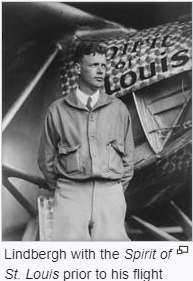
I saw “The Spirit of St. Louis” (1957) when it came out and it was so convincing, that I thought that the “right guy” had to look like Jimmy Stewart even though he was really too old for the part. It’s said that Lindbergh liked Stewart in the role, in part because Stewart was a B-24 combat pilot from WWII.

Among other things, Stewart went on a crash diet before filming, one that was so extreme his health began to suffer. Stewart’s hair was dyed blond to make him look more like Lindbergh. The production company made several replicas of the original Spirit of St. Louis, one modified under Lindbergh’s supervision.

Time Magazine’s review of the film said, “Stewart, for all his professional, 48-year-old boyishness, succeeds almost continuously in suggesting what all the world sensed at the time: that Lindbergh’s flight was not the mere physical adventure of a rash young ‘flying fool’ but rather a journey of the spirit, in which, as in the pattern of all progress, one brave man proved himself for all mankind as the paraclete of a new possibility.”

Lindbergh

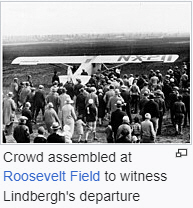
Lindbergh, who was 25, recounted his experience in his biography WE, which was published a few months after the historic New York to Paris flight and served as the film’s basis. Of course, a lot happened to Lindbergh between the time of his flight and the release of the film, including the 1932 kidnapping of his son and his widely publicized neutrality stance in discussions about the U.S. entering WWII. He apparently changed his mind after Japan’s Pearl Harbor attack.
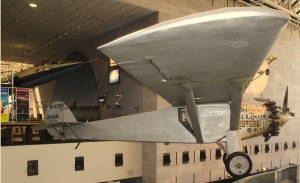
My photo of the plane

Lindbergh died in 1974 at 72. Stewart died in 1997 at 89. I have often thought that in addition to Billy Wilder who directed the film, fate brought the two men together,

Lindbergh flew the Spirit of St Louis around the country to promote aviation before donating it to the Smithsonian (Air and Space Museum) where I saw it on display several years ago, still thinking that a giant photo of Jimmy Stewart needed to be posted next to it.

–Malcolm

John Huston’s final film

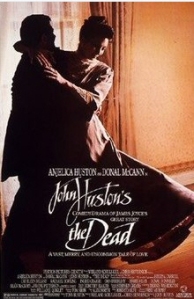
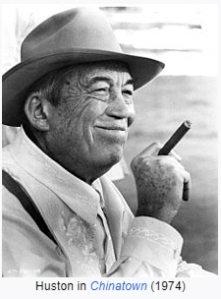
John Huston was dying while working on “The Dead,” a 1987 film closely based on James Joyce’s 1914 short story in The Dubliners collection. The film won a post-humus Best Director Oscar for Huston and a Best Supporting Actress award for his daughter Anjelica.  I was drawn to the film because I was a fan of the Hustons and, most definitely of James Joyce.

According to Wikipedia, “The film takes place in Dublin in 1904 at an Epiphany party hosted by two sisters and their niece. The story focuses on the academic Gabriel Conroy (Donal McCann) and his discovery of his wife Gretta’s (Anjelica Huston) memories of a deceased lover. The ensemble cast also includes Helena Carroll, Cathleen Delany, Dan O’Herlihy, Marie Kean, Donal Donnelly, Seán McClory, Frank Patterson, and Colm Meaney.”

I was happy that my favorite passage from Joyce’s story–often cited as among the most beautifully written in the English language from, perhaps the best English story story–was included in the film as a voice-over reading:

“It had begun to snow again. He watched sleepily the flakes, silver and dark, falling obliquely against the lamplight. The time had come for him to set out on his journey westward. Yes, the newspapers were right: snow was general all over Ireland. It was falling on every part of the dark central plain, on the treeless hills, falling softly upon the Bog of Allen and, farther westward, softly falling into the dark mutinous Shannon waves. It was falling, too, upon every part of the lonely churchyard on the hill where Michael Furey lay buried. It lay thickly drifted on the crooked crosses and headstones, on the spears of the little gate, on the barren thorns. His soul swooned slowly as he heard the snow falling faintly through the universe and faintly falling, like the descent of their last end, upon all the living and the dead.”

The New York Times review began:

”’ONE by one we’re all becoming shades,’ says Gabriel Conroy, looking out into Dublin’s bleak winter dawn. Gretta, the wife he loves and suddenly realizes he has never known, lies asleep on the bed nearby. His own life now seems paltry:  ‘Better pass boldly into that other world, in the full glory of some passion, than fade and wither dismally with age.’
“These words are spoken toward the end of ‘The Dead,’ John Huston’s magnificent adaptation of the James Joyce story that was to be the director’s last film.

“Some men pass boldly into that other world at 17. Huston was 81 when he died last August. He failed physically, but his talent was not only unimpaired, it was also richer, more secure and bolder than it had ever been. No other American filmmaker has ended a comparably long career on such a note of triumph.”
 Pauline Kael wrote that “The announcement that John Huston was making a movie of James Joyce’s ‘The Dead’ raised the question ‘Why?’ What could images do that Joyce’s words hadn’t? And wasn’t Huston pitting himself against a master who, though he was only twenty-five when he wrote the story, had given it full form? (Or nearly full—Joyce’s language gains from being read aloud.) It turns out that those who love the story needn’t have worried. Huston directed the movie, at eighty, from a wheelchair, jumping up to look through the camera, with oxygen tubes trailing from his nose to a portable generator; most of the time, he had to watch the actors on a video monitor outside the set and use a microphone to speak to the crew. Yet he went into dramatic areas that he’d never gone into before— funny, warm family scenes that might be thought completely out of his range. He seems to have brought the understanding of Joyce’s ribald humor which he gained from his knowledge of Ulysses into this earlier work; the minor characters who are shadowy on the page now have a Joycean vividness. Huston has knocked the academicism out of them and developed the undeveloped parts of the story. He’s given it a marvelous filigree that enriches the social life. And he’s done it all in a mood of tranquil exuberance as if moviemaking had become natural to him, easier than breathing.”

Wikipedia Noted: “The Japanese filmmaker Akira Kurosawa cited The Dead as one of his 100 favorite films. The Dead received mostly positive critical reviews. The film holds a 94% rating on Rotten Tomatoes, based on 31 reviews.”

As a work of love and a work of art, the movie wasn’t a blockbuster. But that doesn’t matter. It doesn’t need any validation other than the appreciation of those who saw it and saw it for what it was.

–Malcolm

Malcolm R. Campbell is the author of “Conjure Woman’s Cat.”

Watching ‘Friendly Persuasion’ Again and Still Enjoying the Story and Performances

“Friendly Persuasion is a 1956 American Civil War drama film produced and directed by William Wyler. It stars Gary Cooper, Dorothy McGuire, Anthony Perkins, Richard Eyer, Robert Middleton, Phyllis Love, Mark Richman, Walter Catlett and Marjorie Main. The screenplay by Michael Wilson was adapted from the 1945 novel The Friendly Persuasion by Jessamyn West. The movie tells the story of a Quaker family in southern Indiana during the American Civil War and the way the war tests their pacifist beliefs.” – Wikipedia

My pacifist beliefs were in their formative stages when this film was released, so I had many reasons for wanting to see it. I liked the film when I saw it in 1956 in the shadow of the Korean War and during an era when the Southern States still took a great deal of pride in their fight against the Union in the Civil War.

For those of my generation, I think “Friendly Persuasion” still holds up well, though I’m fair certain the light-hearted touch–rather a Disney-like approach–would be criticized today for its reliance on humor within the Quaker family more than its portrayal of more true-to-life battle scenes.

The film was drawn from the 1945 novel of the same name by Jessamyn West, a Quaker who wrote a plotless novel story about Quaker life. She was drawn into the making of the film through her willingness to pull together materials from her novel about the Civil War era that would make a cohesive story for the movie.

I found it interesting that while West was working on the book, she had tuberculosis from which she wasn’t expected to recover. Family stories about growing up as a Quaker were shared with her by family members, and had a strong influence on the first edition.

There are many types of Quaker beliefs, so I did not agree with those who criticized the movie for purported inaccuracies in dogma.

Fans of Gary Cooper will like his out-of-type performance in this film.

Malcolm

Thank goodness I didn’t see ‘Night Watch’ when it first came out in 1973

I would have been ticked off paying for the tickets.
My wife and I were looking through the movies on DISH for something but didn’t really find it. The night before, we watched “Elvis” (2022 with Austin Butler and Tom Hanks) which we liked, so we took a chance on “Night Watch.”

What a mess. I liked Elizabeth Taylor and Laurence Harvey in “Butterfield 8,” but I didn’t think the same kind of chemistry was there in this mystery/thriller. Very different roles to be sure, but even so, I think the most patient viewers would have gotten tired of Taylor’s repeated claims that there were dead people in the boarded-up house next door. Frankly, Taylor–whose character was recovering from a nervous breakdown–was over the top manic about the dead people which nobody else saw, including the viewers and the police.

The reviews were mixed, “Time Out called it a “tired, old-fashioned thriller”; whereas The New York Times wrote, “Elizabeth Taylor, and about time, has got herself a good picture and a whodunit at that”; and Variety opined, “Lucille Fletcher’s Night Watch isn’t the first average stage play to be turned into a better than average film. Astute direction and an improved cast more than help”. – Wikipedia

“Tired” and “old-fashioned” summed up my reaction. But then, I never liked Laurence Harvey, merely tolerating him in “Butterfield 8.” How many of you have seen this film, either at the theater when it came out or years later on a satellite or cable channel? Did it seem tired to you? Would you have gone nuts if you ever saw bodies in your neighbor’s house on a dark and stormy night?

–Malcolm

‘High Noon’

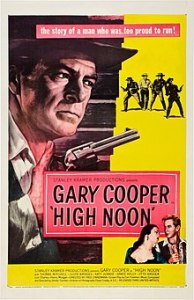
My wife hates “High Noon” and the theme song it rode in on. John Wayne didn’t like it either. I think it’s the perfect movie,  not necessarily my favorite but perfect in the way it was put together: the music, the ticking block, the fact it was shot in real-time, and the fact (which the Duke hated) that normal citizens wouldn’t help a marshal fight off a gang of bad guys that would function like a SEAL team compared to people who mainly used guns for hunting.

Wikipedia writes that “John Wayne was originally offered the lead role in the film, but refused it because he believed that Foreman’s story was an obvious allegory against blacklisting, which he actively supported.” Perhaps Wayne saw a correlation with the blacklisting nonsense, but I don’t. But then, I didn’t support blacklisting or the work of the House Un-American Activities Committee (HUAC).

From the Amazon Listing

Classic western tale of a lawman whose retirement plans go awry when a revenge-seeking gunman and his gang arrive in town – will anyone stand with the marshal? Winner of four Oscars, including Gary Cooper for Best Actor.

Glenn Frankel’s Book’s Amazon Listing

“What has been often overlooked is that High Noon was made during the height of the Hollywood blacklist, a time of political inquisition and personal betrayal. In the middle of the film shoot, screenwriter Carl Foreman was forced to testify before the House Committee on Un-American Activities about his former membership in the Communist Party. Refusing to name names, he was eventually blacklisted and fled the United States. (His co-authored screenplay for another classic, The Bridge on the River Kwai, went uncredited in 1957.) Examined in light of Foreman’s testimony, High Noon‘s emphasis on courage and loyalty takes on deeper meaning and importance.”

From Variety’s Film Review

“The Stanley Kramer production does an excellent job of presenting a picture of a small western town and its people as they wait for a gun duel between the marshal and revenge-seeking killer, an event scheduled for high noon. The mood of the citizens, of Gary Cooper the marshal, and his bride (Grace Kelly), a Quaker who is against all violence, is aptly captured by Fred Zinnemann’s direction and the graphic lensing of Floyd Crosby, which perfectly pictures the heat and dust of the sun-baked locale.”

Yes, the film still plays well today even among viewers who know nothing of the HUAC/Blacklisting drama that was part of our culture when “High Noon” was made.

Malcolm

‘The Milagro Beanfield War’ by John Nichols, a film by Robert Redford

I’m thinking of this film today because I just learned that John Nichols died at 83  in November, and I’m rather embarrassed that I missed it at the time especially when such publications as The New York Times and The Guardian carried the news. (I can find no public-domain photographs of Nichols.)

The Guardian writes, “Nichols won early recognition with the 1965 publication of his offbeat love story The Sterile Cuckoo, later made into a movie starring Liza Minnelli. The coming-of-age book and subsequent movie were set amid private northeastern colleges that were a familiar milieu to Nichols, who attended boarding school in Connecticut and private college in upstate New York.

First Printing

“He moved in 1969 with his first wife from New York City to northern New Mexico, where he found inspiration for a trilogy of novels anchored in the success of The Milagro Beanfield War.”

Wikipedia writes, “Critic Richard Scheib liked the film’s direction and the characters portrayed. He wrote, “Redford arrays a colorfully earthy ensemble of characters. The plot falls into place with lazy, deceptive ease. Redford places it up against a gently barbed level of social commentary, although this is something that comes surprisingly light-heartedly. There’s an enchantment to the film – at times it is a more successful version of the folklore fable that Francis Ford Coppola’s Finian’s Rainbow (1968) tried to be but failed.”

I liked the movie although the reviews were mixed.

From The Publisher

“Joe Mondragon, a feisty hustler with a talent for trouble, slammed his battered pickup to a stop, tugged on his gumboots, and marched into the arid patch of ground. Carefully (and also illegally), he tapped into the main irrigation channel. And so began-though few knew it at the time of Milagro beanfield war. But like everything else in the dirt-poor town of Milagro, it would be a patchwork war, fought more by tactical retreats than by battlefield victories. Gradually, the small farmers and sheepmen begin to rally to Joe’s beanfield as the symbol of their lost rights and their lost lands. And downstate in the capital, the Anglo water barons and power brokers huddle in urgent conference, intent on destroying that symbol before it destroys their multimillion-dollar land-development schemes.

“The tale of Milagro’s rising is wildly comic and lovingly tender, a vivid portrayal of a town that, half-stumbling and partly prodded, gropes its way toward its own stubborn salvation.”

–Malcolm

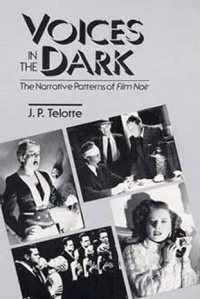
‘Voices in the Dark,’ by J. P. Telotte

Jay Telotte and I were members of the faculty of the Department of English of a small Georgia college. His great love was film, a focus that turned into a career when he later became an expert in the field with multiple books, honors, and articles, and is now professor emeritus at the Georgia Tech School of Literature, Media, and Communication. We did not agree about Katherine Hepburn, and Meryl Streep, or coffee with chicory. And yet, eating dinner at his house always included a film shown on an old-fashioned projector. He liked films like “Juliet of the Spirits” and turned me into a believer in Federico Fellini’s work.

We also liked film noir, perhaps my favorite film genre, so I was pleased when he wrote Voices in the Dark: The Narrative Patterns of Film Noir in 1989. We had both moved on to other positions when the book came out, so I never got a chance to ask him why he didn’t enlarge it to include neo-noir. His wife, Leigh, who was an English teacher, switched over to computer documentation–as did I–and we both ended up briefly working in the same department at Hewlett-Packard in Atlanta. (She was on staff and I was a contract writer.) Later, Leigh Ehlers Telotte wrote several books, including Victoria, Queen of the Screen: From Silent Cinema to New Media.

From the Publisher

The American film noir, the popular genre that focused on urban crime and corruption in the 1940s and 1950s, exhibits the greatest amount of narrative experimentation in the modern American cinema. Spurred by postwar disillusionment, cold war anxieties, and changing social circumstances, these films revealed the dark side of American life and , in doing so, created unique narrative structures in order to speak of that darkness. J.P. Telotte’s in-depth discussion of classic films noir–including The Lady from Shanghai, The Lady in the Lake, Dark Passage, Double Indemnity, Kiss Me Deadly, and Murder, My Sweet–draws on the work of Michel Foucault to examine four dominant noir narrative strategies.

The book is very readable and is a wonderful introduction to noir films, many of which you can see on Turner Classic Movies in their noir alley segment. I learned a lot about film from Jay and wished we had moved in the same circles after moving to the Atlanta area.

–Malcolm

Malcolm R. Campbell is the author of magical realism novels set in Florida.


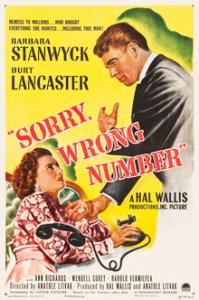
‘Sorry, Wrong Number’ with Barbara Stanwyck and Burt Lancaster

“For sheer, unadulterated terror there have been few films in recent years to match the quivering fright of Sorry, Wrong Number–and few performances to equal the hysteria-ridden picture of a woman doomed, as portrayed by Barbara Stanwyck.” — Cue Magazine.

My wife and I enjoy noir films. Fortunately, Turner Classic Movies (TCM) owns a lot of them and shows them frequently.

“Sorry, Wrong Number” began its life as a 1943 radio play written by Lucille Fletcher and starring Agnes Moorehead. When Fletcher was asked to expand her play into what became the 1948 feature film, Moorehead was considered a character actress and didn’t get the role. That went to Barbara Stanwyck who–in my view–turned in a stunning performance that received an Oscar nomination. Some critics thought the radio play was stronger due to the scenes that had to be added to bring the story up to feature film length. According to WNYC, “No less an authority than Orson Welles called it ‘the greatest single radio script ever written.’”

In short, a neurotic invalid (Stanwyck) accidentally overhears a phone conversation plotting her own murder. She’s bedridden and spends most of the movie on the phone trying to puzzle out the strange mix of conversations, callers, and busy signals. At one point Stanwyck is told to call a specific number for information about her husband and, after trying and not getting an answer, she asks the operator what the number goes to. The morgue, she’s told.

Of course, we wait for the line “Sorry, wrong number.” We wait a long time. When we finally hear it, it packs a punch. The suspense is off the scale and that’s what makes it a great noir film.

–Malcolm

Dang, Dumbledore is dead

Gambon

When he’s not Dumbledore he is (was) 82-year-old Michael Gambon. Natural causes, was it? Maybe that’s the cover story to obscure Snape’s role in the matter. After all, if you’ve seen the Harry Potter movies, you know that Snape has done it before. But Snape is twice dead. Once in the series and purportedly once in “real life” as Alan Rickman in 2016.

There’s a long list of denizens we can look at: Bellatrix Lestrange, Draco Malfoy, Lord Voldemort, Dolores Jane Umbridge, Lucius Malfoy, &c., &c. Like Snape, any of these characters could have escaped the “fiction” of the series and manifested in “real life.” That’s probably why Richard Harris (the first actor to play Dumbledore) died after the first two movies in the series in 2002 of Hodgkin’s lymphoma–according to the cover story.

I’m biased in favor of Harris’ portrayal because I saw him once on the stage as well as in many movies and was used to his style (and his off-camera hijinks). He played a more ethereal Dumbledore than Gambon. Both were Irish and both were good in the role.

According to Variety, “While it is easier for a character actor, often working in supporting roles, to rack up a large number of credits than it is for lead actors, Gambon was enormously prolific, with over 150 TV or film credits in an era when half that number would be impressive and unusual — and this for a man whose body of stage work was also prodigious.”

Most readers and viewers don’t know that there’s a fine line between the fiction of novels and feature films and life as we think we know it. People tend to think they’re “safe” when the movie ends and when they reach the last page of the novel. Ha! I think not.

Malcolm