Panic Grass – a writer’s dream name

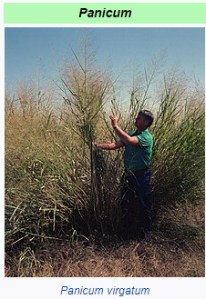
Wikipedia photo

I love double meanings. That’s why I like the name “panic grass.” It has nothing to do with panic–that comes from Panicum–but the use of the word when describing an environment where (in your story) things are going wrong is a nice subliminal trick.

The common or regional names of many plants will help you create the kind of ambiance you want. Perhaps that’s cheating.  But I don’t care as long as the name is factual and also likely to be used in the place where my story is set.

If you have a good plant or wildflower guide for your state or region, you’ll find a lot of “local color.” I have these guides for both Florida and Montana. They not only help me describe the location but support my addiction to puns and words with double meanings such as “spurned panic grass.”

The guidebooks also ensure that the flowers in your stories are blooming at the time of the year when they bloom in “real life.”

–Malcolm

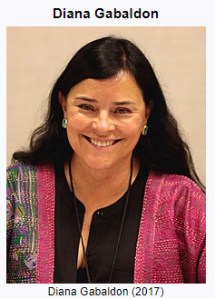
Do as Diana Gabaldon does, not as I do

Those of us who were members of the former CompuServe Literary Forum witnessed the birth of Diana Gabaldon’s Outlander series. She uploaded snippets of the work in progress, encouraged discussions about them, and later when she became a successful author continued to support the forum and answer our questions about the art and craft and business of writing novels. Her gracious support of other writers included her writing a blurb for my novel The Sun Singer.

In our craft discussions, she and I disagreed on one thing. And that was, should the author stop writing while completing a gap in the research, or should s/he continue writing and fill in the correct information later?

She said: “Keep writing.” I said: “Stop writing.”

She argued that when the author was on a roll, stopping to fill in historical or other information would simply derail the flow of the novel and the author’s daily writing process.

I argued that writing while something is still unknown could very well send the novel down the “wrong road” and necessitate a lot of needless rewriting later.

She preferred to put a “placeholder” in the manuscript, reminding her that she still had some facts to verify before submitting the book to her agent.

I preferred (and still prefer) to know the facts–whether they apply to history, geography, customs, or whatever–before I write the next scene or chapter.

It goes without saying that her Outlander series of books–and their spinoffs–have been infinitely more successful than my novels. So, I suggest you follow her advice and keep putting words down on the page even if you’re not finished verifying your information.

The fact that I’m eight years older than Diana doesn’t mean that I have more wisdom. It simply means that I’m eight years more set in my ways. I’ll freely admit that as I continue pausing my writing while checking my facts.

If you’re not set in your ways, putting a placeholder in our MS is probably the smart thing to do until you have time to look up what you still need to lookup.

Malcolm

My novel-in-progress, “Weeping Wall,” sat for several months while I verified the geological information I needed in the first paragraph.

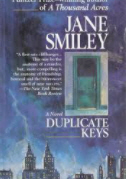
On re-reading Smiley’s ‘Duplicate Keys’

I first read this 1984 book in the mid-1990s after enjoying Jane Smiley’s 1991 Pulitzer Prize winner A Thousand Acres. I was disappointed because I expected more spooky police work and/or big-city thrills and chills. As a film noir fan, I’m used to harsher and darker crime stories

Publisher’s Description

Alice Ellis is a Midwestern refugee living in Manhattan. Still recovering from a painful divorce, she depends on the companionship and camaraderie of a tightly knit circle of friends. At the center of this circle is a rock band struggling to navigate New York’s erratic music scene, and an apartment/practice space with approximately fifty key-holders. One sunny day, Alice enters the apartment and finds two of the band members shot dead. As the double-murder sends waves of shock through their lives, this group of friends begins to unravel, and dangerous secrets are revealed one by one. When Alice begins to notice things amiss in her own apartment, the tension breaks out as it occurs to her that she is not the only person with a key, and she may not get a chance to change the locks.

Jane Smiley applies her distinctive rendering of time, place, and the enigmatic intricacies of personal relationships to the twists and turns of suspense. The result is a brilliant literary thriller that will keep readers guessing up to its final, shocking conclusion.

Okay, maybe I wasn’t ready for the “enigmatic intricacies of personal relationships” in 1995. Or perhaps I’ve either mellowed or become more eclectic in my reading since then.  Even so, I’ll probably never really grok the characters because they’re New Yorkers who enjoy subways, walking, lots of people, and all the other strangenesses I experienced whenever I visited NYC.

(I lived briefly in Syracuse as a kid, one of my brothers was born there, and then I went back there for grad school, but it’s on a different planet than the big city.)

The book is keeping my attention this time which says a lot for keeping books on one’s shelves and trying them out again later.

Malcolm

My novels include Fate’s Arrows (magical realism) and Sarabande (contemporary fantasy). Both novels are available in paperback, hardcover, Kindle, and Nook.

‘The Hush’ by John Hart

As I read this powerful novel for the third time, I wonder why I didn’t review it in February of 2019 when it was published as a sequel to Hart’s The Lost Child. The book is dark, features a forbidding land of swamps and woods where outsiders get lost or killed, is fawned over by hunters and a family who has gone to court to extract it from owner Johnny Merrimon, and is as close to Johnny as his psyche.

“The Hush” refers to a hush arbor, one of many places where slaves worshipped in private to avoid trouble with their owners. The lives of slaves and the Merrimons are tangled together on this property in ways that even the current generation don’t know–though stronger and stronger dreams are hinting at the sins of the past.

I’ve read many of Hart’s books. All of them are strong–visceral, almost–and well written. This one–for me–is the strongest novel because of the linkage between the land, the people, and the folklore.

“The Hush,” wrote Washington Post reviewer Bill Sheehan, “is a harsh, inimical landscape in which disorientation rules and trees, paths and familiar landmarks seem to shift and disappear. It is a self-contained world in which unwelcome visitors are sometimes driven to madness and sometimes destroyed, and Hart evokes that surreal landscape with a power and economy worthy of the great British horror novelist Ramsey Campbell. ‘In that first hour, the forest was still,’ Hart writes, ‘but as light strengthened, a dawn chorus rose around them, a symphony of catbird and Carolina wren, of mourning dove and cardinal and the deep-throated gunk of green frogs in the pocosins that fingered up from the distant swamp.’”

In this novel, the reader doesn’t escape from the land which, perhaps, is the real protagonist, though most of the townspeople see Johnny as more an inexplicable anomaly than the land he owns–to the extent anyone can own such land as this.  His best friend Jack, who suffered through the past with him in The Lost Child, risks everything to help him. That might prove impossible.

Multiple readings of novels tend to bring out secrets we didn’t notice the first time through. When it comes to The Hush, those of us who seek out the mysteries of land and people may be too close to see the real from the unreal.

Highly recommended for readers of dark fantasy.

–Malcolm

Malcolm R. Campbell is the author of “Fate’s Arrows,” magical realism set in the Florida Panhandle during the days when the KKK ruled the world.

Hardcover edition woes

The pandemic has screwed a lot of supply chains as various manufacturing and retail operations shut down.

The shutdown problem is impacting my hardcover books, all of which are listed on Amazon (and possibly elsewhere) as out of stock. These come from a different printer than the paperback editions which are still available. The Kindle editions are also available.

I apologize for the inconvenience to those of you who have been perplexed about the missing hardcover editions of Conjure Woman’s Cat, Eulalie and Washerwoman, Lena, Sarabande, and Special Investigative Reporter. Let’s hope they return soon.

Malcolm

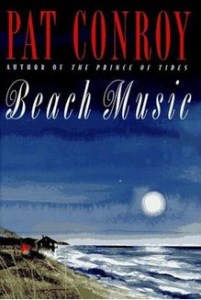
Looking back at Pat Conroy’s ‘Beach Music’

Beach Music (1995), Conroy’s sixth book, is the story of Jack McCall, an American who moves to Rome to escape the trauma and painful memory of his young wife’s suicidal leap off a bridge in South Carolina. The novel is wide-ranging in its historical and geographical scope, and in its treatment of the Holocaust, Russian pogroms, and southern poverty, among other themes; it is generally recognized as Conroy’s ambitious—and perhaps darkest—work.Pat Conroy Web Site

Beach Music began as a 2,100-page manuscript which his publisher’s staff trimmed down. My mass market paperback is 800 pages. By today’s “standards” of shorter and shorter novels, this book is huge.

Like Conroy’s other novels, Beach Music focuses on a broken southern white male who’s the product of a dysfunctional family that grows up in the beautiful–and lyrically presented–South Carolina Lowcountry.

Excerpt: “It enclosed us in its laceries as we watched the moon spill across the Atlantic like wine from an overturned glass. With the light all around us, we felt secret in that moon-infused water like pearls forming in the soft tissues of oysters.”

The novel’s length comes, in part, from the backstories of many of the other characters as well as childhood reminiscences between protagonist Jack McCall and his brothers.

If we were to extract a basic plotline, it would be this. McCall leaves the Lowcountry with his two-year-old daughter Leah and moves to Rome after his wife Shyla commits suicide by jumping off a bridge. McCall is, of course, blamed for this; his wife’s parents claim McCall is unfit to raise Leah, but fail to prove their case in court. He severs his relationships with his family to the point of keeping his address and phone number secret. Slowly, family members work their way back into his life and communications begin to open up.

Part of his understanding of his extended family comes from considering their dark backgrounds, including the Holocaust. His mother’s background is especially bleak and is almost too horrible to comprehend. My belief is that these divergences, while well written and very dark, are too long.

The darkness is balanced out somewhat by the fact that McCall and his brothers take a devil-may-care approach to life. They’re likely to say or do almost anything, proper or not. On McCall’s first trip back to the states, somebody asks him who’s watching his daughter in Rome while he’s gone. His response is that Charles Manson got paroled and needed the work.

While sitting with his brothers in the hospital room where their mother is in a coma, somebody mentions that they should be careful what they say because people in comas can hear what’s being said at one level of the mind or another. Jack responds by saying something like, Mama, this is Jack. I’m the one who loves you. My brothers think you’re trash and don’t care about you at all. When it comes to your children’s love, it’s always Jack.

My favorite Conroy novel remains Prince of Tides, also filled with Lowcountry beauty and a family’s dysfunctions. I’ve read Prince of Tides multiple times. This past week was the first time I re-read Beach Music since it came out. It remains in my view, a stunning book in part because of its flaws.

Malcolm


Ad Hoc Writing Research

If I were writing historical novels, I would probably do a lot of research before I even committed to writing each book. My novels are written without an ourline or any idea how they will end up. This means I do the research for each scene when I get to it. While the novel in progress is set in 1955, the fact that I was an elementary school kid in that year doesn’t mean I know a lot about the time period.

So, it’s time to Google everything.

  • The last scene took place at a grocery store. Okay, when somebody entered the store, what kinds of posters, die-cut signs, and hand-written specials did they see on the window sill or window? I found a great Noxzema suburn cream sign, a nice Planters Peanuts poster, and a list of the meat prices per pound.
  • The current scene takes place in the backyard of some well-to-do people. While we had cheap pre-Weber metal barbecue, the fru fru people often had barbecue grills made of brick, 44 inches wide are larger.
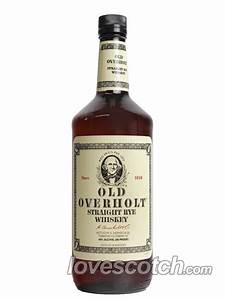
  • What are they having to eat? I knew part of this already, but did a bit of online checking. The menu: porterhouse steak, corn, collards with ham hocks, baked potatoes, corn bread, and macaroni salad. The men are drinking either Jax Beer or Old Overholt Rye whiskey. I would enjoy all of this except for the Rye which I never liked.
  • The family wanted music. So, after verifying that long playing records were, in fact, available in 1955 AND that RCA had a three-in-one (78, 45, and 33 and 1/3 rpm) record player, I needed to make sure they had something to listen to. Since the men in the family are KKK members, they won’t be listening to jazz, blues, or gospel. Glenn Miller seemed like a safe choice.
  • Now, if I can, I’d like to find out how long each of the tracks is so I can time the action with which song would be playing at five minutes into the dinner and ten minutes into the dinner, etc.  (I did this once before when I timed the cuts on a Scott Joplin CD with a ride between Tallahassee and St. Marks, Florida. Probably nobody checks these things, but I wanted to know what song would be playing as Emily and her father (in Widely Scattered Ghosts) reached various landmarks along the way. Heck, I even check the weather reports for the dates and cities where my novels are set to make the weather in the novel the same as it was in “real life.”

Okay, I only have one more thing to check. What happens if somebody gets shot in the arm with a target arrow? There’s so little history taught in med school, that doctors can’t tell me what they would have done in 1955. I was e-mailing back and forth with a medical museum curator who admitted that doctors seem to believe that their speciality “rose like a Phoenix out of the ashes of ignorance” just before they got out of medical school. So, on treatment, I need to skirt around the specifics I don’t know. I’m not happy about that, but as Vonnegut always said, “so it goes.”

Malcolm


Review: ‘Iron House’ by John Hart

Iron HouseIron House by John Hart
My rating: 4 of 5 stars

John Hart’s books are among the darkest I’ve read, and “Iron House” is no exception. The story begins with an orphanage where the amenities are few, care and supervision is lapse, and groups of bullies rule the corridors and terrorize the weaker children. The darkness doesn’t begin or end here. The story features an assortment of characters nobody will like, the cruel upbringings where they were reared, and the violent lives many of them wore like armor in order to survive.

Michael has lived on the streets of New York as part of an organized crime organization that is feared above all others. When he falls in love with Elena, he wants a fresh start. However, his “colleagues” don’t want him to have any rest other than a grave. Michael is efficient, practical, and savvy, but as the plot turns in on itself with dark secrets falling like dominoes, he may not be strong enough to solve the mysteries that stand between him and saving those he loves–including Elena.

I’ve given the book four stars because I think some of the descriptions of violence and torture are excessive. However, those scenes do show the total inhumanity and animal nature of the bad guys, so they’re not totally out of place in the novel. The novel has two strong points in addition to the strong characters. First, it keeps the reader guessing because the mysteries and secrets get deeper and darker as the complex plot unfolds; second, the main characters, Michael, Elena, and Michael’s long-lost brother Julien are always at risk–and with each breath of air, the risk becomes greater as the story proceeds.

The novel shows the worst of human nature on many fronts–and perhaps the often misguided best.

View all my reviews

Malcolm

Malcolm R. Campbell is the author of “Conjure Woman’s Cat,” “Eulalie and Washerwoman,” “Lena,” “Special Investigative Reporter,” and “Sarabande,” all of which you can find on Bookshop.org.

I’m tempting you with excerpts

A note from your sponsor (AKA, me).

Short Story Excerpts

“Shock Treatment” in “Stories that Need to Be Told”

“They drove him westward away from Tallahassee’s safe hills, westward through the panhandle counties where King Cotton once reigned, westward through pine flatwoods where wiregrass and fire sustained the world, through Quincy where Coca Cola money brought prosperity one hundred years ago, through Chattahoochee where a psychiatric hospital of some controversy and the Apalachicola River provided conflicting approaches of respite to the world’s cares, through Marianna where both Florida’s Caverns and the now-shuttered reform school were out of sight and out of mind, and thence straight on to the uninspiring Georgian plantation house where Mistress Harkness died of melancholia waiting for her husband to return from the Civil War.”

“The Lady of the Blue Hour” in “Widely Scattered Ghosts”

“On the band bus ride home, the stunning, first chair flute player Melinda Wallace sat beside him. She had no clue how he felt about her, not that he’d said anything. The empty aisle seat next to a clarinet was, he guessed, preferable to sitting in the back with the band’s borderline criminal element of raucous drums and tarnished brass. Melinda smelled like wildflowers and her unruly light brown hair smelled like the wind. When the band played ‘The Stars and Stripes’ Forever’ in concert and Melinda stood up into the light for her piccolo solo—the sweetest banshee cries the world has ever known—her blue eyes were frozen into ice for thirty-two measures of leaps and trills, while her hair could not be restrained.”

Novel Excerpts

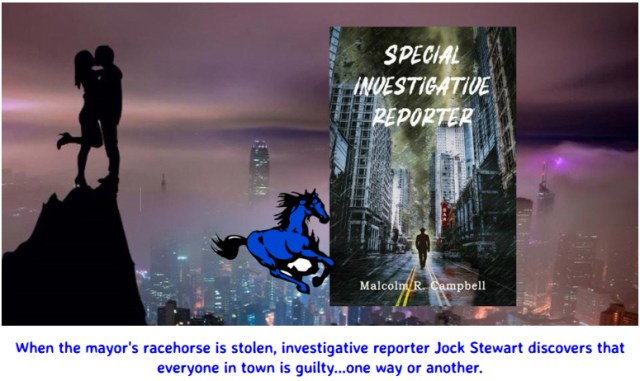
Special Investigative Reporter

Jock poured a fist full of Scotch into an empty coffee mug. That’s when Chief Kruller opened the front door and stepped into the living room without knocking. Fortunately, he wasn’t leading a SWAT team or holding a warrant. He did have a 9 x 12’ mailing envelope in his hand and a smile on his face that was wide enough to display most of his cavities.

“Sorry to bust in on you like this, Jock, but your doorbell isn’t working,” said Kruller, slipping into the best chair in the room. He favored himself with a deep pull on the Scotch bottle.

“The bell usually works when somebody on the porch pushes the button.”

“Good point,” said the chief. “Here, take a look at this morning’s crime scene photograph.”

“Oh, this makes my day,” said Jock. He set down the mug of Scotch to keep from spilling it all over the boss man who, in more detail than anyone really wanted, was handcuffed spread eagle to Bambi’s bed wearing a pink thong. Jock did a quick re-write of his thoughts to clarify that one Marcus Cash was wearing the thong and that, other than the fact Bambi was standing in the foreground wearing a Cat Woman outfit, he had no proof it was actually her bed.

“She lost the key,” said Kruller. “Marcus probably swallowed the damn thing.”

Lena

“Momentarily, but no longer, the swamp was quiet before the voices of the birds returned and spoke of secret things in the cone-laden Bald Cypress and plum laden Ogeechee Tupelo branches beneath clouds carrying late afternoon storms. Spanish moss on the larger limbs fluttered like waking storm flags. Sheltered from the wind, scattered white and maroon dropwort flowers—Willie called it “cowbane”—rocked gently in their cradles of low scrubs and grasses.

“I knew from my dream travels that two swamps existed together, one that stopped short of the Apalachicola River and one that lived and breathed westward past night and death until it touched the boundary of the afterlife that Eulalie called “the Pearly Gates.” I didn’t think my conjured woman had crossed the great river.

“The gasoline-tainted water holding the trucks was foul, and that meant searching it quickly in spite the murky sediments Hoskins stirred up in his frantic thrashing about. I did not find Eulalie there. I followed the current into large mats of duckweed where progress was slower. By the time the rains came and chased me back to the road, I had found no conjure woman or gator bait traces there.

“When the swamp grew dark, a limpkin screamed near the river like a child dying again and again. Tree frogs sang, basses, altos, trebles, and tenors. Eulalie once said nighttime frogs praised the good Lord with voices as pure as sacred harp singers standing in a hollow square. In the center of that square of voices and old trees, I could not sleep, but not for the singing. The events of the day weighed heavily on my heart. Without sleep, I was blind to what a dreamtime journey could show—whether my conjure woman had lived or died.”

Thank you for reading,

Malcolm
 

Unread book on my shelf is an unexpected gift

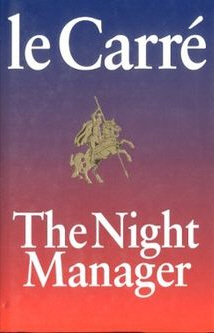
“And gradually it dawned on him, if a dawning can take place in total blackness, that his life has consisted of a run of rehearsals for a play he had failed to take part in. And that what he needed to do from now on, if there was going to be a now on, was abandon his morbid quest for order and treat himself to a little chaos, on the grounds that while order was demonstrably no substitute for happiness, chaos might open the way to it.” – The Night Manager.

Best I can tell is that I bought a trade paperback copy of John le Carré’s The Night Manager in 1993 when it came out, put it on my bookshelf, and forgot about it. I have no idea how or why it ended up on the shelf without being read. I lived in an Atlanta suburb at the time and was apparently more focused on the one-hour commutes to a variety of technology companies where I wrote computer documentation and occasional code than reading novels.

Like most of the author’s fans, I wondered how he would focus his spy novels once the cold war was over. The Night Manager was the first book with a different kind of plot: unscrupulous international arms dealers. The book was generally a success, though Publishers Weekly said at the time that it ended in a way that would make a sequel easy to write.

I’m enjoying the book, a change of pace from the more straightforward, technology-intensive spy novels by such authors as Clancy and Patterson  (and those writing under their names) because the plot is not strictly linear. Nobody needed to worry about le Carré running out of subject matter in the 1990s for now, at 88, his new novel Agent Running in the Field demonstrates that there’s still room in the fictional universe for spies and those who write about them. As an author, I’m impressed with anyone his age who is still writing.

I never saw any of the episodes of the 2016 TV series based on this book. I’m glad I didn’t, for that would have spoilt the gift of finding an unread book on my shelves that I didn’t already know lock, stock, and barrel.  The TV series starred Tom Hiddleston in the lead role as the night manager and also included Hugh Laurie (“House”).

Publishers Weekly liked the book, saying that it was “written with all le Carre’s mastery of atmosphere, character and desperate political infighting among the smoothest of Old School Brits.” I agree. And it’s refreshing to read a spy novel that doesn’t include the manufacturer’s specs of every gun, helo, suppressor, and piece of surveillance gear used by the operatives.

What fun, though, to find a “new book” that didn’t cost me $25 on Amazon.

Malcolm