A Frank Conversation With Mother Nature About the Rain

Me: Baby Cakes, I want to talk about the rain. There’s been so much of it.

Mother Nature: Frank, what the hell are you saying? Malcolm is the only man on the planet allowed to call me “Baby Cakes.”

Me: My name isn’t “Frank.” I’m speaking frankly.

MN: I thought only Frank could speak frankly just as I’m the only one who can speak mother naturedly.

Me: English is a strange language.

More rain today

MN: Look, Toots–I hope it’s okay to call you “Toots” for old time’s sake–global warming is tangling up the planet’s cycles of heat and cold, rain and sun, and Coke vs. Pepsi.

Me: The rain, though, is keeping me from mowing the yard. Soon, the grass will be so high I’ll tear up the mower trying to cut it.

MN: Your writer friend Smoky wants you to get sheep to handle the grass cutting duties.

Me: Sheep, quite frankly, are just too sheepish.

MN: That sounds like something a guy named Frank would say.

Me: The thing is, sheep are more expensive than a lawn mower.

MN: That’s probably true. Nonetheless, I’m working hard to get the planet under control, and that’s not easy to do when–too put it frankly–so many people don’t mind p_ssing in their own pools and s_itting where they eat.

Me: Well said, Baby Cakes.

MN: What time do you get off work?

Me: I’m married. We can no longer meet behind the barn like we did when I was in college.

MN: Barns have changed since then, what with the hay being made a mess with pesticides and GMO tinkering. Maybe you can do something about that. Next time you update your blog, say something about the clowns who think climate change doesn’t exist, that fast food is really food, and that mayo should be slathered all over a hamburger.

Me: If I say something about climate change, will you give me a sunny afternoon and evening so I can mow the yard?

MN: Toots, I’m working on it. If only you weren’t married: we could make beautiful weather together.

Me: Aw, shucks, Baby Cakes, you’re making me cry.

MN: Me, too, and my tears are what you call rain.

Me: Oops.

–Malcolm

Malcolm R. Campbell’s new short story is now live in Kindle, Kobo and iTunes.


National Parks Boast a $34 Billion Boom as Budget Cuts Loom

from the National Parks and Conservation Association

Record-visitation pumps billions into national, local economies in 2016

WASHINGTON – National park visitation generated $34.9 billion for the U.S. economy in 2016, a $2.9 billion increase from 2015, and supported 318,000 jobs, the U.S. Department of the Interior announced today. The number reflects the significant, positive economic impact national park visitors have on gateway communities, including sales, lodging and jobs, as well as the impact on the national economy as a whole.

Read the rest of the press release here.

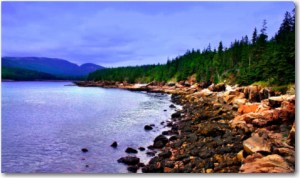
Acadia National Park in Maine. © Coleong/Dreamstime.

It’s widely known that our national parks are having infrastructure problems because funding has been so insufficient that keeping roads, bridges, structures, trails, and emergency and communications systems up to date is impossible.

Like infrastructure needs outside the park system, allocating money to roads and bridges isn’t sexy in spite of the fact that we see periodic reports about the number of bridges, dams, locks, levees and other vital transportation and safety structures and systems that are below par throughout the country.

Writing for SmartAsset in January 2016, Amelia Josephson said that, “According to the NPS, the nearly $3 billion appropriated for the NPS budget falls short of what’s needed. In May 2015 the park service said it had delayed $11.5 billion in necessary maintenance in 2014 due to budget shortfall. Although national parks charge fees, these fees are not nearly enough to fund the national park system, which is why the NPS depends so heavily on Congress’ budget appropriations.”

A small fraction of this money can be made up by friends of the parks organizations that raise money and fund discrete projects within the parks they’re associated with that would otherwise fall outside NPS’ spending. But this is like bailing a lake with a thimble. It does help, but the overall park’s system continues to fall behind.

Cheating the parks isn’t just about nature, protected areas, and outdoor recreation. It impacts the local economies as well–generally those within 60 miles of a park. As the NPCA press release notes, park visitation doesn’t simply bring money to the park, but also to gas stations, camp grounds, stores, restaurants and hotels in the surrounding area. Those who visit national parks tend to stray longer than random tourists who make brief stops at roadside attractions and less-well-known tourist destinations. Of course, park service employee salaries add to the “new money” brought into the regional economy from the park.

Cheating the parks and other public lands is cheating the future, and not just the environment on which we all depend even if we never go out and visit it. It reduces the value of the country in terms of assets and makes the ultimate loss of parks, or parts of parks, more and more likely in the future. We can pretend it isn’t happening just as many pretend there’s no such thing as global warming. That’s the head-in-the-sand approach. We can do better.

Malcolm


Climate Change: Water Cycle and Water Demand

from the EPA

Water Cycle and Water Demand

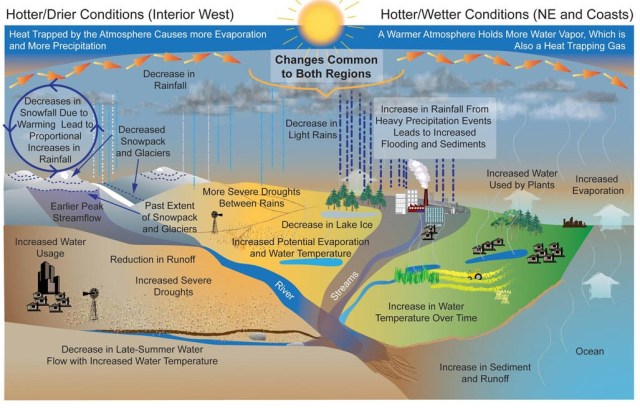
“The water cycle (shown in the following figure) is a delicate balance of precipitation, evaporation, and all of the steps in between. Warmer temperatures increase the rate of evaporation of water into the atmosphere, in effect increasing the atmosphere’s capacity to “hold” water. Increased evaporation may dry out some areas and fall as excess precipitation on other areas.

“Changes in the amount of rain falling during storms provide evidence that the water cycle is already changing. Over the past 50 years, the amount of rain falling during very heavy precipitation events has increased for most of the United States.  This trend has been greatest in the Northeast, Midwest, and upper Great Plains, where the amount of rain falling during the most intense 1% of storms has increased more than 30%.  Warming winter temperatures cause more precipitation to fall as rain rather than snow. Furthermore, rising temperatures cause snow to begin melting earlier in the year. This alters the timing of streamflow in rivers that have their sources in mountainous areas.

“As temperatures rise, people and animals need more water to maintain their health and thrive. Many important economic activities, like producing energy at power plants, raising livestock, and growing food crops, also require water. The amount of water available for these activities may be reduced as Earth warms and if competition for water resources increases.”

epa1

Currently, this information can still be found on the EPA site here.

Malcolm

As a long-time member of such organizations as the National Parks and Conservation Association and the Nature Conservancy, I can’t help but write novels that support conservation the value of the environment.


Wisdom from nature and indigenous cultures

“Malidoma [Dr. Malidoma Some´] teaches that the healing power of nature, ritual and community is what the indigenous world offers to the modern world. In the indigenous world, community is integral to the harmony and balance of each individual.” from the mission statement of East Coast Village

africaThe modern world of science and technology has learned a lot from observing nature and indigenous cultures’ relationships with the natural world. Unfortunately, we have also missed most of what nature and indigenous cultures have had to offer, and we further facilitated that tragedy by calling such cultures hicks, savages, superstitious, ignorant and pagan (in the negative sense most people assign to that word).

Organized religion went a step further, claiming throughout history that pagans–including witches–worshiped the so-called “devil” and needed to be put to death for their beliefs. These beliefs were not only natural but threatened the knowledge and wisdom a culture based on patriarchy had to offer.

Today, for example, we look at prescribed drugs as compounds invented in laboratories and produced in factories. While synthesized drugs have brought quality control and the benefits of mass production, they also come with a price based on a patent that allows drug companies to charge hundreds of dollars for little bottles of pills with ingredients that are probably worth a few pennies.

Yes, it can be dangerous for people without an herbalist certification or an oral tradition of using plants as medcine, much less prescribe them from others. Yet, when the medical establishment condemns the practice out of hand, they are overlooking the fact that many major drugs, past and present, originally came from plants and were frequently discovered by observing what native cultures used for medicine. One expert says that 120 distinct chemicals that come from plants are currently used throughout the world.

In a recent news story (A Doctor Discovered Why Insulin Is So Pricy In America — And How To Buy It More Cheaply)  it was shown that insulin costs diabetes patients more than most of them can afford because a pricey biotech drug created in the 1970s took over the market so completely that the off-patent, generic insulin is no longer available in the United States. The whys and wherefores of medicines and their costs are part of a complex tangle of issues. The lack of natural drugs just might, in some cases, stem from our championing what comes out of a lab over what nature produces.

spellsensuousIn The Spell of the Sensuous, David Abram argues that “Humans, like other animals, are shaped by the places they inhabit, both individually and collectively. Our bodily rhythms, our moods, cycles of creativity and stillness, even our thoughts are readily engaged and influenced by seasonal patterns in the land. Yet our organic attunement to the local earth is thwarted by our ever-increasing intercourse with our own signs. Transfixed by our technologies, we short-circuit the sensorial reciprocity between our breathing bodies and the bodily terrain.”

We have been making excuses for years about the supposed Gods of science and technology at the expense of a shared relationship with the natural world and those who understand it. From time to time, we run across articles that focus on one indigenous culture or another that show one group has little or no cancer and another group has little or no stress and stress-related maladies. But such things usually stop at the curiosity-level “go figure” or the profit-motive level of “how can we synthesize what they know put it in a pill?”

ofwaterDr. Malidoma Some´, a widely known teacher of African wisdom, is the author of multiple books, including “The Healing Wisdom of Africa: Finding Life Purpose Through Nature, Ritual, and Community,” “Creating a New Sense of Home” and the now-classic “Of Water and the Spirit: Ritual, Magic and Initiation in the Life of an African Shaman.”

On his website, Dr. Some´ writes that “It is possible that we have been brought together at this time because we have profound truths to teach each other. Toward that end, I offer the wisdom of the African ancestors so that Westerners might find the deep healing they seek.”

I don’t reject art, culture, science or technology. I do reject thinking they are all we have.  Dr. Some´ has things to teach us that we have turned a deaf and snobbish ear to for generations. Now we have a medical system nobody can pay for, global warming nobody knows how to fix and poverty that exceeds our comprehension. Something is badly out of sync and those who tell us that modern man is like a cancer upon the climate suggest that we ourselves are the problem.

Abram suggests we will never solve the major issues of life as long as we’re only willing to look at everything except nature and natural wisdom whether it comes out of Africa or the so-called “First Nations” (to use the Canadian phrase) who live invisibly among us.

I was taught what most kids of my generation were taught. Christianity is all there is. Paved streets are better than unpaved country roads. Science and technology are better than anything the witches, root doctors, and “illiterate savages” have to offer.

Undoing all that brainwashing can take a lifetime. If only, we could start fresh with our children and not addict them to false gods in the first place.

–Malcolm

KIndle cover 200x300Malcolm R. Campbell is the author of “Conjure Woman’s Cat,” a novella about a granny and a kitty fighting the KKK that’s filled with the wisom of the natural world. It’s on sale today on Kindle.

“I loved the way Campbell made magic part of the fabric of the place…Readers of magic realism will appreciate Conjure Woman’s Cat. Highly recommended.” –  Lynne Cantwell, hearth/myth – Rursday Reads


Will Earth last forever in spite of the damage?

“The eyes of the future are looking back at us and they are praying for us to see beyond our own time. They are kneeling with hands clasped that we might act with restraint, that we might leave room for the life that is destined to come. To protect what is wild is to protect what is gentle. Perhaps the wilderness we fear is the pause between our own heartbeats, the silent space that says we live only by grace. Wilderness lives by this same grace. Wild mercy is in our hands.” – Terry Tempest Williams in “Red”

Some claim that no matter what foolishness we bring to our planet, Earth abides. Do you agree?

I hope that claim is more than wishful thinking. For years I thought an ever abiding Earth was a certainty and that even in the worst-case nuclear winter we can imagine, the planet could shake off the damage. Now, I think we’ve done too much for that certainty.

Author George R. Stewart certainly took that view in his famous 1949 science fiction novel called Earth Abides. While this book, which is among the best novels I’ve ever read, is a eulogy for civilization as we know it, it’s not a story about the end of the Earth. This book is somewhat responsible for my thinking that when all is said and done, the planet will one day be reborn without us.

Plenty of Time?

For years, people have said that no matter how badly we treat the environment, the ultimate destruction of the planet is so many years into the future that we still have time to change what we are doing. In that vein, saying that global warming or dying oceans or dangerously high population growth will one day do us in, is about like telling a teenager he needs to save some of his summer job money for retirement or he’ll starve some day.

As an author, I have absolutely no interest in writing post-apocalyptic fiction. Nonetheless, I often play the what-if game inside my head about all sorts of things that will never evolve into my books.

One game involves walking down a long highway into the future and seeing alongside the road a timeline of positive and negative news events, discoveries, storms, political decisions, and other critical moments. How far can I walk and still find mankind here? Are there actually multiple roads? Perhaps a frightening event leads us to make positive changes and one prospective road gets longer. Perhaps something else lures us into a false sense of security and we begin to think Earth will abide forever. At that point, all the roads get shorter.

If we knew how long the Earth would abide at our present rate of destroying it, what would we do? Would we keep on keeping on or would we finally realize that the world’s wild mercy really is in our hands?

This post first appeared on my now-discontinued Magic Moments blog in 2012.

–Malcolm


Glacier Park: Proposed Fish Passage Barrier

from NPS Glacier National Park:

akokalaWEST GLACIER, MONT. – Public comments are encouraged on a recently completed environmental assessment for a proposed fish passage barrier downstream of Akokala Lake in the North Fork District of Glacier National Park. Comments are due by July 7, 2014. The Akokala Creek Fish Passage Barrier Environmental Assessment is available at http://parkplanning.nps.gov/AkokalaFishBarrier. (Click on document list to read.)

Akokala Lake is one of the last bull trout supporting lakes on the west side of the park and is at risk of invasion by non-native lake trout, which are known to have severe detrimental effects on native fish populations. The drainage is also susceptible to invasion by rainbow trout and possibly brook trout. Monitoring and genetic testing show hybridization between westslope cutthroat and rainbow trout has already begun to occur in Akokala Creek. Brook trout can out-compete westslope cutthroat trout and hybridize with bull trout.

The environmental assessment analyzes two alternatives: 1) Alternative A-No Action, and 2) Alternative B-Construct a fish passage barrier on Akokala Creek. The preferred alternative is to construct a fish passage barrier (Alternative B). A fish passage barrier would prevent additional non-native fish from accessing Akokala Lake and the upper Akokala drainage, and reduce or eliminate further expansion of westslope cutthroat-rainbow trout hybridization. By protecting the drainage against non-native invasive fish, this project would also help safeguard important habitat refugia for native fish confronting the stressors of climate change.

The environmental assessment, as well as additional information is available at http://parkplanning.nps.gov/AkokalaFishBarrier. Public comments can be made directly through this website, or written comments may be mailed to Superintendent, Glacier National Park, Attn: Akokala Fish Barrier EA, PO Box 128, West Glacier, Montana 59936.

Personally, I support the fish barrier due to the risk to native specifies from non-native species.

Malcolm

Erosion of the American Wilderness Idea

From the Crown of the Continent Research Learning Center:

“Brownbag” Lecture

Thursday, May 22, 2014
12 noon-1 PM
Glacier National Park Community Building

wolkeAuthor and wilderness lover, Howie Wolke will talk about the ongoing loss of wilderness, both in the big outdoors and within the human animal. He will relate the erosion of the wilderness idea to the spreading disease of Wilderness Amnesia.

Wolke is a ‘wild preservative,’ to borrow the term from the late Edward Abbey, advocating for the designation and protection of real wilderness in the United States. He is past president and current vice president of the national conservation group Wilderness Watch. He also cofounded Big Wild Advocates, Montanans for Gallatin Wilderness, the original Wyoming Wilderness Association and the original wilderness-focused Earth First. Following his passion, Wolke has made his living as a wilderness guide and outfitter for the last 36 years.

Click on the link above for upcoming brownbags.

Malcolm

Three of Malcolm R. Campbell’s contemporary fantasy novels are set in Glacier National Park.


How to Construct a Bog

This paper is a hastily prepared primer on bog construction. It’s not meant for the serious student of biogeography, but for the outdoor hobbyest who wants to have fun while creating something worthwhile.

Preparing the Landscape

Bering Glacier - Wikipedia Photo
Bering Glacier – Wikipedia Photo

Using water and cold weather, prepare a glacier such as those that were lying around during the Pleistocene Era. The transport of glaciers is likely to be a mammoth undertaking and is not recommended. Veteran glacier workers often recount the sad fate of two novices who attempted to hijack Alaska’s Bering Glacier and place it on a ship waiting off Cape Yakataga. Their midnight icecapade ended in failure when the two men became frozen to their work.

Allow your glacier to work for a long time. Then, melt it carefully so that a small pond remains. The pond–which is often called an undrained depression–should be free of fresh water springs, brooks, rivers, streams or creeks. This undrained depression will become the focal point of your bog.

Obtaining the Plants

sphagnumAssuming you have chosen the right environment, your pond could turn into a bog all by itself. But, this could take years and, frankly, how long do you want to wait around?

Secure a truck–or a fleet of trucks–and haul the following to your bog site: water lilies, bogbeans, sphagnum moss, tamarack and spruce trees. Please obtain your plants from legal bog plant nurseries rather than taking them from national parks, forests or the bogs of other aficionados.

Orchids, bog myrtles, pitcher plants,  and huckleberries will add a nice finishing touch to your bog if you can afford them.

Establishing the Plants

Tamarack in Autumn - Wikipedia photo.
Tamarack in Autumn – Wikipedia photo.

Plants tents do grow outward in concentric bands or zones from the center of a bog. With this in mind, wade or swim out to the center of your pond and establish the water lilies and other floating plants that friends have donated to this project. (Perhaps you can raise funds via a Kickstarter project rather than nagging all the master gardeners in your neighborhood).

Proceed toward the edge of your pond and plant the bogbeans and, perhaps, some sedges (e.g.: Yellow Sedge, Northern Long Sedge, Few Flower Sedge).

Next, you’ll want to take a large quantity of sphagnum–one of the 300 varieties of peat moss–and weave it into a floating mat in the shallow water. Step out of this mess of moss and plant your tamaracks and spruces.

Bog Research

Mer Bleue Bog, a typical peat bog, in Ontario - Wikipedia photo
Mer Bleue Bog, a typical peat bog, in Ontario – Wikipedia photo

Some hobbyists get bogged down with books and scientific journals. However, a high-class bog can’t be built in a day, and it can’t be built without research. Primary, or on-site, research is required for first class results. Neighbors who are likely to look askance at your bog building will turn their criticism into approval when you’re able to stare them down and say, “I know what I’m doing.” And, without filing an environmental impact statement, you’re likely to be arrested for disturbing the noise of the city with the relative quiet of the natural habitat.

Buy a one-way ticket to your state’s largest bog. Make sure you are not sent to a swamp because swamps and bogs differ. Please travel via a non-stop flight; otherwise, your bog may turn into a coniferous forest before you arrive. On-site, study precipitation, drainage, evaporation, humidity, oxygen and nitrogen levels in the water and soil, and the stratification, foodstuff interchanges and periodicity potentials. Take a sack lunch. This will take a while.

Some people can create a bog without even trying. For others, it’s a lifelong struggle. Research is only for the brave; the shortcut methodology in this report is for the fast-track individual. Whichever you prefer, your bog can be a thing of great beauty, the envy of all your fair weather friends and a hobby guaranteed to give you many happy hours of peace in this noisy old world of yours.

Malcolm


A talk with Scott and Smoky Zeidel, authors of ‘Trails’

scottandsmokyIt’s a pleasure to welcome Smoky and Scott Zeidel to Malcolm’s Round Table to talk about their new book Trails: Short Stories Poetry and Photographs released in paperback and e-book this month by Vanilla Heart Publishing.

Smoky is the author of fiction and nonfiction, including The Storyteller’s Bracelet (2012) and Observations of an Earth Mage, (2010). Her husband Scott, who plays the guitar, teaches music history as an adjunct professor at Mt. San Antonio College in California.

MALCOLM: Trails has been dedicated to the squirrels. Is this the entire family of tree or ground squirrels or a bird-feeder robbing band in your yard?

SCOTT: The squirrels are metaphors for nature. So, to answer your question, the book is dedicated to every type of squirrel in the world, the little bastards.

SMOKY: I started to say, “He doesn’t really mean that last part.” But then, I looked out my studio window, and there’s a pregnant ground squirrel out on the deck, ripping a rug to shreds, to get wool to line her nest, and I think, maybe Scott’s right.

trailsMALCOLM: I’ve had many conflicts with squirrels over the years, usually a difference of opinion about just who the bird feeders are for. Scott, when you write that you once thought everyone remembered their own birth, I thought of people who had either bad vision or better than normal vision and supposed everyone’s eyesight was the same. What has this memory given you that others do not have—long-term vision, connectedness to your family going back in time, insight into the big picture of our incarnation, or something else?
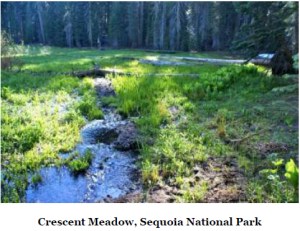
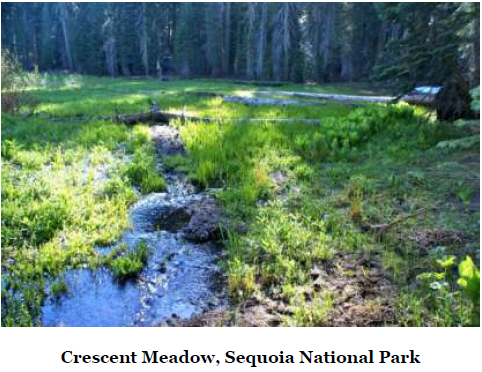
crescentSCOTT: I can’t speak for others, but, like I said, I do remember my birth. Nevertheless, was I instantly awake, instantly aware, at the moment of my birth? On a purely rational level, is this even possible? I think not. On a metaphysical level, when did my life really begin as a sentient being? When will it end? These are the big questions.

MALCOLM: Smoky, some people say that old stories change every time they’re told. Did you hear different versions of your childhood stories over time and do you now find yourself telling them differently when you relate them to others? Do you begin to wonder what parts of them have slowly become fiction?

SMOKY: I assume you’re referring to the stories I relate in the book about how I became a storyteller; the stories about my mother being a turkey murderer and my uncles’ wild snake stories. Hell, when I heard them the first time I wondered how much of them were true and how much my mother and my uncles made up. Even as a little girl I recognized these magical stories as being part truth, part fiction. What I garnered from them wasn’t whether my elders were being totally truthful or not, but rather the love they poured into the stories as they told them. Stories without love are dull, and seldom are they remembered. But these stories? There was so much love in them it wouldn’t have mattered if my mother said she’d slain a dragon, or my uncles done battle with Kaa (from Rudyard Kipling’s The Jungle Book) himself. The stories would have stayed with me.

MALCOLM: Scott, when you follow Smoky into the hospital for seemingly an infinite number of visits leading back to her being struck by lightning in 1989 and you sit, as you wrote, in another waiting room that looks the same as all the others, do you see it all as being within the hands and plans of the universe or do you watch people, read books and wait in a stoic limbo mode?

SCOTT: My intention was not to be particularly deep or philosophical here. I’m just a man. This is what I do; this what everyone should do. We all should hold out our hands and arms to others, friends, enemies, loved ones. What else is there? I comfort Smoky because this is what I do.

MALCOLM: Smoky and Scott, before either one of you wrote the first word of this book, did one of you say to the other, “Let’s co-author a book about life, walking and nature” or was it a muse or a publisher that suggested the project?

SCOTT: Our wonderful publisher, Kimberlee Williams, suggested the project. She has been so supportive and helpful. Kimberlee is our muse.

SMOKY: Let me clarify that “Kimberlee is our muse” thing. I talk about Muse frequently in the book; Kimberlee is not that muse. Kimberlee could ask me a thousand times to dive naked into a freezing mountain river and I wouldn’t do it. Muse, however… well, you’ve read the book, Malcolm. And whoever reads this here, on your blog, can read the book to learn more about that Muse.

buckeyeMALCOLM: Smoky, has it taken a lifetime to learn the lesson of the California buckeye, that it’s part of a continuing process of life rather than a work of art to be preserved for all time as it was during one moment? Or, did the beauty of nature’s changes come to you more as an epiphany when you looked at the seeds you collected?

SMOKY: The beauty of nature’s changes first came to me when I was three years old and sitting in a blooming apple tree in my parents’ back yard. (I wrote about that experience in my “I Am Nature” essay in my book, Observations of an Earth Mage.) I’ve always been keenly in tune with the cyclical nature of Nature. In tune so much, in fact, I feel intense physical pain when rain is coming, for example, or when I’m near a place where our Mother Earth has been ravaged by bulldozers or mining equipment. The lesson of the buckeye is best summarized as a lesson in the impermanence of beauty; the impermanence of life as we know it. Life goes on, of course. It just changes form. The buckeye becomes a sprout, then a seedling, then, over time, an enormous tree. It would be wrong—it would be impossible, in fact—to try to contain it in any one form, no matter how beautiful. We also talk about that in the last chapter of Trails.

MALCOLM: Scott, you traveled a long way—and many years—from your childhood play in the dirt outside your house to the Big Sur where you re-discovered the land on a rainy night while reading Vonnegut. Do you wonder now why the journey to the Big Sur took as long as it did or whether you had missed signs and hunches early on that you needed to go there, or somewhere, to re-connect?

SCOTT: I do wonder why it took so long. I certainly missed signs along the way, many signs. When I would sit at a table in one of my many Ph.D. seminars, I felt like a robot, a machine, waiting for something. But sometimes I felt something taping, taping on my shoulder. Now I know what it was. It was Poe’s raven. It was my muse. I just brushed it away.

MALCOLM: Smoky, you write that you “find there are two kinds of people: those who believe it is possible to talk and listen to trees, rocks, animals, and rivers, and those who do not.” You talk and listen. Are you “wired differently” or are whose who don’t understand the dialogue brainwashed that it’s impossible or too busy to consider it?

SMOKY: Brainwashed might be too harsh a term. I think children hear Nature speaking. But as they grow, they’re told to put aside their playful, creative natures and buckle down and study hard so they can get a good job and support a spouse and 2.3 children and begin the cycle all over again. The quashing of creativity quashes the ability to hear Nature speak. By the time we reach adulthood, we’ve learned the only people who talk to rocks and trees are crazy people. So call me crazy, but I know what I know, and I know when Nature and her children—the rocks, trees, birds, rivers—are talking to me. And I think other people hear it too. They just don’t remember the language. It’s not unlike being dropped on some random street in, say, the Middle East, and all you hear is Farsi. You hear something. You just don’t understand it. The good thing is, this is a skill that can be re-learned, understanding what the trees and rocks are saying. You just have to sit still and listen long enough.

MALCOLM: Scott and Smoky, what draws you to the Kings River in the Sierras? Would another river serve the same purpose or is the voice of this one Sympatico with your thoughts and feelings?

SCOTT: All mountain rivers inspire us: the movement, the sound, the color, the smell. So sensual. But there are many levels to a mountain river. They’re veins through the natural world; they’re Gaia’s poetry; they’re the beauty of life; they’re spirit. But the Kings River is special; it’s a mountain river on steroids.

SMOKY: For me it’s all that Scott said, but I’d add one thing: the Kings was the river of a profound spiritual renewal I experienced and write about in Trails. While other rivers are sacred to me—the Little Pigeon in the Smokies especially comes to mind—none of them have affected me, spiritually, as profoundly as the Kings. The Little Pigeon is the river of my heart; the Kings is the river of my soul.
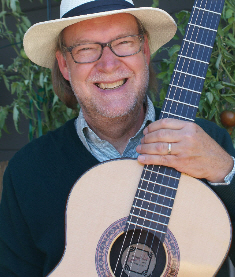
scottMALCOLM: My feelings about mountain rivers are the same. Smoky and Scott, one of you is inspired by a guitar and one of you is inspired by Snake. Is this an example of opposites (or differences) attracting, or is there a synchronicity here that lurks within your respective muses?

SCOTT: Yes, synchronicity! Someone strums a snake; someone strums a guitar. There’s really no difference. As Rumi said, “Everything is music.”

SMOKY: Our muses are definitely entwined, which evokes an image of Snake. And music is a theme of our lives: there are times we live our lives at a fevered pitch, and times when we sit in quiet repose. There are slow, dark sonatas when I am sick; there are times the music plays so fast we can hardly dance fast enough to keep up.

MALCOLM: Does each of you have a favorite line from the book that best communicates the depth and breadth and intent of the book?

SCOTT: For me, it’s what I just said, “Everything is music.”

SMOKY: For me it would be “ …we went to the mountains, deep in the wild Sierra, to refresh our tired bodies and restore our faith in all that is Nature, and wild, and sacred, and good.” I hope our book, Trails, is like that, that it restores readers’ faith that there is good, and it is as close as our own back yards.

MALCOLM: Thank you for stopping by the Round Table today with your wonderful background about Trails.

Trails is available on Kindle, Payloadz and OmniLit. More formats will be released in the coming weeks.
Poll: Most Americans See Population Growth as Threat to Wildlife, Climate

from the Center for Biological Diversity:

biologicalMIAMI— A new poll finds a majority of Americans believe the world’s growing human population is driving wildlife species toward extinction and is making climate change worse. Respondents also said addressing the human population — which topped 7 billion in 2011 — is an important environmental issue and that society has a “moral obligation” to address wildlife extinctions related to population growth.

The national poll of 657 registered voters was commissioned by the Center for Biological Diversity. It was conducted by Public Policy Polling on Feb. 22, 23 and 24. The poll has a margin of error of +-3.85 percent.

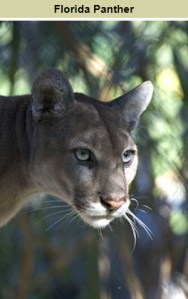
floridapanther“It’s now more clear than ever that Americans are concerned about the toll that human population growth is having on wildlife and our planet,” said Jerry Karnas, population campaign director at the Center. “Population is clearly a driving factor in so many of our environmental issues today, whether it’s sprawling development crowding out Florida panthers and sea turtles, loss of wild habitat for San Joaquin kit foxes in California or the climate crisis pushing polar bears ice seals toward extinction. It’s heartening to see that most Americans understand these connections and don’t want to see them ignored.”

“Although it’s an issue that doesn’t get talked about that much, this poll shows population is an emerging environmental issue that Americans recognize, especially when it comes to protecting wildlife from extinction,” said Jim Williams, of Public Policy Polling.

Among the poll’s results released today:

  • 64 percent said that, with the human population expected to hit 10 billion by 2050, wildlife will be adversely affected.
  • 61 percent said they are already concerned about the rate that wildlife are disappearing.
  • 60 percent said they “strongly agreed” or “somewhat agreed” that human population growth is driving animal species to extinction.
  • 60 percent said our society has a “moral responsibility” to address wildlife extinctions in the face of a growing population.
  • 59 percent said they “strongly agreed” or “somewhat agreed” that addressing the effects of human population growth is “an important environmental issue.”
  • 57 percent believe human population growth is “significantly impacting the disappearance of wildlife.”
  • 57 percent said they “strongly agreed” or “somewhat agreed” that population growth is making climate change worse.
  • 54 percent said stabilizing population growth will help protect the environment.

kitfoxThe Center for Biological Diversity launched its human population campaign in 2009 to highlight the connection between the world’s rapidly growing population and the effect it has on endangered species, wildlife habitat, the climate and overall environmental health. As part of the campaign, the Center has given away nearly 500,000 Endangered Species Condoms intended as a way to get people talking about this critical issue.

The Center advocates for a number of ways to address population, including universal access and adequate funding for family planning services, empowerment of women, sustainable development, a reduction in the consumption of natural resources and personal decisions that lessen the impacts on wildlife and the environment.

“If we’re going to address some of the biggest environmental problems we face, population has to be part of the conversation,” Karnas said. “These poll numbers show Americans are ready to start talking about population and dealing with impacts.”

To download a copy of the poll go to http://www.biologicaldiversity.org/population_poll.

Background

Government scientists have highlighted population as key environmental issue in recent months.

coloradoIn a decision to protect 66 coral species under the Endangered Species Act, the National Marine Fisheries Service said population and consumption of natural sources was “the common root or driver” of ocean acidification and other threats corals face.

The Department of the Interior recently released a report on the future of the Colorado River, concluding that, in 50 years, the river that supplies water to 40 million people may be unable to meet the demands of a burgeoning human population.

The U.S. Forest Service issued a report with another grim prediction: that 36 million acres of the nation’s forests will be lost to houses, strip malls and roads by 2050. That’s an area 16 times larger than Yellowstone National Park.

You May Also Like: Mare Cromwell’s Messages from Mother, a guest post on Smoky Talks

Malcolm