The Heart Shield Bible

Hoodoo practitioners not only consider the Bible to be filled with stories of magic and powerful verses that can be used for spells, but note that from the Civil War through the Vietnam War (and possibly later) Heart Shield Bibles were popular amongst soldiers. These New Testament editions were small enough to fit in the breast pocket of a jacket or shirt and featured gold or gold-colored metal over steel that was said to be able to stop a .45 caliber bullet.

Among the manufacturers was the Protecto Bible Company of St. Louis. The covers of these bibles were often engraved with slogans such as “May this Keep You Safe from Harm” and “God’s Weapon.” They came in a 3-inch by 4.5-inch size and were 3/4-inch thick and sometimes included Psalms. Another edition contained prayers for Catholics.

Many people sent these to their loved ones easily since they often came in a ready-to-ship box.
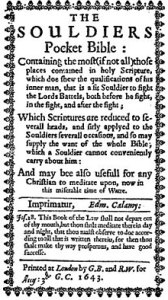
During World War II, Bibles carried the inscription: “As Commander-in-Chief I take pleasure in commending the reading of the Bible to all who serve in the armed forces of the United States. Throughout the centuries men of many faiths and diverse origins have found in the Sacred Book words of wisdom, counsel, and inspiration. It is a foundation of strength and now, as always, an aid in attaining the highest aspirations of the human soul.” –Franklin D. Roosevelt

Interestingly enough, a fair number of these Bibles are currently being sold via eBay, sometimes called Shields of Faith. Did they really work? Stories from the front include statements from slightly injured men who claimed the Bibles stopped enemy rounds. Perhaps the distance traveled and angle of the incoming round made a difference.

However, there’s video on YouTube showing a man simulating a Heart Shield Bible with other materials and testing it with rounds of several calibers. All of them went through. On the other hand, since he used a phone book, those who are sold in the Heart Shield Bible will no doubt remind us that the books in the test were not Holy Writ. Here’s the video link.

The words alone, in Protestant and Catholic editions–like a pocket-sized edition a portion of the ancient Jewish mystical book The Zohar–might be enough, for they are often carried by believers who know little or nothing about the Heart Shield Bible or the hoodoo practice of carrying Bibles and selected Bible verses for general good luck and protection.

–Malcolm

This post originally appeared on “The Sun Singer’s Travels.”

Briefly Noted: ‘Spiritual Merchants’ by Carolyn Morrow Long

Spiritual Merchants: Religion Magic & Commerce Paperback – May 31, 2001

This is a very thorough, readable and well-illustrated reference to the traditionally large and widespread practice of selling hoodoo, Voodoo and other spiritual supplies via mail order, web sites, and retail stores. The book begins with a compact description about the origins of hoodoo and charms–one of the best descriptions I’ve seen–and then goes on to discuss the nature of selling charms, herbal mixtures and other supplies by mail. The book includes a list of current (as of the publication date) merchants that were in business along with their histories.

One thing you notice before reading too far into the mechanizing section is the sad truth that many merchants faked what they were selling.  The ingredients were either not as advertised or were not prepared in the proper manner. Carolyn Long conducted extensive interviews with catherine yronwode (pronounced “Ironwood”) who founded the Lucky Mojo Curio Company. Long notes that yronwode not only has a great deal of hoodoo information (history, spells, practices) on her site but guarantees that the powders, oils, herbs, candles and other supplies she sells are genuine.

All savvy merchants, current and historical, were likely to run afoul of the USPS if they claimed their merchandise would actually produce working magical spells and/or cure ailments. For that reason, merchants sold–and continue to sell–their products “as curios only.”

Long includes a chapter about one of the more famous products, High John the Conqueror (and related “John” products) which are generally used for protection. The irony is, nobody’s sure what it is. Many plants have been considered that are native and non-native to the United States. The problem goes back to the fact that early conjurers were not, of course, using the scientific name of the root, so now we’re stuck having to guess. Until shown otherwise, I would tend to believe yronwode’s description here.

From the Publisher

They can be found along the side streets of many American cities: herb or candle shops catering to practitioners of Voodoo, hoodoo, Santería, and similar beliefs. Here one can purchase ritual items and raw materials for the fabrication of traditional charms, plus a variety of soaps, powders, and aromatic goods known in the trade as “spiritual products.” For those seeking health or success, love or protection, these potions offer the power of the saints and the authority of the African gods.

In Spiritual Merchants, Carolyn Morrow Long provides an inside look at the followers of African-based belief systems and the retailers and manufacturers who supply them. Traveling from New Orleans to New York, from Charleston to Los Angeles, she takes readers on a tour of these shops, examines the origins of the products, and profiles the merchants who sell them.

If you are researching hoodoo and/or writing a hoodoo-based folk magic novel, this book will serve as a handy reference.

–Malcolm

Malcolm R. Campbell is the author of the hoodoo-based novels “Conjure Woman’s Cat” and “Eulalie and Washerwoman.”

Briefly Noted: ‘Uncle Monday and Other Florida Tales’

Uncle Monday and Other Florida Tales, Edited by Kristin G. Congdon, Illustrated by Kitty Kitson Peterson (University Press of Mississippp, 2001), 196pp

unclemonday“Uncle Monday” is a widely known legend about a central Florida shape shifter and conjure man first collected in print by Zora Neale Hurston in the 1930s as part of her fieldwork throughout the state.

It’s an apt title story for this collection of oral-tradition stories compiled and annotated by Kirstin G. Congdon. I have the hard cover edition which is out of print; the paperback is available via Amazon. Unfortunately, it’s not available on Kindle.

These stories are part of what makes Florida, Florida. This volume makes them accessible, though some can be found throughout the Internet (oddly enough, sometimes copyrighted by those who own the sites) as well as in Florida’s Folklore Programs archives and volumes published by the Federal Writers Project.

Congdon is also the author of Happy Clouds, Happy Trees: The Bob Ross Phenomenon (with Doug Brandy) and Just Above the Water: Florida Folk Art (with Tina Bucuvalas).

From the Publisher

Few states can boast the multitude of cultures that created Florida. Native American, African American, Afro-Caribbean, White, and Hispanic traditions all brought their styles of storytelling to fashion Florida’s legends and lore.

Uncle Monday and Other Florida Tales captures the way the state of Florida has been shaped by its unique environment and inhabitants.

Written for adults, children, and folklorists, this gathering of forty-nine folktales comes from a wide variety of sources with many drawn from the WPA materials in Florida’s Department of State archives. Kitty Kitson Petterson’s detailed pen-and-ink drawings illustrate each narrative. The stories represent a cross-section of the ethnic diversity of the state.

The book is divided into five sections: “How Things Came to Be the Way They Are,” “People with Special Powers,” “Food, Friends and Family,” “Unusual Places, Spaces, and Events,” and “Ghosts and the Supernatural.” Within these sections are stories with titles ranging from “How the Gopher Turtle was Made” to the improbable “The Woman Who Fed Her Husband a Leg Which She Dug Up from a Cemetery.” In these tales Florida is a world full of magic, humor, and adventure. There are tall tales, old magical legends, even quirky, almost straightforward narratives about everyday living, such as one story titled, “My First Job.”

Kristin G. Congdon’s informative introduction discusses the origins of Florida tales and the state’s storytelling tradition. A reflection accompanies each story to guide readers to a deeper understanding of historical context, morals, and issues. Although oriented towards children, Uncle Monday and Other Florida Tales is also accessible to adults, particularly scholars interested in the state’s folklore and oral traditions. Whether in a classroom or home, this guide adds great value to the collection.

Reviews

The book has three five-star reviews on Amazon, including this one by “grasshopper4”:  “Uncle Monday is a shape-shifter who for years has resided in a lake near Orlando. Uncle Monday is also a terrific compilation of folklore from Florida. There are myths, legends, tall tales, fairy tales, family stories, and a plethora of excellent oral narratives that have been and remain told in Florida. The introduction to the book is well-written, and each section provides good background information on various characters and tale types. The book also has wonderful illustrations that capture the feel of various stories, and the book includes excellent ideas for teachers to use when presenting the texts in class. It’s a model study by a fine folklorist.”

The book is a wonder for folklore students, writers researching old legends for use in Florida stories, and anyone enjoying a great story.

–Malcolm

Uncle Monday is mentioned in my novel “Eulalie and Washerwoman.” This post originally appeared on “Sun Singer’s Travels”

Throwing the Bones

What do bones bring to mind? Perhaps, the bones left on a dinner plate, the fish or chicken bones you try not to swallow, the bones you break when you fall, the bones that ache as you grow older, or perhaps you think of the recent TV show “Bones” based on the novels of forensic anthropologist Kathy Reichs.

Fans of the TV show and Reichs’ novels know that bones are used in forensics to determine identity and potentially the natural or criminal cause of death. Conjurers and others who “throw the bones” do so as a method of divination. The use of bones as oracles or to determine the future of a person in relation to a question is ancient. The method is also rare inasmuch as most people tend to focus more these days on Tarot cards, I Ching readings, crystals, and psychic skills.

“Bone Reading is a form of divination that uses animal bones, nuts, shells, and curios such as dice or beads…collectively known as ‘bones’ …to divine information . . .In times past, the bones were often tossed into a circle drawn on the ground; however, modern bone readers are more inclined to toss them onto a specially marked cloth. ” – Carolina Conjure

Possum Skeleton – Wikipedia

Conjurers use a variety of methods, with many relying on the bones of one animal–often a possum or a chicken–that are kept in a pouch or basket–and used multiple times for multiple readings. Some use natural colorings, marks or paints to create a heads/tails side of each bone. This tends to limit the reading to one or more yes/no questions.

Others consider the layout of the circle whether it has been printed on a cloth or drawn on the ground. Some visualize a single cross that’s called a crossroads and consider the quadrants where the bones fall. Others divide the circle into sections based on the face of a clock, the “wheel of the year” (seasons, solstices, equinoxes), or the signs of the zodiac.

Those who visualize the circle where they toss the bones as being divided into sections, may also interpret the bones partially on bone type (what it means by itself), intuition, or the guidance of spirits (typically ancestors). Depending on the question being considered, they may include a domino, seeds, dice, shells, stones or other objects in the circle. Whatever falls outside the circle when the bones are thrown (tossed, scattered) does not figure in the reading other than noting that it was excluded.

Introduction to Bone Throwing

Bone readers typically don’t use the entire skeleton of an animal. Their collection may include bones obtained in various ways so that each has a special significance. Others may not seem to apply to a particular question. In addition, those using, say, possum or chicken bones, see meanings in each bone: good or bad news, travel, health, relationships. Those reading possum bones may throw only six of them, the right and left jawbone, the right and left front legs, and the right and left back legs,

The circle is considered sacred space. It contains the reading just as a particular Tarot card spread contains the cards to be considered. Many readers begin the reading with a prayer, the recitation of a psalm, and settling themselves into a relaxed posture and frame of mind so as to be receptive to the messages found when they throw the bones.

Bone reading is difficult–and some say, impossible–to learn out of a book or from a website even if you’re using the bones to answer yes/no questions. Interpreting the bones–as with tea leaves–depends on practice, a wise mentor, and sometimes initiation into a religion or a system. I find it fascinating while writing my conjure and crime novels, but would never attempt it myself. On the other hand, my Tarot deck is an old friend.

Malcolm

For information about my hoodoo novels “Conjure Woman’s Cat,” “Eulalie and Washerwoman,” “Lena,” and “Fate’s Arrows,” click on my name to see my website.

Hoodoo Nuances: Rising and Falling Clock Hands

“When both clock hands are rising, cast spells of a positive or uplifting nature; when both clock hands are falling, cast spells that are meant to cast off evil and keep enemies down. But you must not perform magic when one clock hand is rising and another is falling. For Example: if the time is 10:40 the hands are rising, if the time is 2:15 the hands are falling, if it’s 5:45 do not do any magic because the hands are doing both.”

– Moon Phases in Hoodoo Magic from the “Spiritual Illumination” blog.

Years ago when more people were conscious of moon phases, rising and falling tides, solstices and equinoxes, and the flow of the seasons, farmers, fishermen and others who depended on nature for their livelihood, referred to their almanacs to that they were planting, harvesting, and fishing by the signs. For example, as the Natural Events Almanac mentions by way of introduction, “Planting by the signs is a fairly straight forward operation. You plant aboveground crops (lettuce, peas, tomatoes, etc.) when the moon is waxing (growing) from New to Full Moon. Underground crops (beets, radishes carrots, potatoes, etc.) are planted when the moon is waning from Full to New Moon. However, true gardening by the signs is a bit more complicated.”

While the I Ching (book of changes) seems fairly remote from hoodoo, it emphasizes aligning ones life and choices with the natural flow of change, the direction the universe is heading at the moment you ask the oracle a question.   The idea here, which is deeply understood by conjurers, works (for spells, gathering/planing herbs, collecting rain water) and by old farmers and fishermen is that success is more likely when you go with the flow rather than against it.
Taking note of the hands of a traditional clock–which I suspect some day soon people will no longer know how to read–fine-tunes one’s work with the flow of time hour by hour. Like planting and fishing, some work is best done under waxing (growing) moments and some is best done under waning moments.

Conjurers base their practices on what works for them. To some extent this is intuitive inasmuch as you can, with practice, feel the moon’s changes without looking out the window, sense high tides and low tides without referring to a tidal clock, and understand the hours without looking at the positions of the sun and moon–or the hands on your clock.

The “old-time” conjurer woman who posts at Spiritual Illumination believes that “the three most important timing considerations in hoodoo are the day of the week, the time of day, and the time of the moon. Of less importance (generally) are the positions of the planets and the day of the year.” This is a personal preference and differs from person to person.

As a writer, I like conjuring nuances because they add depth to my series of folk magic novels. Personal experience has shown me that notions about time, moon and tides are not superstition because–let us say–that if one works with oracles like the I Ching, the Kabbalist’s Tree of Life, Tarot Cards, and meditation, the flow of time and space and energy become very evident when it comes to their impact on what we are doing. So, it’s not surprising that hoodoo practitioners are very conscious of the benefits of going with the flow.

In some ways, our attitudes about life are a form of conjure in that consciously or subconsciously, our minds are creating the future. What works for the hoodoo practitioner works for all of us.

–Malcolm

Malcolm R. Campbell is the author of the hoodoo/crime novels “Conjure Woman’s Cat” and “Eulalie and Washerwoman.”


If your conjure woman stocks Belladonna, run like hell

Wikipedia photo.

Belladonna (nightshade) and the potato you eat with your steak are related. Solanaceae, plants that prefer shade or dappled sunlight, is a large family! However, if your conjure practitioner keeps belladonna in stock, its primary use–other than as a curiosity or an ornamental–in folk magic is to poison people. In 1915, plant researcher Henry Walters said nightshade was a plant filled with hatred.

Several berries might do the trick. Touching it will badly inflame your skin. In areas where belladonna grows wild, medical students were (and perhaps still are) taught to recognize the symptoms of belladonna poisoning by memorizing this phrase: “Hot as a hare, blind as a bat, dry as a bone, red as a beat, and mad as a hatter.”

It’s use now in cosmetics is rare, though it once was fairly common. It was once used by women to accentuate their eyes, hence bella donna (beautiful woman). It still has some medical uses, though the dangers it presents are outside the skill set of most herbalists and root doctors.

It can be used in the treatment of whooping cough, Parkinson’s disease, motion sickness, psychiatric conditions, and as a painkiller. (See WebMD for more information.)

How apt that the active agent in belladonna, atropine, is named after Atropos, the Greek fate who snipped an individual’s threat of life. Or, as Milton said, “Comes the blind Fury with the abhorred shears/And skits the thin-spun life.

The plant often appears in myths and fairy lore. Purportedly, it put Snow White to sleep when it was injected into the apple she was given. Like Henbane and Thornapple (aka Devil’s Apple), Belladonna is associated with the goddess of night and death, Hecate.

According to Amy Stewart (in a handy and fun little guidebook called Wicked Plants) says that nightshade “causes rapid heartbeat, confusion, hallucinations, and seizures. The symptoms are so unpleasant that atropine is sometimes added to potentially addictive painkillers to keep patients from getting hooked.”

The plant’s names, nightshade and belladonna sound like magic, mystery and enchantment. Yet, it’s not the kind of mystery I want my friendly neighborhood herbalist or conjure woman playing around with.

Malcolm

Malcolm R. Campbell is the author of Conjure Woman’s Cat and its sequel Eulalie and Washerwoman.

Spotlight: Can the evil conjure man really turn into an alligator?

Today’s spotlight focuses on my recent novel Eulalie and Washerwoman and announces a Kindle freebie for one of my short stories.

Eulalie and Washerwoman

ewkindlecoverThis 1950s story about dueling conjurers features an antagonist named Washerwoman who brags that his famous mentor, Uncle Monday, knew how to turn into an alligator. But can Washerwoman do it as well?

Eulalie, who first appeared in Conjure Woman’s Cat, knows all there is to know about conjure. She will definitely need her skills to stop blacks from losing their homes and then going missing themselves.

I hope you like the magic and the mystery of the Florida Panhandle piney woods where the activities of a strong KKK seldom got mentioned in the sunshine state’s tourism brochures.

Free Kindle Book

willingspiritskindlecoverMy Kindle short story “Willing Spirits” will be free on Amazon January 18-20. The story features the purported St. Louis spirit named Patience Worth who spoke via medium Pearl Curran between 1883 and 1937. Patience was so prolific that she actually wrote critically acclaimed books.

Now, a young high school student has waited until the last minute to read one of those books and write a book report. She considers contacting its deceased author. What can possibly go wrong?

Amazon Giveaway

Later today (1-14-17) I’ll be running an Amazon giveaway for my contemporary fantasy novel Sarabande. It features a very determined young woman from the Montana mountains who fights against more troubles than anyone can shake a stick at to find the avatar who she hopes will stop the spirit who’s been haunting her for three years.

Watch Twitter for the giveaway. They come and go so fast, there’s never time to post about them here once they go live.

UPDATE: Giveaway went live about 12:10 eastern time and within the next 10-15 minutes, the three books available were snapped up. Thank you to everyone who entered.

–Malcolm


Thyme for cooking, conjure and health

“Thyme (/ˈtaɪm/) is an evergreen herb with culinary, medicinal, and ornamental uses. The most common variety is Thymus vulgaris. Thyme is of the genus Thymus of the mint family (Lamiaceae), and a relative of the oregano genus Origanum.” – Wikipedia

If you’re a Simon & Garfunkel fan, you probably remember their third album “Parsley, Sage, Rosemary and Thyme.”

If you have an herb garden, you know that thyme is easy to grow, looks nice and smells good.

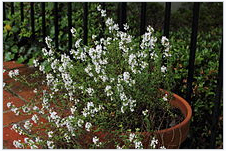
thymeIf you have a spice rack in the kitchen, no doubt there’s some thyme there. I add thyme to my spaghetti sauce. A lot of recipes call for its use in roasts, scrambled eggs, chowder, biscuits and with potatoes and other vegetables. Sunset says that “Thyme is a kitchen workhorse, infinitely useful with a wide range of meats and vegetables, and also with both savory and sweet fruit dishes. With cooked dishes, try adding thyme at the beginning and then a little more at the end, just before serving to make its flavor pop.”
Medicine

The leaves and oil of thyme have a lot of claims behind their efficacy in treating diarrhea, stomach ache, whooping cough, colic, soar throat, flatulence, and as a diuretic. The Natural Society website states that “The volatile essential oils in thyme are packed with anti-septic, anti-viral, anti-rheumatic, anti-parasitic and anti-fungal properties, which explains why thyme-based formulas are used as an expectorant, diuretic, fungicide and antibiotic.”

Spirituality

When used as incense, it’s been said to stimulate courage and purify homes and temples. According to Wichipedia, “It was mixed in drinks to enhance intoxicating effects and induce bravery and warriors were massaged with thyme oil to ensure their courage. Women wore thyme in their hair to enhance their attractiveness. The phrase ‘to smell of thyme’ meant that one was stylish, well groomed, poised, and otherwise attractive. Thyme is a Mediterranean native spread throughout Europe by the Romans. Their soldiers added it to their bathwater to increase bravery, strength and vigor. It enjoyed a long association with bravery. In Medieval England, ladies embroidered sprigs of thyme into their knights’ scarves to increase their bravery. In Scotland, highlanders brewed tea to increase courage and keep away nightmares.”

Conjure

You can buy this curio online in several places

My interest in thyme, other than using it a lot in my cooking, is for its folk magic applications. Hoodoo practitioners use it to help their clients sleep, usually as an incense placed on charcoal or leaves placed inside or beneath a pillow for a so-called “magic dreaming pillow,” and for attracting money. Growing thyme in a garden, grows your wealth. It protects you and helps your income if you tie the leaves up in paper money and bury it where two paths cross beneath a full moon. It can also be added to bath crystals and sachets–or even as a perfume.

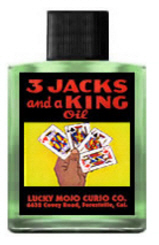
Add it to a mojo bag with bayberry, cinnamon, and alfalfa to attract money. Some practitioners mix it with galangal, vetiver, patchouli and cardamon when making Three Jacks and a King oil for gambling. (Massage the oil into your hands when you pick up the deck of cards and “feed” your mojo bag with it.) Traditionalists recite the 23rd Psalm when they use the oil. Some folks dress (coat) candles with it or even sprinkle it on poker chips.

Catherine Tronwode, author, practitioner and owner of the Lucky Mojo Curio Company, says that old time recipes like Three Jacks and a Kind, are “slightly different — some placing emphasis on catching lucky numbers through dreams, others on being hit with lucky “coincidences” or hunches, and still others on obtaining uncanny runs of finger dexterity at cards or dice — or all of these combined with luck at love and games of chance — but they have in common the underlying aim of enhancing the magician’s internally generated forces, enabling action upon the external world.”

For information about the use of thyme and other plants in conjure, consult Hoodoo Herb and Root Magic: A Materia Magica of African-American Conjure by catherine yronwode. For plant usage in pagan, Wicca and traditional witchcraft, see Cunningham’s Encyclopedia of Magical Herbs by Scott Cunningham.

–Malcolm

Malcolm R. Campbell is the author of two folk magic novels, “Conjure Woman’s Cat” and “Eulalie and Washerwoman.” Both books are available in e-book, audiobook and paperback editions.


Conjure: why those frizzle chickens are handy

“The Frizzle is a breed of chicken with characteristic curled or frizzled plumage. While the frizzle gene can be seen in many breeds, such as thePekin and Polish, the Frizzle is recognized as a distinct breed in a number of European countries and Australia. In the United States frizzled chickens are not considered a breed, and at shows are judged by the standards of the breed they belong to.” – Wikipedia

Unless one keeps chickens or attends 4-H competitions, most of us will probably never see a chicken with frizzled (curled) plumage, what one blogger calls the “divas of the chicken world.” However, if you’re researching hoodoo for your books–as I have been–it’s amazing what you learn about all kinds of things that are indirectly related to your subject.

So, how would chickens help a conjurer?

Frizzle chicken - Wiipedia photo
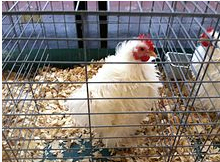
Frizzle chicken – Wikipedia photo

First, conjure includes what’s often generically referred to as foot track magic, tricks (hexes) that are placed on the ground in order to keep away or send away people who might walk through them or over them; they are also used as one of the many techniques that can protect one’s own property.

Second, the best defense is a good offense, so if you’re a conjurer, you want your property protected so that others can’t come on it while you’re asleep or away and place tricks on the normal pathways use use to come and go, walk to the potting shed or garden, or gather eggs from your own chickens.

If your chickens aren’t confined in a coop, what do you see them doing on the property? They’re constantly scratching the soil looking for something to eat. If they scratch through a hex sign, for example, they destroy it. According to some conjurers, black frizzle hens are a very good defense against anything a rival did to your property if they find a way to get onto it without your own magic turning them away.

As the very handy Lucky Mojo site puts it, “The backwards curling of the frizzled feathers on these birds is seen as a natural expression of their ability to undo bad work that has been laid down to walk over. Frizzles come in all the usual chicken colours and patterns, but since black hens are the birds most often used to scratch up evil powders in the yard, it follows that a black Frizzled hen would be the best possible bird in the world for that purpose. As with the black cat, also much admired and much feared in hoodoo work, a black Frizzle hen’s dangerous associations with the infernal can be parlayed by a deft root doctor into a powerful tool for undoing and reversing evil and uncrossing clients..”

If you’re working evil, you’ll find the eggs from black hens very effective, but that’s another story. If you want the chickens for style, you should know that their plumage doesn’t offer as much protection against rain and cold weather as flat feathers. Keep them in a sheltered place during bad weather.

–Malcolm

Malcolm R. Campbell is the author of the hoodoo novel “Conjure Woman’s Cat,” available at major booksellers in paperback, e-book and audiobook.


Magnolia might help you keep your spouse at home

If you live in the South, you’ve probably seen ancient magnolia trees in the woods all your life, and possibly you’ve stopped by a local nursery on more than a few occasions to add the dark green leaves and white flowers to your yard. In Florida where I grew up, we had the Southern Magnolia and the Sweetbay Magnolia. Your local native nursery is a good place to start, or if you want to know more about the tree in general, stop by the Magnolia Society International and take a look at their resources tab for practical information.

Sweetbay Magnolia - Wikipedia photo
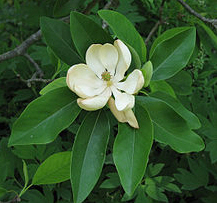
Sweetbay Magnolia – Wikipedia photo

The society notes that there are more than 200 species of the shrub/tree which are found in ” temperate, subtropical and tropical areas of southeastern Asia, eastern North America, Central America, the Caribbean and parts of South America. Many are now grown worldwide because of their beautiful flowers, shape and form.”

Medical Uses

Like many plants, the bark and leaves of magnolias have been made into medicine. Purportedly, the magnolia has been used to combat indigestion, stress, headaches, stroke and other aliments–including toothache. I can’t speak to the safety or efficacy of any of these, though you can find a blurb about it on WebMD here.

In the conjure department

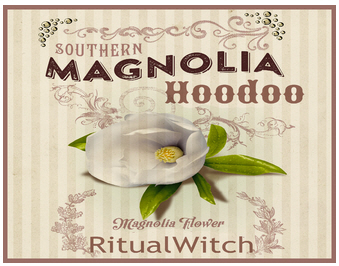
While researching my 2015 novella Conjure Woman’s Cat, I found that a lot of the plants I walked by in the Florida woods when I was young can be used for all sorts of magical purposes. For example, if you check out the web site of the Ritual Witch, you’ll find a section called Southern Magnolia Hoodoo.  Oils, bath salts, candles and mojo bags with a magnolia flavor to them can ramp up your romance.

magnoliahoodooOr, if you have your own magnolia tree in the yard and want to make sure your spouse isn’t following his or her wandering eye, hide or sew some of the leaves into your mattress.

This is cheaper than hiring a private detective and supposedly stops any “oops moments” from happening. There are a few more graphic spells and mojo bags that I’ll leave to your imagination, most of which seem to be sought after by jealous wives–yes, that sounds sexist, but I’m just reporting facts from my research.

As Catherine Yronwode mentions in her very handy “Hoodoo, Herb and Root Magic Book,” Will Batts recorded a song back in 1933 that said he didn’t want a jealous women because she would “put somethin’ in the mattress, make you wish you was dead.”  I have no experience with this, but why tempt fate?

Love magic and keeping your lover at home magic have always been a widely practiced area of conjure. Find a plant, and somebody has found a magical use for it. A quick Google search with the words “root doctor” or “conjure” in it along with the name of a plant or mineral will turn up more than most of us ever dreamt was out there.

Magnolia is more than a pretty flower it would seem.

–Malcolm

KIndle cover 200x300(1)Malcolm R. Campbell is the author of the novella “Conjure Woman’s Cat,” about a conjure woman who fights the KKK with folk magic and a very loyal cat.