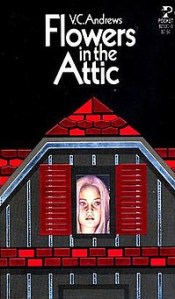
 Of course, I read it. After all, there was a war on, I was addicted to Southern Gothic by running with a bad crowd and was working for an employer who tapped my phone (not because I read the book, though I’m not sure about that).
I like the Wikipedia comments about the book: “A review in The Washington Post when the book was originally released described the book as ‘deranged swill’ that “may well be the worst book I have ever read”. The retrospective in The Guardian agreed that it is deranged but called it “utterly compelling.”
Sure, there were claims that it might have been based on a true story. I didn’t care. There were also claims that its author V. C. Andrews was as messed up as her novel. I saw that as a plus. People are still arguing about such things thirty-seven years after Andrews died. Where there’s smoke, there’s fire? I think people want there to be fire even though the evidence about real fire is rather slim.
Last year the New York Post said, “Real life of ‘Flowers’ author VC Andrews was as creepy as her gothic novels.” The post based that view on a book about Andrews: “While the new book “The Woman Beyond the Attic: The V.C. Andrews Story” (Gallery Books) by Andrew Neiderman may not be as salacious as “Flowers in the Attic,” it’s surely worth its own Lifetime Original Movie.”
I don’t think so, but the reporter never called me for a comment.
While one can hardly say the book is “just good clean fun,” everyone wants to find some reason anyone would write such a novel, and then follow it up with more or the same.
How or why it all happened seems irrelevant to me as an author. The story stands for itself. What it means and/or what the author meant are the kind of swill we get from English departments that think novels must be explained–and possibly the authors as well.
Flowers in the Attic was, for me, a compelling story.
–Malcolm
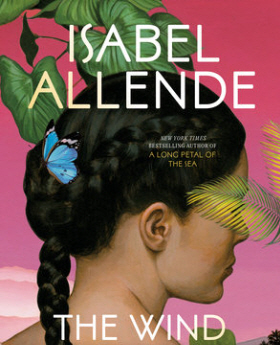
 “Telling a story that is rooted so deeply in political events can be a difficult balancing act; an author walks a fine line between writing immersive fiction and explaining historical and social context. “The Wind Knows My Name” contains little of the magic that defined Allende’s earlier novels. Instead, she turns her focus to the brutal details of government-sponsored violence and asks her reader to look closely at the devastation. Allende draws a straight line from Nazi Germany to modern-day atrocities — not because the specifics are the same, but because the damage is.”


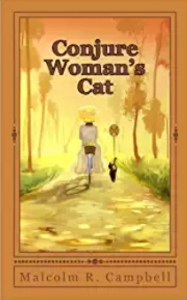

 Malcolm R. Campbell
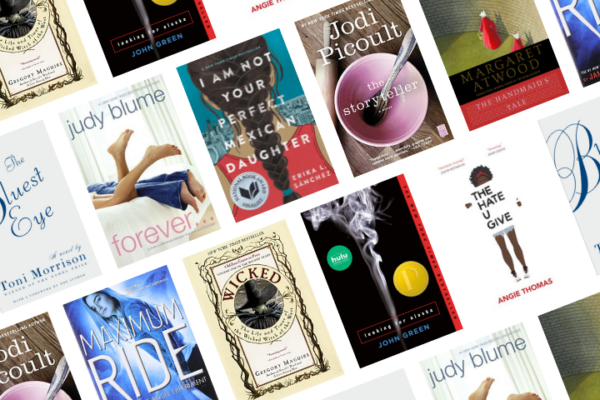 According to PEN America, “Books are under profound attack in the United States. They are disappearing from library shelves, being challenged in droves, being decreed off limits by school boards, legislators, and prison authorities. And everywhere, it is the books that have long fought for a place on the shelf that are being targeted. Books by authors of color, by LGBTQ+ authors, by women. Books about racism, sexuality, gender, history. PEN America pushes back against the banning of books and the intolerance, exclusion, and censorship that undergird it.” Learn more from
 Feature:
  skewering of ‘Dilbert’ comic creator Scott Adams, who went on a racist rant last month that spurred dozens of newspapers to drop his long-running syndicated cartoon strip.” Variety See also
  pacing—a slow roll of dread and horror, especially in the first half—is exceptional. Bartz hits all the gothic highlights, but, far from feeling stale, they work
 commanding as the sociopath musical megastar whose life is crumbling around her but it is the steely menace in Todd Field’s film that is simply delicious. The great crack-up of Lydia Tár, the Berlin Philharmonic’s entirely fictitious but docudramatically real-seeming chief conductor, has given the cinema its greatest spectacle, its greatest provocation and its greatest pleasure. If there is any justice, it will be producer-director Todd Field, with fellow producers Alexandra Milchan and Scott Lambert, who will be invited up on stage at the end of the evening to receive the climactic best picture statuette.” Guardian
 News:
News:  Malcolm's Round Table