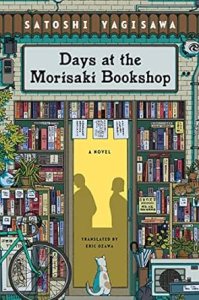
‘Days at the Morisaki Bookshop’ by Satoshi Yagisawa

What book lover could resist this shop?

“‘Days at the Morisaki Bookshop'” is a sweet, gentle tale about the power of books to bring solace to troubled souls and offer them hope for the future. The title takes us inside a bookshop housed in an old wooden building on a quiet corner of a Tokyo district that has come to be known as ‘Book Town.’” – Karen Heenan-Davies at Bookertalk

From the Publisher

“The wise and charming international bestseller and hit Japanese movie—about a young woman who loses everything but finds herself—a tale of new beginnings, romantic and family relationships, and the comfort that can be found in books. 

“Twenty-five-year-old Takako has enjoyed a relatively easy existence—until the day her boyfriend Hideaki, the man she expected to wed, casually announces he’s been cheating on her and is marrying the other woman. Suddenly, Takako’s life is in freefall. She loses her job, her friends, and her acquaintances, and spirals into a deep depression. In the depths of her despair, she receives a call from her distant uncle Satoru.

Satoshi Yagisawa

“An unusual man who has always pursued something of an unconventional life, especially after his wife Momoko left him out of the blue five years earlier, Satoru runs a second-hand bookshop in Jimbocho, Tokyo’s famous book district. Takako once looked down upon Satoru’s life. Now, she reluctantly accepts his offer of the tiny room above the bookshop rent-free in exchange for helping out at the store. The move is temporary until she can get back on her feet. But in the months that follow, Takako surprises herself when she develops a passion for Japanese literature, becomes a regular at a local coffee shop where she makes new friends, and eventually meets a young editor from a nearby publishing house who’s going through his own messy breakup.

“But just as she begins to find joy again, Hideaki reappears, forcing Takako to rely once again on her uncle, whose own life has begun to unravel. Together, these seeming opposites work to understand each other and themselves as they continue to share the wisdom they’ve gained in the bookshop.

“Translated By Eric Ozawa”

The novel was published in 2009 with the English translation being released this past summer. The story appeared in 2010 as the film “Morisaki shoten no hibi” directed by Asako Hyuga and starring Ryô Iwamatsu and Akiko Kikuchi. Watch the trailer here.

According to Japanese Comfort Reads, “The crime genre seems to be over-represented among Japanese novels in translation, and there are plenty of highbrow books too that someone has decided represent the best of Japanese literature. I enjoy all of these, but surely there is room for novels that satisfy a different need, novels that would entice both a 16-year-old girl and an 80-year-old man?”

–Malcolm


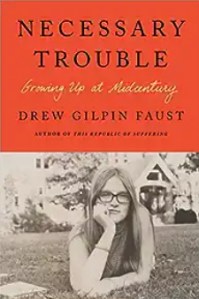
‘Necessary Trouble’ by Drew Gilpin Faust

Faust and I grew up in the South about the same time when Jim Crow was king and most people saw the Civil War as a glorious and noble lost cause.  I’m interested in her take on the world we knew and the trouble people are having talking about that world openly and fairly today.

In an August 22 interview with NPR, she says, “I believe that affirmative action has changed the shape of and the landscape of higher education in a way that we need to continue,” she says. “The past is with us. We can’t pretend that it’s not, even as we misrepresent it or try to erase it.” When asked about Florida Governor Ron DeSantis’ black history teaching standards, she says, “It’s preposterous and it’s extremely distressing. It’s a complete distortion of the past, which is undertaken in service of the present, of minimizing racial issues in the present by saying everything’s been ‘just great’ for four centuries. Slavery was not ‘just great.’ It was oppressive. It was cruel. It involved exploitation of every sort, physical violence, sexual exploitation. ”

This interview gives you an idea about what to expect in Faust’s new book Necessary Trouble released by Farrar, Straus, and Giroux on August 22.

From the Publisher

“A memoir of coming of age in a conservative Southern family in postwar America.

“To grow up in the 1950s was to enter a world of polarized national alliances, nuclear threat, and destabilized social hierarchies. Two world wars and the depression that connected them had unleashed a torrent of expectations and dissatisfactions―not only in global affairs but in American society and Americans’ lives.

“A privileged white girl in conservative, segregated Virginia was expected to adopt a willful blindness to the inequities of race and the constraints of gender. For Drew Gilpin, the acceptance of both female subordination and racial hierarchy proved intolerable and galvanizing. Urged to become “well adjusted” and to fill the role of a poised young lady that her upbringing imposed, she found resistance was necessary for her survival. During the 1960s, through her love of learning and her active engagement in the civil rights, student, and antiwar movements, Drew forged a path of her own―one that would eventually lead her to become a historian of the very conflicts that were instrumental in shaping the world she grew up in.

“Culminating in the upheavals of 1968, Necessary Trouble captures a time of rapid change and fierce reaction in one young woman’s life, tracing the transformations and aftershocks that we continue to grapple with today.”

About the Author

Drew Gilpin Faust is the Arthur Kingsley Porter University Professor at Harvard University. She was Dean of the Radcliffe Institute for Advanced Study from 2001 to 2007, and after twenty-five years on the faculty of the University of Pennsylvania, she served as Harvard’s president from 2007 to 2018. Faust is the author of several books, including This Republic of Suffering: Death and the American Civil War, winner of the Bancroft Prize and a finalist for the National Book Award and the Pulitzer Prize; and Mothers of Invention: Women of the Slaveholding South in the American Civil War, which won the Francis Parkman Prize. She and her husband live in Cambridge, Massachusetts.

–Malcolm

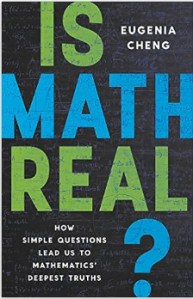
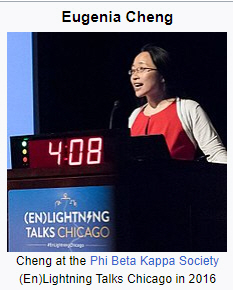
‘Is Math Real?’ by Eugenia Cheng

While watching “A Beautiful Mind,” I wondered if all those equations on the blackboard could possibly be real. Yes and no. “Yes” because a consultant kept the film’s math on track and “no” because the plot plunged viewers into one of John Nash’s delusions at the beginning of the film.

And yet, is math real in “real life”?

An NPR story states that “From start to finish, Eugenia’s book explores the ways we do math outside the classroom — and how they upend the binary true/false we’re taught from an early age. From examples where 1+1 does not equal two, to the concept of infinity, Is Math Real? relieves us of that rigidity and encourages us to reevaluate our relationship to the abstract. She reminds us that math is driven by human curiosity and creativity—not by right and wrong answers.”

I also thought that the chalkboard filled with equations in films proved the math was fake. If the math were real, wouldn’t the mathematicisn use a computer? Not so, it turns out. First, that’s tradidional, and second, it make theorms easier to present to a class.

From the Publisher

One of the world’s most creative mathematicians offers a new way to look at math—focusing on questions, not answers

“Where do we learn math: From rules in a textbook? From logic and deduction? Not really, according to mathematician Eugenia Cheng: we learn it from human curiosity—most importantly, from asking questions. This may come as a surprise to those who think that math is about finding the one right answer, or those who were told that the ‘dumb’ question they asked just proved they were bad at math. But Cheng shows why people who ask questions like “Why does 1 + 1 = 2?” are at the very heart of the search for mathematical truth.

“Is Math Real? is a much-needed repudiation of the rigid ways we’re taught to do math, and a celebration of the true, curious spirit of the discipline. Written with intelligence and passion, Is Math Real? brings us math as we’ve never seen it before, revealing how profound insights can emerge from seemingly unlikely sources. ”

From the Reviewers

“An invigorating philosophical take on the field…Cheng has a talent for making mathematical discussions accessible, and her wide-ranging analysis leads to some surprisingly weighty conclusions…It adds up to a stellar meditation on the nature of knowledge and math.”―Publishers Weekly (Starred)

“[Cheng] also succeeds in making the reader feel that not understanding something in mathematics isn’t the same as being bad at it: rather, it is a clue that you are onto something deeper, the pursuit of which could reap rewards.  The book is infused with personal ruminations that lighten the load and keep the tone conversational…Cheng wears her heart and politics on her sleeve, segueing seamlessly…from mathematics to social concerns…Nicely parried, while providing fodder for those who want to chew on this some more.”―New Scientist

You don’t need a chalkboard to understand this book.

–Malcolm

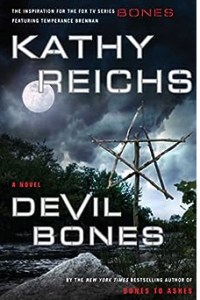
‘Devil Bones’ by Kathy Reichs

After my focus on Oppenheimer,  John Nash, the fires in Hawai’i, and quantum mechanics, it was a joy to go back to simpler books about chopped-up bodies, serial killers, and the other nefarious deeds Kathy Reichs (Bones) writes about in her crime/thriller series about a forensic anthropologist. This time I went back in time to an older novel from 2008, Devil Bones. It has a pentagramme on the cover that tells you whether or not this is your kind of book.

Here’s a real-life tip. If you’re working on an old house and discover a deep root cellar, don’t go down there. Since this is a wholesome family blog, I won’t tell you what’s down there in the novel even though the publisher’s description spills the beans about that.

From the Publisher

“In a house under renovation, a plumber uncovers a cellar no one knew about and makes a grisly discovery: a decapitated chicken, animal bones, and cauldrons containing beads, feathers, and other relics of religious ceremonies. In the center of the shrine rests the skull of a teenage girl. Meanwhile, on a nearby lakeshore, the headless body of a teenage boy is found by a man walking his dog.

“Forensic anthropologist Temperance Brennan is called in to investigate, and a complex and gripping tale unfolds. Nothing is clear—neither when the deaths occurred, nor where. Was the skull brought to the cellar or was the girl murdered there? Why is the boy’s body remarkably well preserved? Led by a preacher turned politician, citizen vigilantes blame devil worshippers and Wiccans, and Temperance will need all of her expertise to get to the real culprit first.”

I smile when I read these kinds of descriptions because I don’t believe in the devil and wonder just what the hell those who believe they are devil worshippers think they’re doing.

Malcolm

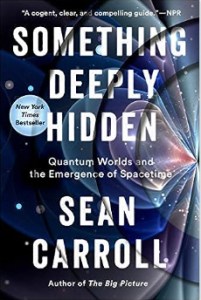
‘As you read these words, copies of you are being created.’

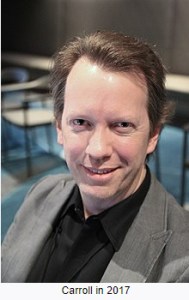
So begins the publisher’s description of Sean Carroll’s 2020 book Something Deeply Hidden: Quantum Worlds and the Emergence of Spacetime. If you’ve wondered about quantum mechanics, especially the Many Worlds Interpretation (MWI), this book will clear things up for you in this universe and, possibly, others.

Nature Magazine wrote: “At the beginning of Something Deeply Hidden, Sean Carroll cites the tale of the fox and the grapes from Aesop’s Fables. A hungry fox tries to reach a bunch of grapes dangling from a vine. Finding them beyond his grasp, but refusing to admit failure, the fox declares the grapes to be inedible and turns away. That, Carroll declares, encapsulates how physicists treat the wacky implications of quantum mechanics. Carroll wants that to stop. The fox can reach the grapes, he argues, with the many-worlds theory. “

From the Publisher

“As you read these words, copies of you are being created.

“Sean Carroll, theoretical physicist and one of this world’s most celebrated writers on science, rewrites the history of twentieth-century physics. Already hailed as a masterpiece, Something Deeply Hidden shows for the first time that facing up to the essential puzzle of quantum mechanics utterly transforms how we think about space and time. His reconciling of quantum mechanics with Einstein’s theory of relativity changes, well, everything.

“Most physicists haven’t even recognized the uncomfortable truth: Physics has been in crisis since 1927. Quantum mechanics has always had obvious gaps—which have come to be simply ignored. Science popularizers keep telling us how weird it is, how impossible it is to understand. Academics discourage students from working on the “dead end” of quantum foundations. Putting his professional reputation on the line with this audacious yet entirely reasonable book, Carroll says that the crisis can now come to an end. We just have to accept that there is more than one of us in the universe. There are many, many Sean Carrolls. Many of every one of us.

“Copies of you are generated thousands of times per second. The Many-Worlds theory of quantum behavior says that every time there is a quantum event, a world splits off with everything in it the same, except in that other world the quantum event didn’t happen. Step-by-step in Carroll’s uniquely lucid way, he tackles the major objections to this otherworldly revelation until his case is inescapably established.

“Rarely does a book so fully reorganize how we think about our place in the universe. We are on the threshold of a new understanding—of where we are in the cosmos, and what we are made of.”

From the Reviewers

“Sean Carroll is always lucid and funny, gratifyingly readable, while still excavating depths. He advocates an acceptance of quantum mechanics at its most minimal, its most austere—appealing to the allure of the pristine. The consequence is an annihilation of our conventional notions of reality in favor of an utterly surreal world of Many-Worlds. Sean includes us in the battle between a simple reality versus a multitude of realities that feels barely on the periphery of human comprehension. He includes us in the ideas, the philosophy, and the foment of revolution. A fascinating and important book.”—Janna Levin, professor of physics and astronomy at Barnard College and author of Black Hole Blues

“[A] challenging, provocative book . . . Moving smoothly through different topics and from objects as small as particles to those as enormous as black holes, Carroll’s exploration of quantum theory introduces readers to some of the most groundbreaking ideas in physics today.”Publishers Weekly

“What makes Carroll’s new project so worthwhile, though, is that while he is most certainly choosing sides in the debate, he offers us a cogent, clear, and compelling guide to the subject while letting his passion for the scientific questions shine through every page.”NPR

I’m biased, of course, because the MWI is my passion.

Malcolm

‘Summer Serenade’ by Elise Skidmore

As a disclaimer, I should mention that I have known Elise online since the days when CompuServe was the pre-eminent social, technical, and professional network in cyberspace. Both of us were participants in the very busy Literary Forum where Elise was on the staff for almost ten years.

Summer Serenade was released on August 10 by Heart Ally Books at 112 pages. Skidmore’s previous books (Looking for the Light: Hindsight is 2020, A Dance of Dreams. among others) show us a prolific poet and short story author. She also produces her books’ illustrations.

From the Publisher

“A New Yorker by birth, Elise Skidmore lives on the south shore of Long Island with her husband. Recently retired, they enjoy spending time together and love to travel. Their nest may be empty, and though she misses her two daughters, she is very proud of the wonderful women they have become.

“She has been a writer since childhood, with poetry being her focus for many years. It’s her way of working through dark times and celebrating the joyful ones. SUMMER SERENADE is her fifth volume of poetry. Two of her earlier anthologies were finalists for Epic eBook Awards. She is also an amateur photographer and her original photography can be seen in all her books. While one may summarize Elise in any number of wonderful descriptors, the chief among them must always be a writer.”

Since I grew up on Florida’s Gulf Coast, I appreciate the book’s dedication: “To anyone who has held a seashell to their ear and heard the ocean singing.” Yes, I have. And then there’s the opening story “You Wanted a Story.” It’s a wonderful prelude to the poems that follow.

Malcolm

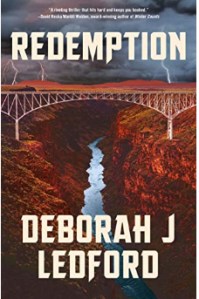
‘Redemption’ by Deborah J. Ledford

Some years ago, I was a fan of Ledford’s “Smoky Mountain Inquest Series” which I thought was exceptionally well written with a strong sense of place and wonderful action sequences. So I am happy to see a new novel coming out on September 1, the first of the “Eva ‘Lightning Dance’ Duran” series.

From Ledford’s website: “Two-Time Nominee for the Anthony Award in the Best Audiobook Category. Agatha Award winner DEBORAH J LEDFORD is the award-winning author of the upcoming Eva “Lightning Dance” Duran Native American crime fiction novel REDEMPTION from Thomas & Mercer Amazon Publishing, set in Northern New Mexico.

From the Publisher

“From award-winning author Deborah J Ledford comes a thrilling new series featuring a Native American sheriff’s deputy who risks it all to find a friend who’s gone missing.

“After four women disappear from the Taos Pueblo reservation, Deputy Eva “Lightning Dance” Duran dives into the case. For her, it’s personal. Among the missing is her best friend, Paloma, a heroin addict who left behind an eighteen-year-old son.

“Eva senses a lack of interest from the department as she embarks on the investigation. But their reluctance only fuels her fire. Eva teams up with tribal police officer and longtime friend Cruz “Wolf Song” Romero to tackle a mystery that could both ruin her reputation and threaten her standing in the tribe.

“And when the missing women start turning up dead, Eva uncovers clues that take her deeper into the reservation’s protected secrets. As Eva races to find Paloma before it’s too late, she will face several tests of loyalty—to her friend, her culture, and her tribe.”

From Ledford’s Website

“Before her career as a writer she worked for a decade as a professional scenic artist for motion pictures, industrial films, national commercials and live theatre. Due to her work on industrial films for clients such as Intel and Motorola, Deborah earned security clearance through the US Government. Highest acclaim is for her scenic artistry on the Coen Brothers’ film Raising Arizona.

“Part Eastern Band Cherokee, she spent her summers growing up in the Great Smoky Mountains of western North Carolina where her Smoky Mountain Inquest book series are set. She lives in the Phoenix, Arizona area with her extremely patient husband and their awesome Ausky.

“Member of: International Thriller Writers Association (ITW), Sisters in Crime National (SinC), Crime Writers of Color (CWoC), Mystery Writers of America (MWA), Past-President of Sisters in Crime Desert Sleuths Arizona Chapter, 2012-2013.”

Looks good!

Malcolm

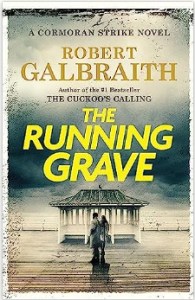
‘The Running Grave: A Cormoran Strike Novel’ by Robert Galbraith

I’m happy to see the upcoming release of a new Robert Galbraith detective novel, the seventh in the series of which I’ve read all but one.  The main character, Cormoran Strike, runs a detective agency that does its work without hacking into databases or traffic cams, but by old-fashioned boots on the ground, interviews, and stakeouts.

This assessment of the novels is especially apt:  “At Five Books, we take crime novels seriously, and the Cormoran Strike books are highly recommended for anyone who is into the genre. The tricks to keep you guessing or the surprise about ‘whodunnit’ are not quite as mind-boggling as Agatha Christie, but perhaps more realistic. The plotting is solid and satisfying, and doesn’t grate like in all too many contemporary crime novels.”

From the Publisher

“Private Detective Cormoran Strike is contacted by a worried father whose son, Will, has gone to join a religious cult in the depths of the Norfolk countryside.

“The Universal Humanitarian Church is, on the surface, a peaceable organization that campaigns for a better world. Yet Strike discovers that beneath the surface there are deeply sinister undertones and unexplained deaths.

“In order to try to rescue Will, Strike’s business partner, Robin Ellacott, decides to infiltrate the cult, and she travels to Norfolk to live incognito among its members. But in doing so, she is unprepared for the dangers that await her there or for the toll it will take on her. . .

“Utterly page-turning, The Running Grave moves Strike’s and Robin’s story forward in this epic, unforgettable seventh installment of the series.”

The books are long and I see that as good. Running Grave, to be released September 26th by Mulholland Books, gives you 960 pages of whodunnit. It’s listed by Amazon in the “International Mystery And Crime,” “Private Investigator,” and “Cozy Mysteries” categories.

–Malcolm

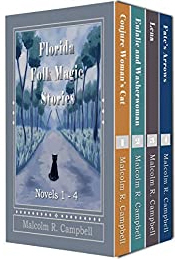
Malcolm R. Campbell is the author of the Florida Folk Magic Series, available at a savings in this four-book Kindle volume.

‘American Prometheus’ – Remembering the book that inspired the movie

“Oppenheimer’s warnings were ignored—and ultimately, he was silenced. Like that rebellious Greek god Prometheus—who stole fire from Zeus and bestowed it upon humankind, Oppenheimer gave us atomic fire. But then, when he tried to control it, when he sought to make us aware of its terrible dangers, the powers-that-be, like Zeus, rose up in anger to punish him.” American Prometheus by Kai Bird and Martin J. Sherwin (2005)

Before the United States was done with Julius Robert Oppenheimer (April 22, 1904 – February 18, 1967), he was declared a security risk by the Eisenhower administration. You learn this on the first page of this definitive, Pulitzer-Prize-winning book about a mystic and theoretical physicist who was as complex as his Nobel-Prize-worthy work that was far flung from nuclear weapons.

From the Publisher

American Prometheus is the first full-scale biography of J. Robert Oppenheimer, “father of the atomic bomb,” the brilliant, charismatic physicist who led the effort to capture the awesome fire of the sun for his country in time of war. Immediately after Hiroshima, he became the most famous scientist of his generation–one of the iconic figures of the twentieth century, the embodiment of modern man confronting the consequences of scientific progress.

He was the author of a radical proposal to place international controls over atomic materials–an idea that is still relevant today. He opposed the development of the hydrogen bomb and criticized the Air Force’s plans to fight an infinitely dangerous nuclear war. In the now almost-forgotten hysteria of the early 1950s, his ideas were anathema to powerful advocates of a massive nuclear buildup, and, in response, Atomic Energy Commission chairman Lewis Strauss, Superbomb advocate Edward Teller and FBI director J. Edgar Hoover worked behind the scenes to have a hearing board find that Oppenheimer could not be trusted with America’s nuclear secrets.

American Prometheus sets forth Oppenheimer’s life and times in revealing and unprecedented detail. Exhaustively researched, it is based on thousands of records and letters gathered from archives in America and abroad, on massive FBI files and on close to a hundred interviews with Oppenheimer’s friends, relatives and colleagues.

We follow him from his earliest education at the turn of the twentieth century at New York City’s Ethical Culture School, through personal crises at Harvard and Cambridge universities. Then to Germany, where he studied quantum physics with the world’s most accomplished theorists; and to Berkeley, California, where he established, during the 1930s, the leading American school of theoretical physics, and where he became deeply involved with social justice causes and their advocates, many of whom were communists. Then to Los Alamos, New Mexico, where he transformed a bleak mesa into the world’s most potent nuclear weapons laboratory–and where he himself was transformed. And finally, to the Institute for Advanced Study in Princeton, which he directed from 1947 to 1966.

American Prometheus is a rich evocation of America at midcentury, a new and compelling portrait of a brilliant, ambitious, complex and flawed man profoundly connected to its major events–the Depression, World War II and the Cold War. It is at once biography and history, and essential to our understanding of our recent past–and of our choices for the future.

From Kirkus Reviews

That Oppenheimer (1904–67) was a rare genius is beyond doubt; his colleagues at CalTech, Göttingen and Los Alamos were impressed to the point of being cowed by his intellect, and “Oppie” was far ahead of even his professors in the new world of quantum theory. He was a rare bird in other ways as well. A child of privilege whose very luggage excited discussion among his cash-strapped European colleagues, he identified early with left-wing causes and was reportedly better read in the classics of Marxism than most Communist theoreticians; and, though a leftist, he expressed enough fondness for the U.S. that those European colleagues sometimes thought him a chauvinist. Worldly in many ways, he was something of a naïf. In time, he shed some of his clumsiness and became the model of a committed intellectual, unusually generous in sharing credit with students and colleagues and able to wear his achievements lightly. (“I can make it clearer,” he once remarked of a thorny physics problem, “but I can’t make it simpler.”) The authors lucidly explain Oppenheimer’s many scientific accomplishments and the finer points of quantum mechanics. More, they examine his life in a political context, for, though one of the fathers of the atomic bomb, Oppenheimer warned against its proliferation and noted, as early as 1946, that our major cities were now susceptible to terrorist attack, the only defense being a screwdriver—to open “each and every crate or suitcase.” His prescience and conscience cost him dearly: Oppie was effectively blacklisted for more than a decade and rehabilitated only at the end of his too-short life.

A swiftly moving narrative full of morality tales and juicy gossip. One of the best scientific biographies to appear in recent years.
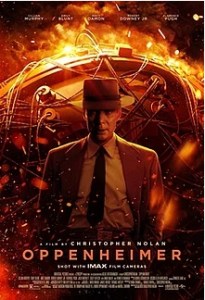
If the Christopher Nolan feature film has captured your attention and interest in the father of the bomb and you want to know more, American Prometheus is a good starting point. As Wikipedia notes, “The film was released on the same day as Barbie, a fantasy comedy film directed by Greta Gerwig based on Mattel’s Barbie fashion dolls and media franchise, and distributed by Warner Bros. Due to the tonal and genre contrast between the two films, many social media users created memes about how the two films appealed to different audiences, and how they should be viewed as a double feature. The trend was dubbed ‘Barbenheimer’. In an interview with La Vanguardia, Cillian Murphy endorsed the phenomenon, saying ‘My advice would be for people to go see both, on the same day. If they are good films, then that’s cinema’s gain.'”

–Malcolm
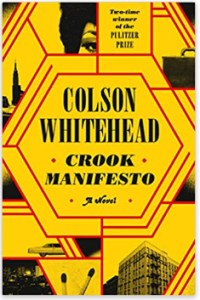
‘Crook Manifesto’ by Colson Whitehead

After writing about Whitehead’s Harlem Shuffle yesterday, I thought I might as well focus on its sequel, Crook Manifesto, which was released today by Doubleday. The book allows Whitehead to continue his focus on Harlem and treat his readers to the characters they got to know in Harlem Shuffle. The books are part of a planned trilogy. I like the Minneapolis Star-Tribune’s comment, “A masterwork of stylish noir and social satire … Whitehead’s larger project propels us forward, probing the whipsaw of race and the ouroboros of virtue and vice.”

From the Publisher

It’s 1971. Trash piles up on the streets, crime is at an all-time high, the city is careening towards bankruptcy, and a shooting war has broken out between the NYPD and the Black Liberation Army. Amidst this collective nervous breakdown furniture store owner and ex-fence Ray Carney tries to keep his head down and his business thriving. His days moving stolen goods around the city are over. It’s strictly the straight-and-narrow for him — until he needs Jackson 5 tickets for his daughter May and he decides to hit up his old police contact Munson, fixer extraordinaire.  But Munson has his own favors to ask of Carney and staying out of the game gets a lot more complicated – and deadly.

1973. The counter-culture has created a new generation, the old ways are being overthrown, but there is one constant, Pepper, Carney’s endearingly violent partner in crime.  It’s getting harder to put together a reliable crew for hijackings, heists, and assorted felonies, so Pepper takes on a side gig doing security on a Blaxploitation shoot in Harlem.  He finds himself in a freaky world of Hollywood stars, up-and-coming comedians, and celebrity drug dealers, in addition to the usual cast of hustlers, mobsters, and hit men. These adversaries underestimate the seasoned crook – to their regret.

1976.  Harlem is burning, block by block, while the whole country is gearing up for Bicentennial celebrations.  Carney is trying to come up with a July 4th ad he can live with. (“Two Hundred Years of Getting Away with It!”), while his wife Elizabeth is campaigning for her childhood friend, the former assistant D.A and rising politician Alexander Oakes.  When a fire severely injures one of Carney’s tenants, he enlists Pepper to look into who may be behind it. Our crooked duo have to battle their way through a crumbling metropolis run by the shady, the violent, and the utterly corrupted.

CROOK MANIFESTO is a darkly funny tale of a city under siege, but also a sneakily searching portrait of the meaning of family.  Colson Whitehead’s kaleidoscopic portrait of Harlem is sure to stand as one of the all-time great evocations of a place and a time.

From the New York Times 

“Returning to the world of his novel ‘Harlem Shuffle,’ Colson Whitehead’s ‘Crook Manifesto’ is a dazzling treatise, a glorious and intricate anatomy of the heist, the con, and the slow game. There’s an element of crime here, certainly, but as in Whitehead’s previous books, the genre isn’t the point. Here he uses the crime novel as a lens to investigate the mechanics of a singular neighborhood at a particular tipping point in time. He has it right: the music, the energy, the painful calculus of loss. Structured into three time periods — 1971, 1973, and finally the year of America’s bicentennial celebration, 1976 — ‘Crook Manifesto’ gleefully detonates its satire upon this world while getting to the heart of the place and its people.”

Malcolm