and now a word from our fantasy sponsor

My book reviews, interviews and posts on Malcolm’s Round Table, Magic Moments and Literary Aficionado are brought to you by, er, me.

Speaking of myself now in the third person, Malcolm R. Campbell is the author of magical realism, contemporary fantasy and satire published by Vanilla Heart Publishing of Washington State. While my noir satire, Jock Stewart and the Missing Sea of Fire, is set in a fictional Texas town with a really screwed up fictional newspaper, my three other novels are set in Glacier National Park, Montana and other places where I have lived or visited.

Last summer brought the release of Sarabande, a harrowing heroine’s journey and contemporary fantasy about a young woman who is haunted by the ghost of her sister. Sarabande seeks the help of a young man who has, on one previous occasion, bent time to “raise the dead.” The solution to the problem is not without its nasty down side.

Satire for your Nook

In 2004, I came out with the first edition of my novel The Sun Singer, the story of a young man whose psychic dreams ultimately lead him into a dangerous mountain world where it will take all of his skills to survive. First things first: he had to figure out who the good guys are and who the bad guys are and, as it turns out, who exactly he is. The second edition of The Sun Singer was released in 2010. College students at Lone Star College, Texas, read and discussed the novel this past Spring as part of a Wayfaring Heroes course.

Garden of Heaven: an Odyssey (also released in 2010) is magical realism about a man who grows up on a Montana ranch who loses his way when a failed love affair sends him down dangerous roads along which is is betrayed multiple times by those he cares about the most. The book is also available as an $4.99 e-book from OmniLit.

Where To Find Malcolm R. Campbell on the Internet

Excerpt from Sarabande

Only $4.99 on Kindle

Gem pulled her hands away and stood up so quickly she knocked over her spinning wheel. She didn’t appear to notice. She walked to the window and leaned out as though making sure no one else would hear her words.

“I was shamed by the king.” Gem pulled up her left sleeve to reveal the letters SJ in a bold pink scar that contrasted with her walnut-colored skin.

“Your strike brand!”

“I bore Justine’s mark as well as his child. Both were conceived in pain in a dark cell covered with urine and rat droppings.” Sarabande went to her, but Gem rolled down the sleeve, covering the ugly mark that signified Sovereign Justine. “No, my friend, I cannot abide your seeing it close at hand. My daughter, though, this doting mother will speak of her at great length if allowed to do so.”

“Cinnabar has shown me her brand,” said Sarabande.

“Discretion is a lesson I was never able to teach her. But listen: on your journey to Osprey’s house, you won’t walk through the domains of kings.”

Sarabande gasped and sat down, suddenly lightheaded when she understood why Gem showed her the scar.

“If there are no kings, what dangers have you seen?”

Gem put her hands on Sarabande’s shoulders and kneaded out the growing knots. Her touch always felt like a touch of power, and she wondered if she shared Osprey’s way with healing magic.

“I have seen a dark creek beneath a bridge on a foggy night. I have heard screams and howls outside my comprehension. I don’t understand it,” said Gem, holding their eye contact as though she understood more than she would say. “Sarabande, you know without my lecturing at great length about the ways of the world. A a woman on a lonely road can be a target. Travel with a sharp knife.”

The impromptu massage felt good. The unclear warning did not. Vague predictions were worse than silence. They stirred up what did not need to be stirred up.

“Yes, I know that, Gem. I will carry a knife and take care to have it handy.”

“With due care, you can avoid your fate, but destiny is the way you’ve already written your life’s story.”

“I wanted to walk the sixteen hundred and fifty miles to Osprey’s house long before it occurred to me I would ever do so. If there is to be shame in it, then I will live or die with whatever I find on that lonely road.”

Thank you for stopping my Malcolm’s Round Table today!

–Malcolm

Smoky Zeidel and ‘The Storyteller’s Bracelet’

Smoky and Tufa

Today I’m happy to welcome back author Smoky Trudeau Zeidel (On the Choptank Shores, The Cabin). Her new novel, The Storyteller’s Bracelet (out this month from Vanilla Heart Publishing) is a historical romance set in the late 1800s during the period when the U. S. Government forced Indian youths into boarding schools where they would learn the “American way of life.” (See my preview of the book here.)

Malcolm: What is a storyteller’s bracelet, and what gave you the idea of using one as the centerpiece in your story about two young Indians from the southwest?

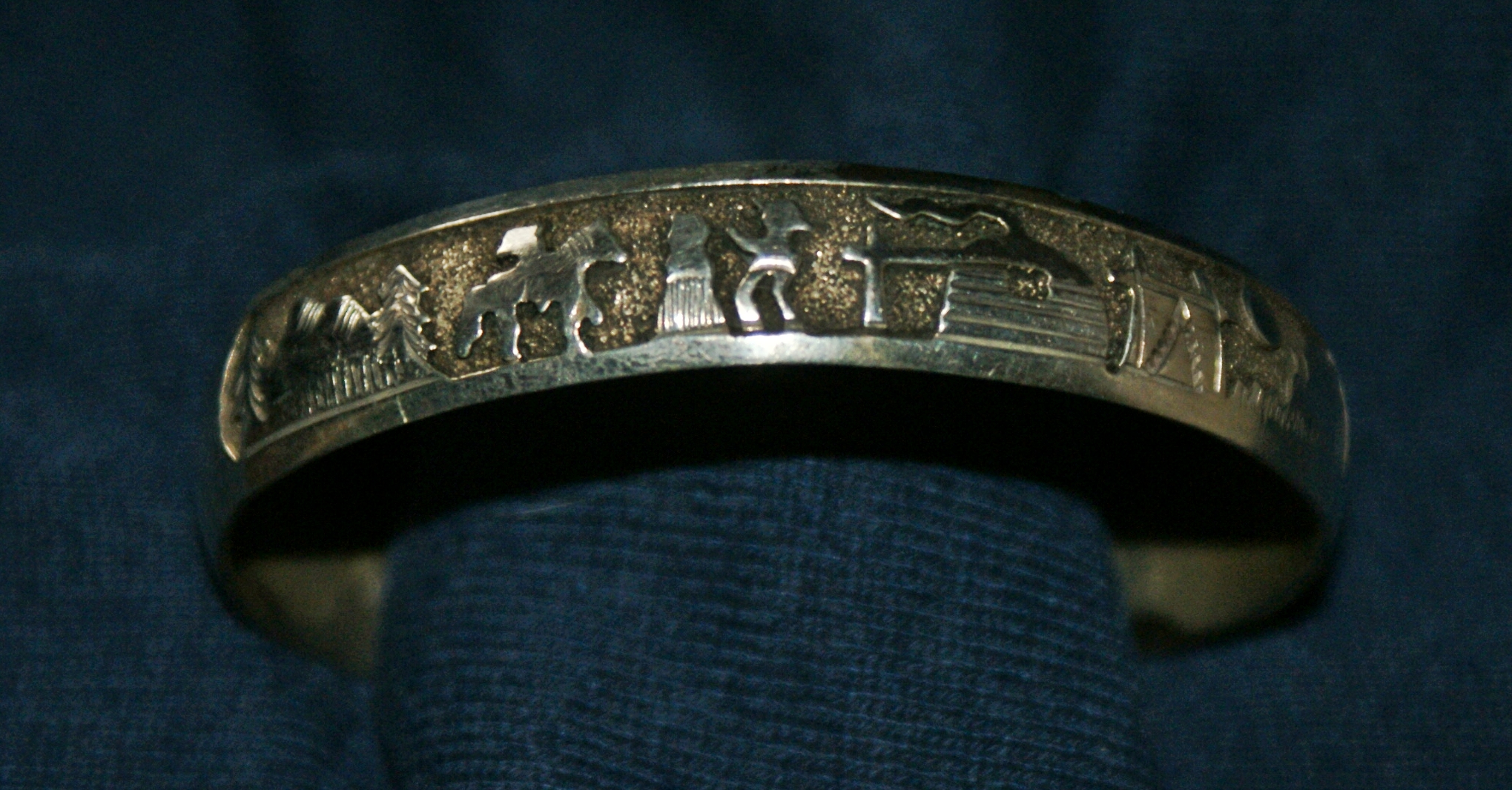
Smoky: A storyteller’s bracelet is a silver bracelet engraved with pictographs that tell some sort of story. My sister Bonnie gave me one as a gift about five years ago. I knew immediately I wanted to create a story about such a bracelet.

Malcolm: While the culture of Otter and Sun Song appears to influenced by the ways of the Tewa and Diné, your protagonists’ tribe isn’t identified in the novel. What led to your decision not to use a specific Indian nation for their background?

Smoky: You’re right about the Tewa and Diné/Navajo, but there also are Hopi influences in the story. I decided not to identify a specific tribe because I’m not Indian, and I didn’t want readers to presume that I am. I did not want to presume to know how a member of a specific tribe would act in any particular situation. Plus, I wanted to be able to pull aspects of different tribal lore into my story, especially when it came to telling the creation stories, because the different stories are beautiful. Also, by not identifying a particular tribe, I was able to bend the stories just a bit to fit the novel. I wouldn’t have felt right doing that if I had identified a particular tribe.

Malcolm: Like many young Indians, Otter and Sun Song were sent away to a white-run Indian school where the intent was to remove the students’ Indian language, beliefs, and culture and replace English, Christianity, and white clothing styles and laborer skills. Most of us didn’t hear about this in our high school history classes. It must have been difficult to place your characters into such an environment. How did you cope with this during the writing process?

Smoky’s Bracelet

Smoky: No, we didn’t hear about the Indian Schools in our history classes, just as we didn’t hear about the Japanese Interment camps. History often has overlooked the ugly things our culture has done, and these are just two examples of that. It was hard to place Sun Song and Otter in the school, but it was crucial to the plot. I also wanted to bring some awareness of what our government did to all the Indian Nations by ripping children and young people away from their tribes, their families, their culture. It was a shameful thing to do. Most of the time, when I was writing particularly tense scenes at the school, I raged at my computer. I felt really angry, even ashamed to have white skin. I guess, in a way, The Storyteller’s Bracelet is an apology to indigenous people everywhere for the way my birth tribe–white people of European descent–treated them.

Malcolm: The Storyteller’s Bracelet has a touch of magical realism in it, as does your earlier novel The Cabin. In both novels, the magic is a natural outgrowth of the places and the characters’ beliefs. Do you often wonder if such magic exists in “real life,” or do you approach it more as a viable storytelling technique?

Smoky: It is, of course, a viable storytelling technique, and is an integral part of the plot of The Storyteller’s Bracelet, as it was in my earlier novel, The Cabin. But yes, I do believe such magic exists in real life, at least for those of us who know how to tap into it. I’ve experienced it firsthand on several occasions. Does my body physically move from one plane to another in a different place and time, like in my books? No–at least, I don’t think so. But I have traveled to a cave in a faraway mountain range to converse with a Spirit Bear, and I have found myself transported to an island on a raft that is pushed by a great gray whale, with whom I also converse. Is it magic? Or is it imagination? I’m not sure there’s a difference.

Malcolm: Otter and Sun Song are in touch with their environment and treat wild creatures and special places there with respect.  This reminded me of your own approach to nature as you wrote about it in Observations of an Earth Mage. Did your own view of the natural world help you tell Otter’s and Sun Song’s story or did you have to “step away” from your own views to allow your characters’ views to be truly their own?

Smoky: No, I didn’t have to step away. Sun Song and Otter are like my own children–I created them, gave birth to them. It was critical to me that they shared my belief that we are all one with nature, neither above nor below every living creature, whether it be the smallest of insects or the powerful mountain lion or brown bear. We are nature. All of us. Intentionally harming any living thing is like harming a family member, for we are all the same, we are all one, to Mother Nature.

Malcolm: As a historical romance, The Storyteller’s Bracelet focuses on the feelings between Otter and Sun Song as well as the forbidden and dangerous feelings between Otter and the white girl Wendy whom he meets in the town where the Indian school is located. However, since these relationships unfold on a much broader canvas than the classic love triangle, were the two women a planned part of the plot from the outset or were you simply “following your characters” as you wrote when Wendy appeared on the scene?

Smoky: The two women were always in the planned plot, but they ended up being much feistier that I ever imagined. Sun Song, for example, in my initial story idea had a much smaller role than she ended up with. I ended up following her, because she made it clear this was to be her story as much as Otter’s. My planned original ending is nothing like how the actual novel turned out. Following Sun Song’s lead, I was able to work my way to these characters’ true story. And both I and the publisher, Kimberlee Williams of Vanilla Heart Publishing, think this story is much, much better than the one I originally planned.

Malcolm: Thank you, Smoky.

Where to find Smoky on the Internet

Website and Blogs

Author fan page on Facebook

Twitter

Amazon book listing

Book Review: ‘The Subversive Harry Potter’ by Vandana Saxena

Vandana Saxena has done a careful and credible job surveying themes of fantasy fiction and adolescence in The Subversive Harry Potter: Adolescent Rebellion and Containment in the J. K. Rowling Novels (McFarland, April 2012). Substantiated by the source materials, her approach views the years between childhood and adulthood as a time of testing, experimentation and rebellion that society allows and/or tolerates with the expectation that youth will ultimately enter “normal” adult society within the confines of generally accepted social and cultural values.

Saxena demonstrates that, paradoxically, young adult novels—such as the Potter series—not only facilitate the rebellious and experimental mindset of their expected readers (and protagonists), they also serve to contain it. J. K. Rowling, for example, leans heavily on the hero monomyth (hero’s journey) theme which, no matter how strange the journey, envisions the hero joining “normal society” once the quest is complete. Saxena correctly notes that the monomyth always arises on a foundation of the norms and beliefs of the culture or country where the story is set.

Rowling also draws heavily on the tradition of English Boarding School fiction that echoes what such schools were intended to do in society: mold raw, undisciplined youths into model citizens. Harry and the other students at Hogwarts are expected, by the powers that be at the Ministry of Magic, to play by the rules after they leave school in spite of their love of pranks and disobedience prior to graduation.

“The school story, as a narrative emerging from a specific cultural context and being situated in a socio-cultural institution like a school,” writes Saxena, “is doubly bound to the ideas and ideologies of its epoch.”

Hero, Schoolboy, Savior and Monsters

In addition to its focus on the literary and cultural traditions of hero and school themes, The Subversive Harry Potter explores Harry’s role as the savior of his magical world as well as that world’s marginalized monsters (giants, house-elves, werewolves) whom he and Hermione befriend out of their humanity and their defiance of societal norms.

Saxena points out that while Rowling’s books have often been criticized for their positive approach to magic and witchcraft, the series has two strong Christian themes. First, Harry becomes the savior who accepts death, not as a fearful end, but as a grace he receives while offering up his own life on behalf of his friends, fellow students and magical world. Second, love is called the strongest magic of all with a power so great that Lily Potter’s love for her son Harry lives on long after her sacrificial death on his behalf.

The hero, schoolboy and savior themes are not only skewed outside their normal linear evolution by the friendship and help of such outcasts as Hagrid, Dobby and Lupin, but by the presence of magic itself. Saxena’s study portrays adolescents—from the viewpoint adults—as “other,” that is to say, alien. However, within our consensual mainstream reality, magic, witchcraft and anything else regarded as supernatural, are much more alien.

The Subversive Harry Potter shows that, like Philip Pullman’s His Dark Materials trilogy, Rowling’s use of magic not only makes for exciting reading, but introduces elements that impact the protagonist’s expected evolution from adolescent/other to mainstream adult. It’s as though society is saying, “You can play with fantasy during your teenage years, but we expect you to grow out of it.” Yet, what if the supernatural is too strong and too compelling to leave behind? This is a “danger” society perceives in wildly popular fantasy literature as well as an interesting counterpoint to the hero, schoolboy and savior themes in the Potter series itself.

The Influence of “Queer Theory”

Saxena’s view of magic and fantasy within adolescent fiction is strongly influenced by her study’s reliance on “Queer Theory” as a means of exploring potentially discordant themes and values. As a post-structuralist critical theory that defines everything outside of society’s norms as “queer,” the theory would suggest that the hero/savior who exhibits a larger-than-life performance of his role is not exhibiting normal behaviors. The study suggests that magic further “queers” the functions of the monomyth, the boarding school theme, and the savior roles within the series.

While the words “queer” and “queer theory” in context within an academic study illustrate society’s view of everything different (including fantasy and magic), the tightly focused 1990s terminology is in my view unfortunate and out of date when extrapolated upon in 2012 for a wider research project.

“Queer analysis,” writes Saxena, “of the narrative of boyhood therefore reveals the essentially performative aspect of boy-to-man growth. The elements of fantasy and magic denaturalize this cultural project. The narrative of fantasy revolves around the power of magic, an illegitimate force whose presence in society has been characterized by simultaneous ubiquity and secrecy.”

The author’s role?

Unfortunately, the fantasy author’s role (if any) in either orchestrating or intuitively utilizing the hero, schoolboy, savior, monster and magical themes to facilitate/contain adolescent rebellion through instructional or inspirational storytelling was outside the parameters of the study. This leaves an open question about whether the themes explored in the study are overt elements of authorial intent or simply part and parcel of fantasy and hero’s journey fiction. Saxena shows that Rowling knew very well the traditions—within British society—of school fiction, the evolution of a hero, and of giant and elf folklore.  But she doesn’t explore whether Rowling intended for her fiction to impact adolescent needs within society in the manner viewed by theorists.

The Subversive Harry Potter grew out of a doctoral dissertation and, as such, is a formal academic study intended for literary theorists, psychologists, sociologists and other scholars. The retail price ($40 for a 218-page paperback) is within the realm of scholarly and professional publication pricing rather than that of general nonfiction.

For an academic audience, The Subversive Harry Potter meets its goals while providing fantasy authors and fans with some very interesting food for thought.

Malcolm

Malcolm R. Campbell is the author of magical realism and contemporary fantasy novels, including the hero”s journey “The Sun Singer” and the heroine’s journey “Sarabande.”

Briefly Noted: ‘The Armchair Birder Goes Coastal’

John Yow has followed up The Armchair Birder: Discovering the Secret Lives of Familiar Birds (Feb, 2012) with another handy bird book written in an anecdotal style called The Armchair Birder Goes Coastal: the Secret Lives of Birds of the Southeastern Shore (The University of North Carolina Press, May 1, 2012) which is a true wonder for birders, authors and others who want to know more about specific birds and their habits than the encyclopedic bird guidebooks present.

Yow writes with a lot of humor and insight. In the Anhinga entry, for example he starts off by saying, “Thought it’s seldom the most riveting aspect of bird study, I think in this case we better start with nomenclature. Nobody seems very happy with the name ‘anhinga.'”

He’s right about that. In Florida, we preferred calling them Snake Birds because they swam (or walked) under water with nothing but their long necks above the surface, looking like snakes with bills. Others called them Water Turkeys, though I have to agree with Yow in saying they look very little like turkeys.

In this book, we’re not talking mockingbirds and meadow larks. Think about what you saw on your last trip to a Southern beach or swamp: Black-Necked Stilts, Reddish Egrets, Wilson’s Plovers, Browm  Pelicans, Forster’s Terns and Black Skimmers. Illustrated with black and white drawings, this book is not for the vacationer with a short-term “what’s that” curiosity. The well-known photo-illustrated guidebooks will do for that. Yow writes for the reader who has time to sit a spell and watch and listen.

Author Janet Lembke is spot on when she writes,  “Infusing stories, observations, and musings, Yow makes it easy to learn about these fascinating birds. This book might well lead ‘armchair birders’ to become active birders, and eventually, conservationists.” There’s so much more to a bird than simply knowing what it is, and this book delivers the secrets that it usually takes a while to discover on your own.

Malcolm

contemporary fantasy for your Kindle

Inanna’s Heroine’s Journey – a drama for authors and seekers

“The world’s first love story, two thousand years older than the Bible—tender, erotic, shocking, and compassionate—is more than a momentary entertainment. It is a sacred story that has the intention of bringing its audience to a new spiritual place. With Inanna, we enter the place of exploration: the place where not all energies have been tamed or ordered.” – Diane Volkstein in “Inanna, the Queen of Heaven and Earth: her Stories and Hymns from Sumer”

Inanna, as envisioned by nikkirtw123 on Photobucket is strikingly close to my vision of Sarabande

As an author, I view my characters through a high-powered microscope and present the results of what I see as part of my stories. I will put you into the characters’ shoes if I can because—as Diana Volkstein writes—this is where the energies haven’t been tamed or ordered.

In my hero’s journey adventure Garden of Heaven: an Odyssey, I describe that place like this: “He knew him at the binary level where the line between matter and energy is barely discernible and often non-existent: Where urges pull at their chains, where drives push dumbly and drip sweat, where instincts race unchecked, where a horrifying sadness lies buried, where a raw pulse drums a cadence for the primitive rites of changing seasons, where white-hot impulses leap synapses in a shower of elemental fire.”

I wanted a similar, up-close focus in my heroine’s journey novel Sarabande. So, for the story of a woman seeking wisdom and wholeness, I could think of no better model than the myth of Inanna, a graphic dramatization of a woman’s inner journey to find herself outside the traps and trappings of a masculine world that has–as Sylvia Brinton Perera (“Descent to the Goddess”) wrote–forced the binary level of feminine power into dormancy for 5,000 years.

Or, as the late Adrienne Rich said, “The woman I needed to call my mother was silenced before I was born.”

Sarabande’s Heroine’s Journey

The journey in “real life”

In today’s terms, Sarabande was a tomboy. She was an expert with a knife, bow and arrow, a fishing pole, and everything she needed to know to survive in the wilderness. She learned all this from her father because her her mother believed women should only learn to keep a good home and not question society’s norms for women. However, Sarabande will never truly become herself as long as she is a disciple of either her late warrior father or her misguided, preachy mother. She is being taunted by a ghost that she must approach face to face in the ghost’s world.

Early on in her quest to rid herself of the ghost of her dead sister Dryad, Sarabande learns to see the world at a binary level: The lake, surrounding mountains and the cloud-draped sky broke apart into millions of colored specks. Sarabande leaned against Sikimí, even though he was no longer solid, and saw that her own light-pink hand was not solid either. In spite of her sudden dizziness, she did not fall. In fact, when her fingertips touched Sikimí’s side, a swarm of pink specks flew, like bees, into the permeable yellow gold of the horse, and when they did, their color changed to match the specks in their new environment.

But she doesn’t know what it means. So it is, that her quest to find and confront her sister follows the pattern of Inanna’s Heroine’s journey to confront her sister Eriskigal, Goddess of the Underworld. The underworld, in this case, is not the world of mobs and crime or “hell” in the Christian view, but the more dangerous world of the unconscious. Like Inanna, Sarabande will be broken, shamed and close to death before she learns who she is.

This is the heroine’s journey, to be buried in mother earth like a seed where she will be reborn with the spring into a new creation that finally has the freedom to follow the original injunctions of her destiny and her gender.

Malcolm

Review: ‘The Divine Comics’ by Philip Lee Williams

“In a great comedy, we are always made aware of the darkness in life, but the ending must be happy or it’s not a comedy. A man’s journey to wholeness is therefore most rightly named ‘The Comedy,’ for the end is the final awareness of that love which is the joy of the universe.” – Helen M. Luke in “Dark Wood to White Rose: Journey and Transformation in Dante’s ‘Divine Comedy’”

Philip Lee Williams’ magnificent “The Divine Comics: a Vaudeville Show in Three Acts” begins and ends with Whitman Bentley, a young man with gangly legs who’s been dreaming again, perhaps to escape the fact that among the eccentrics at The School of Music, he “may be the weakest, torn with every phobia in the catalogue.”

Since the novel’s back-cover informs readers that Williams’ novel reimagines and updates Dante’s “The Divine Comedy,” we know going in that Whitman Bentley will, to put it crudely, go to hell and back, after—as Dante might put it—the eccentric second-string symphony conductor awakes to find himself in a dark wood where the right road is wholly lost and gone.

En route to the ending of “The Divine Comics,” (which is pure poetry and white rose wonderment) the reader—as well as Williams’ huge cast of dysfunctional characters—may sense that that there is no right road and that the trickster gods (known as the Divine Comics, aka “The Lords of the Inner Kingdom”) are plagued with every manner of dark joke in the catalogue. Ah, but the chapters in “The Divine Comics” are called skits for a reason.

The novel’s three sections, “Fire,” “Earth” and “Air,” match Dante’s “Inferno,” “Purgatorio,” and “Paradiso.” “Fire” focuses on a school of music, “Earth” on the followers of a lady who takes her friends on a cruise to France where they will be well paid to treat her as their queen, and “Air” on a mixed group of artists, politicians and scientists who have been assembled as honored fellows at a rich man’s Rocky Mountain retreat.

Each troop of trekkers has its own farcical road of trials, puns, groaners, riffs, improvisations on every imaginable subject under heaven, and assorted terrors to follow, complete with a guide, until all the skits merge into one with the novel’s almost-overpowering crescendo of an ending. Like “The Divine Comedy,” Williams’ “The Divine Comics” has four levels of meaning: literal, allegorical, moral and mystical. While the novel has great depth and a near-infinite number of overt and covert references to music, popular culture, history and religion, it is a very readable and entertaining story.

At this point in the review, Dante purists may be wondering if any of the groups in the story is guided by Virgil. No, but there’s a good reason for that. Former used car salesman Al Carswell, who hosts Whitman Bentley’s group in the vestibule of hell, says that “the Big V” isn’t around much. “Last people he brought through was a bunch of Jaycees who died of ptomaine in Butte, Montana. After that, he turned sort of sour on things, don’t you know?”

Williams has done one hell of a job updating hell, purgatory and paradise for today’s savvy seekers of a great story and/or the white rose. Observers—such as the readers of this novel—left standing  in the dark wood for eternity will sooner or later shout, as James Joyce might put it, “Here Comes Everybody,” for Dante’s epic poem and Williams’ update some 690 years later are both masterpieces describing the human condition. This is not to say everybody must use “The Divine Comics” as a personal heaven and hell travel guide. After all, how will we know at any moment whether we’re in or out of Whitman Bentley’s dream? As Williams says many times in the novel as an author commenting on the story he’s telling, “It’s a question well worth our attention.”

“The Divine Comics” is, indeed a comedy. But rest assured that before you reach that happy ending, The Lords of the Inner Kingdom, will capture your attention and then leave you breathlessly rolling in the aisles at a Vaudeville show filled with enough black humor to last a lifetime, and then some.

Malcolm

Malcolm R. Campbell is the author of four novels, including the satire “Jock Stewart and the Missing Sea of Fire”

Briefly Noted: “The Storyteller’s Bracelet’ by Smoky Trudeau Zeidel

Available for pre-order on Amazon, “The Storyteller’s Bracelet” is a new historical romance from Smoky Trudeau Zeidel (“On the Choptank Shores,” “The Cabin”) with a June 22, 2012 release date from Vanilla Heart Publishing. Smoky will stop by Malcolm’s Round Table to discuss her book later this month. Meanwhile, you can learn more about Smoky in her interview with Shelly Bryant here.

Publisher’s Description: It is the late 1800s, and the U.S. Government has mandated native tribes send their youth to Indian schools where they are stripped of their native heritage by the people they think of as The Others. Otter and Sun Song are deeply in love, but when they are sent East to school, Otter, renamed Gideon, tries to adapt, where Sun Song does not, enduring brutal attacks from the school headmaster because of her refusal to so much as speak. Gideon, thinking Sun Song has spurned him, turns for comfort to Wendy Thatcher, the daughter of a wealthy school patron, beginning a forbidden affair of the heart.

But the Spirits have different plans for Gideon and Sun Song. They speak to Gideon through his magical storyteller’s bracelet, showing him both his past and his future. You are both child and mother of The Original People, Sun Song is told. When it is right, you will be safe once more. Will Gideon become Otter once again and return to Sun Song and his tribal roots, or attempt to remain with Wendy, with whom he can have no future?

Comment: Smoky and I share the same publisher, so in my view, it would be improper for me to review The Storyteller’s Bracelet. Yet, as I read an advance copy to prepare for our upcoming discussion, I couldn’t help but notice the great care Smoky has taken with her approach to the culture, beliefs and thoughts of her dual protagonists Otter and Sun Song. Since the title character in my novel Sarabande has an Indian heritage, I wrestled with the problem of accurately telling a story from an Indian’s point of view.  Smoky’s words ring true. What an absolutely wonderful book. This should be grabbed up as a classic.

Malcolm

contemporary fantasy for your Kindle

Review: ‘Should I Not Return’ by Jeffrey T. Babcock

“Denali, that Great Grail Castle in the Clouds continues to thrill and kill with each passing year. As of the fall of 2011, 133 climbers have perished on Denali, ever since Allen Carpe and Theodore Koven became the first to die on its icy slopes in 1932.” – Jeffrey T. Babcock in the dedication to “Should I Not Return”

When Jeffrey T. Babcock and his older brother Bill set out to climb the highest mountain in North America, Alaska’s 20,320-foot Denali (Mt. McKinley) in 1967, they knew before they reached “The Great One” that they would be tested in a dangerous world of rock, ice, snow and wind where every climber is at risk and may not return. They did stand on top of the continent on a cold and windy day that July, but en route to the summit, their Mountaineering Club of Alaska (MCA) team stared into the eyes of tragedy from an unexpected combination of events.

The MCA team was several days behind the twelve-person Wilcox-Snyder Expedition. A class-6 storm suddenly raged over Denali, separating the members into those who were able to retreat and those who were stranded high up on the mountain in the bitter cold blizzard conditions. Injured and greatly worried about the other members of their group, the descending Wilcox-Snyder team members met the advancing MCA team, made radio contact with the National Park Service to report their status, and then made their way off Denali. Due to its position on the mountain, the MCA team became the primary rescue group. Jeffrey and Bill Babcock found two of the dead; the others were never found.

The death of seven members of the Wilcox-Snyder group in one day has been called North America’s worst mountaineering tragedy. It has also generated a fair amount of controversy as the actions of leaders Joe Wilcox and Howard Snyder and the National Park Service have been scrutinized under multiple microscopes leading to multiple accusations of blame. Jeffrey T. Babcock, who went on to lead other climbing expeditions including another successful summiting of Denali, has spent a lifetime pondering whether or not the MCA team could have accomplished the impossible and saved any of the Wilcox-Snyder climbers. Now, most experts think not.  But nobody knew this during the summer of 1967.

Babcock has, to the extent it’s possible, come to terms with Denali in 1967 via his “non-fiction novel” Should I Not Return. While the novelization combines real life events from two climbs into protagonist Henry Locke’s coming-of-age climb of Denali on a team led by his brother Johnny, the book’s account of the tragedy and the rescue attempt is based on facts. The result is a compelling and accessible adventure story for a general audience as well as a riveting true-to-life account of a widely known mountaineering event for climbers familiar with techniques, routes and high-altitude weather conditions.

West Buttress of Denali – NPS Photo

Should I Not Return is richly illustrated with photographs from the MCA and other teams as well as sidebars containing historical information about earlier Denali ascents and the climbers involved. While the sidebars are nice time capsules for climbers and others interested in Alaska and its mountains, they can be skipped by those who prefer to stick with Henry and Johnny’s trial by wind and ice.

The emotional and practical need for young Henry—whom some of the other characters view as “Johnny’s baby brother”—to prove himself adds impact to the story. While Johnny and the other MCA team members know each other well, Henry is viewed as a neophyte easterner who will more than likely them back or put them at risk. The terror of the story is amplified because readers see events unfold through the eyes of the youngest team member rather than a veteran climber.

In addition to their geographical and historical value, the photographs serve the same purpose as the illustrations in adventure novels of an earlier era. For example, when Johnny falls through a snow bridge into a crevasse, an accompanying photograph of a Lower Ice Fall snow bridge on Muldrow Glacier demonstrates for non-climbing readers how precarious Johnny’s situation was. The inhospitable conditions Henry and the others face on that glacier is illustrated by a bleak photograph  (by the author) showing just how tiny a man is when he stands next to the sheer walls of Pioneer Ridge. While Babcock’s prose is strong enough to stand on its own, the pictures add greatly to the reading experience.

If Should I Not Return were the product of Jeffrey T. Babcock’s imagination, I would recommend it to everyone who loves compelling adventure stories. For mountaineers, the book adds immeasurably to the historical record of Denali from a very capable writer who was first on the scene of a controversial climbing tragedy.

Malcolm R. Campbell

Malcolm R.  Campbell is the author of four novels, including the 2011 contemporary fantasy adventure “Sarabande”

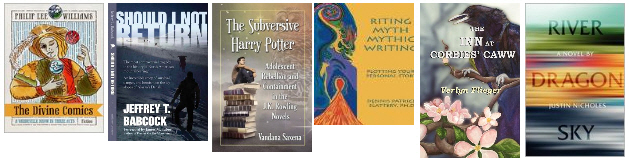
Upcoming Reviews: Williams, Babcock, Saxena, Slattery, Flieger and Nichols

I have a great list of books here on my desk to review, starting with The Divine Comics by Philip Lee Williams. Mr. Williams is somewhat responsible for the fact my reviews are running late, for his novel is a thousand pages long and, in spite of the fact it’s very readable, it’s taken me a while to finish. You’ll see a review of it next week after a break for a long holiday weekend.

JeffreyT. Babcock’s book based on the true story of a 1967 mountain climbing tragedy on Mt. McKinley will follow closely. I mentioned Should I Not Return in this morning’s post on Magic Moments, The Range of Light.

The Subversive Harry Potter: Adolescent Rebellion and Containment in the J.K. Rowling Novels by Vandana Saxena takes a look at teens, rebellion and the kinds of books that tend to support the rite of passage between childhood and adulthood as viewed through the lens of J. K. Rowling.

A fan of fantasy and folktales, I’m looking forward to reading Verlyn Flieger’s The Inn at Corbies’ Caww. A long-time Tolkien scholar, Flieger knows the territory and proves it with fine writing and a wonderful story. (I know this because I peeked into the book when it arrived.)

After mentioning Riting Myth, Mythic Writing: Plotting Your Personal Story by Dennis Patrick Slattery here on this blog on May 22, I decided that there was much more to be said. So, you’ll be seeing a review in the near future.

River Dragon Sky, Justin Nichols’ novel about a Taoist “street seer” in China has a noir feeling about it along with a lot of secrets. Nichols is also the author of Ash Dogs.

You May Also LikeMain Street Stories, by Phyllis LaPlante, reviewed by Smoky Zeidel on Smoky Talks Books. The author of The Cabin and On the Choptank Shores, Zeidel’s new novel The Storyteller’s Bracelet is coming out in June.

Malcolm

Briefly Noted: ‘Riting Myth, Mythic Writing: Plotting Your Personal Story’

“Myths are public dreams, dreams are private myths.” – Joseph Campbell

A new book by Dennis Patrick Slattery, a long-time researcher, teacher and author of mythology, depth and archetypal psychology, will help those interested in their own journeys and personal myths take a few more steps down the path.

New from Fisher King Press, Riting Myth, Mythic Writing: Plotting Your Personal Story uses 80 writing meditations to draw readers directly into the process rather than presenting facts and ideas in a lecture-style format. Those of us who write full time already know the power the writing itself has on the author during every writing moment. The book is the next best thing to a workshop in a sacred place with an experienced facilitator and other students of like mind.

In his introduction to the book, Michael Conforti writes, “Imagine sitting in an Irish pub, drinking ale and listening to the bard weave stories about so many different things, or perhaps captivated by the glow of an outdoor fire while listening to an elder telling stories about history, traditions, and ways to navigate the different life portals that each and every one of us will have to enter at some time. And then—there are stories about destiny, that illusive, mercurial something that catches hold of us at the beginning of life and never seems to want to let go. La forza di destino!! These are the experiences one has in knowing and working with Dr. Dennis Slattery. Whether sharing a pizza and beer or having the luxury of attending one of his lectures or classes, one is privileged to experience an authentic ‘elder’ who, in the tradition of all those wise ones who came before him, has the gift of bringing the world of myth and imagination to life and showing us that indeed these are as real as anything we can touch and hold in our hands.”

A pint of ale might go very well with this book.

Malcolm

The hero’s journey myth in a fantasy adventure