Once the barrage of lightweight summer books has come and gone, readers’ thoughts to turn fall reading and holiday gifts. To help us make our choices, the usual flurry of best books of the year articles and lists is showing up all over the Internet and in your favorite book stores. For this, you can always start with the list of 101 best books of the year on Publishers Weekly. (The feature has site errors in it, but click on OK and get past them.) Or you can look at USA Today’s list of fall books here.
Indie Bound publishes a “Next” list for upcoming books. Here are their favorites for November:
Likewise, Southern Independent Booksellers Alliance (SIBA) keeps up with bestsellers for bookstores in the southeast. Here’s the link to their hardbacks PDF. On the download, they’ve highlighted several books, including:
When people ask me about fiction and poetry, my answer depends on what (if anything) I know about the person. Do they like romance, fantasy, general fiction, crime? However, my three top picks of the year in fiction are:
And, for those who like poetry (I think Bryant’s latest book is only on Sams Dot Com):
I’m intrigued by these short stories, but they may not work for everyone:
In the crime category, I liked Robert Galbraith’s (J. K. Rowling) The Cuckoo’s Falling and Stephen King’s Joyland. In plays, I liked Elizabeth Clark-Sterne’s On the Doorstep of the Castle. Also, Tracy R. Franklin’s strong collection of poetry and essaysLooking for the Sun Door is a beautiful book. And, since a short story of mine appears in the anthology, I have to mention Spirits of St. Louis: Missouri Ghost Stories. Of course, I wouldn’t mind if you clicked on the banner below to take a look at my new contemporary fantasy The Betrayed.
I hope you find plenty out there for your to-be-read list and for the lists of your friends and family.
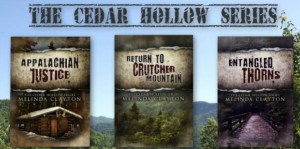
Today’s guest is author Melinda Clayton (“The Cedar Hollow Series”). Her new novel, a stunning tale about a family in the midst of self-destruction Blessed Are the Wholly Broken, was released October 16. Clayton, who has published numerous articles and short stories in print and online magazines, is a licensed psychotherapist in the states of Florida and Colorado. She holds an Ed.D. in Special Education Administration. She recently founded Thomas-Jacob Publishing described as a “unique family-owned publishing company.”
Clayton previously visited Malcolm’s Round Table in July of 2012 when her novel Entangled Thorns was released as the third book in “The Cedar Hollow Series.”
Malcolm: Welcome back! In your new novel Blessed Are the Wholly Broken, you move away from the Appalachian Mountain families in “The Cedar Hollow Series” to Phillip and Anna Lewinsky, a modern-day urban couple, living in Memphis. As an author, how difficult was it to shift away from the prospective “comfort zone” of an on-going series with known characters and established settings to a new environment featuring students graduating from college who are ready for careers and family life?
Melinda: Thanks for having me back, Malcolm. It was difficult, but I also felt it was time. There may be other Cedar Hollow stories, but the story of Phillip and Anna Lewinsky had been rattling around in my head for some time. I had also wanted to write a story set in the area of Tennessee in which I grew up, so that was fun. It was also fun to revisit the University of Memphis on Memphis’ rainiest day of 1989. I remember that day well. I was really tired of the rain, of being cold, and of getting soaked on my walks to both class and work.
Malcolm: At the beginning of the book, you quote a line from “In Place of a Curse,” a signature poem by John Ciardi: “They who are wholly broken, and they in whom mercy is understanding, I shall embrace at once and lead to pillows in heaven.” In addition to suggesting a unique title for your novel, how does this sentiment set the stage for the story to come?
Melinda: I think of Phillip as being “wholly broken.” This is a man who in his early twenties felt he had everything he needed to be happy. In his words, “I felt like the luckiest guy in the world. First job, first apartment, first girlfriend, best friend. What more could I have possibly wanted?” But by his mid-forties, when we first meet him in the Prologue, he feels he has nothing at all. “Life imprisonment or death; that is the question. And while the outcome matters immensely to the other players in this drama of my life, it matters not at all to me. I am dead either way.”
I wanted to explore that dynamic, the path one might travel that could lead from euphoria to despair, from hopeful to hopeless.
Malcolm: Asking a therapist why s/he writes about characters with deeply rooted psychological problems probably makes as much sense as asking a composer why s/he writes about characters who are struggling with a symphony. Yet, as I think about both “The Cedar Hollow Series” and Blessed Are the Wholly Broken, I can’t help but see the books’ characters as almost being—as we say in the South—“too broke to fix.” In addition to the page-turning read we all look for, do you think these novels will also help provide closure for readers who know people who seem wholly broken and/or who often feel they might be wholly broken?
Melinda: Wow, I might have to think about that for a minute! I think the “broken” characters in the Cedar Hollow Series have within them some spark of hope, enough, at least, to compel them to continue moving forward. One reviewer remarked that she loved it that those books all ended on a hopeful note, a type of new beginning for the characters. If there’s a message to those books, it might be something along the lines of each cloud having a silver lining, or there being a light at the end of the tunnel. Never give up; this too shall pass, etc.
I think Blessed Are the Wholly Broken is different in that within the first page, we know Phillip Lewinsky has been found guilty of the murder of his wife. One of the beta-readers called me midway through reading and said, “But he’s going to get out, right?” She found him to be a sympathetic, likable character and wanted a happy ending for him. I suppose a philosophical argument could be made that in a paradoxical sort of way, he was happy with the ending and he did find the closure he was looking for, but the writing of Wholly Broken was more about an examination of the unraveling of a life than it was about reaching closure.
Malcolm: How do prospective wholly broken people/characters impact the therapist/novelist?
Melinda: In some ways, the impact is the same for both the therapist and the novelist, in that I’ve always been fascinated by trying to discover what makes us all tick. Behavioral theory would say we don’t engage in a behavior unless we’re getting something out of that behavior. Maybe we’re being positively reinforced in some way, or maybe we’re trying to avoid something uncomfortable. That’s overly simplistic, but I think for the most part, it’s true.
As a therapist, part of finding the solution lies in finding the why of the behavior. Once a person recognizes and understands the purpose behind their behavior, they can choose whether or not they want to change it.
As a novelist, it’s fun to work to tie together a character’s motivations, choices, and decisions with their ultimate outcome.
Malcolm: After readers learn on the first page of Blessed Are the Wholly Broken that a crime has been committed, the novel moves about quickly from one time to another and from one place to another rather like a “whodunit.” I felt like I was reading a detective story. How did you approach your research for this, especially that involving medical, police, prison and courtroom procedures?
The dorms at Memphis State University (now U of M) where Phillip and Anna meet.
Melinda: This novel, by far, required more research than all three of my previous novels put together. I spent time both talking with and emailing medical and legal experts as well as making several phone calls to the Lauderdale County Jail to make sure I accurately portrayed not only procedures, but physical components of the building.
I sent hardcopies of the chapters dealing with medical issues to an expert in the field of microbiology, and chapters dealing with legal and courtroom procedures to the founder of a law firm in New York.
I wanted the book to be as true to the regions as possible, so I also researched weather patterns in that area during that time to make sure if it was raining in the novel, it really had rained on that particular day. I pulled up calendars from that time to make sure if court was held on a specific day in the novel, it would have really been held on that day in Ripley, Tennessee.
I think I probably spent more time on research than I did on writing. Everyone was incredibly helpful; if there are mistakes, they’re completely my own.
Malcolm: While Blessed Are the Wholly Broken was still a work in progress, you formed your own publishing company. How did the becoming a publisher change your perspective about what it takes to prepare and format manuscripts, and to publish and market a book? How did it change your viewpoint as a writer? Did becoming a publisher change your writing habits or approach or were you able to keep your publisher’s hat in the closet until the manuscript was done?
Melinda: Becoming a publisher in the middle of the writing process taught me that publishing is a lot of work! In some ways it stifled me as a writer because as I typed, I couldn’t help thinking, “Ugh, once I get done with this manuscript, I have to reformat it three different ways….” On the flip side, I loved having the ability to review and proof the finalized manuscripts before hitting “publish.” It was nice to have one last chance to check for any typos or formatting errors before going “live.”
Malcolm: Best of luck with Thomas-Jacob Publishing and Blessed Are the Wholly Broken. Where can prospective readers find you your novels on the Internet?
Melinda: Thanks, Malcolm! And thanks for the wonderful interview.
All of my books can be found through major retailers such as Amazon and Barnes & Noble. They’re also available through Smashwords, Apple, Sony, and Kobo.
When new authors offer free books on their blogs and on Amazon, they sometimes find there are very few takers. “It’s free, for goodness sakes,” they say and begin to wonder if there’s something wrong with their post, their Amazon page listing or the Internet.
In an era where readers expect free and/or cheaper books, let’s set aside the argument that people don’t really value what they don’t pay for. That’s a thorny question for another day.
The first problem an unknown author has with free books is simple: prospective readers don’t even know the books exist, much less that they’re free. Obviously, if J. K. Rowling or Stephen King make their books free for a weekend, everyone will know about it. News travels fast.
But, if you’re unknown, “free” doesn’t make you known. So, before you start with “free,” the stage must be set via blogs, Facebook and other networking sites. If you have a following, people will see your posts about an upcoming “free book weekend.” If you don’t have a following, find a subject related to the book to draw people to your post. People who don’t know about you won’t search for your book and your name, but they will be searching for trending topics that might relate to your book.
Okay, what if you have a huge following and few people download your free book? There are probably a lot of reasons. One of them is, of course, that people who follow each other are doing it primarily to get their names out there, not to buy anything.
More importantly, though, is the matter of the reader’s investment. “Free” might bring a book into a reader’s house when they already know about it and already want to read it. Or, if you’re writing nonfiction–where author’s name recognition is less important than fiction–people may download “free” when it’s about their hobby, career, favorite vacation spot, or a national issue they follow.
The primary reason “free” doesn’t work for unknowns who haven’t already created a lot of buzz is very simply this: the reader doesn’t want to spend the time to read the book. Readers expect a lot of bang for their buck; more to the point, while they may waste many hours a day playing games on the Internet or watching silly television shows, they’re more protective of their time when it comes to reading books.
Mental Algorithm: DO I PURCHASE THIS BOOK? DO I DOWNLOAD IT IF IT’S FREE?
Most readers have a figurative decision tree inside their heads…how long is the book…have I heard of the author…what’s it about…are other people reading it and saying nice things about it…is there already talk of a movie deal…how many stars and how many reviews does it have on Amazon…are Kirkus, Publishers Weekly, The Huffington Post, Flavorwire, Slate, Salon and the nearest metro newspaper talking about either the book or the author?
You see where that’s going. Each time the reader says “no” in the decision tree, the book becomes less likely to be downloaded for free, much less purchased.
We can argue all we want that the reader spends time and money on other things, things that may seem frivolous when compared to the book. The thing is, those other things are known things. On Facebook, Candy Crush Saga provides a certain kind of fun within known time frames. A Happy Meal at McDonalds provides a known eating experience.
What an unknown book, free or marked down, provides for the amount of time it will take the average reader to read it, is unknown. As long as it is, “free” will mean very little to prospective readers who are already zoned out and maxed out by the thousand other prospective free/cheap books they can download today, tomorrow and for the rest of their lives.
“Free” may be nice, but it isn’t magic. You need better than free to tempt your readers.
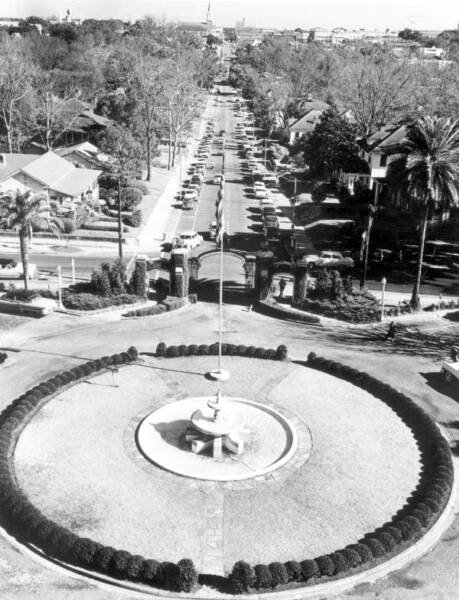
College Avenue in 1964 looking from the unniversity toward downtown
I grew up in a town where College Avenue led straight from the main business district to the university’s main gate. I liked the sweeping hill, the brick paving, and the older homes that owned the street as it drew closer to the university’s administration building. As I wrote The Seeker, College Avenue at night looked like the perfect place for a stalker.
And I knew exactly where that stalker would come from: the university library. I worked there as a student assistant to help pay the bills. It was my favorite place on campus except for the fact somebody there was spying on young women. He pushed books out of the shelves in a signature way so he could, apparently, look up dresses and ogle legs.
We never caught him. One minute an aisle leading through the open stacks was pristine; the next minutes there were books on the floor. I often wondered what kind of a sick person was on the loose. I never knew, but my imagination supplied plenty of details for the 1960s-era College Avenue chapter of The Seeker.
Protagonist David Ward is there in the dream world because he fears the stalker is following his girl friend Anne Hill. There’s little he can do, though, but watch the night unfold. He feels as powerless as I did in the library trying to get “the library guy.”
Except from The Seeker
Kindle Version
David stood at the corner of College and Monroe in Tallahassee, Florida. To the north: the primary downtown business area, including the Florida Theater, which was showing Send Me No Flowers with Rock Hudson and Doris Day. To the west: the State Theater presented Elvis Presley in Roustabout. Farther west, College Avenue grew dark as it approached the university and the night beyond.
He dreamt and he knew he was dreaming. The sounds of the city were clear and, so, too, the conversations of the people on the sidewalk between the theaters, and some of their thoughts as well, expectations of popcorn, concerns about recent exams and questions about who they would see this evening and whom they would be with. Unlike his standard dreams, David walked like a ghost, unseen and unheard among the students and family groups and scattered grandparents. Yes, he could follow Anne or Nick or even RC without their knowledge. But if danger threatened, he could shout no warnings nor take any action.
He walked north and found Anne in front of the Florida Theater with Marta and Karen. Karen and Marta wanted to go out to a hamburger place with three students in a double-parked car. Anne didn’t.
“I’m fine, just a bit of a headache,” she said.
“We should stay together,” said Marta.
Staying together is smothering me.
“The streets are crowded,” said Anne. “It’s a safe night for walking back to the dorm.”
The car pulled away and Anne walked toward College Avenue with David, though she didn’t know it. Her hair was in a ponytail and she wore a light blue sweater against the gentle chill of the evening. The rivers of people coming and going from the theaters converged at College Avenue with cars driven by dates, friends, and parents in a clamor of horns and shouted greetings.
Very few people are walking toward the campus. The hill is dark past Schwobilt’s Department Store and the Baptist Church. Not good. Somebody’s whistling off key across the street. Maybe I should see Roustabout. Afterwards, perhaps a group of students will head back toward from front gate.
David also heard the whistling, but he saw no one there, heard no thoughts to follow within the rag-tag, repetitive “Lord, I Want to be a Christian” that swirled like an ill wind around the YMCA building and several small clothing shops across the street.
Anne hovered hear the ticket booth within the safe glow of light beneath the marquee.
“Go inside, Anne,” he said. While she didn’t hear him, David heard her think of him, wishing she had invited him down for Thanksgiving. The young woman in the glass booth looked up, smiled.
David would hate Roustabout, but at least he would be here.
“I’m thinking about it,” said Anne.
This is silly.
She looked at the movie posters in the glass cases. Glanced across the street, and then walked away, comforted—he could tell—by the elderly couple standing in front of the jewelry store. She heard them talking about wedding rings and didn’t want to intrude. The Big Bend Bookstore caught her eye. She tried the door. It was locked.
Why are they closed so early? A good night for strolling, movies, and bookstores. I could pick up a copy of Herzog even though Marta thinks it’s strange.
Except for the wedding ring couple and the two girls looking at clothes in the Schwobilt’s window, people were disappearing into the night. The lady in the ticket booth turned off her light after putting up a SOLD OUT sign. Anne stood in front of the bookstore looking at the stacked up bestsellers for ten minutes. David saw a few tempting titles, but then, he wasn’t really there.
But he who whistled that song was there.
He’s watching me.
David stared past the clothing shops toward Monroe Street. Nobody. The notes we louder now and more off key, rather like the sound from a poorly made slide whistle prize out of a cereal box.
“Anne, go inside the theater.”
In my heart, in my heart, in my heart. Damned mocking notes, it’s “Nick of Time” Nick looking for girls to pray with him and then what, a private communion?
The song unsettled her. She hurried across Adams Street and tried the locked door at Schwobilt’s as the notes of the song grew closer, then farther away; there were no polices car in sight, no wedding ring couple, and no RC.
The dorm will be safe. No men in the hall.
David walked through every shadow and looked around all the corners, but the tune was everywhere at once.
The church was locked.
No sanctuary here. Just: “ … be a Christian, to be more loving, to be more holy, to be like Jesus,” over and over like a 45 rpm record stuck on a turntable replaying until the power fails.
–
If I were to visit my old hometown today, I seriously doubt I’d feel comfortable walking down College Avenue at night: I’ve seen that stalker scene so many times, the street has changed.
Today’s guest on Malcolm’s Round Table is Kelley Hazen, an artist who has appeared in multiple stage, screen and television productions. You may have seen her in “Nightingale in a Music Box,” “What Women Want,” and “Grey’s Anatomy.” She also lectures for the renowned Griffith Observatory in Los Angeles, CA.
Recently Kelley founded Storyteller Productions in Southern California with her husband, Bruce Carver. The boutique, state-of-the-art studio offers full recording services featuring intuitive narration. My three-story collection called Emily’s Stories, from Vanilla Heart Publishing, was Storyteller Productions fourth audio book.
Malcolm: When I listened to your narration of “Emily’s Stories,” I was reminded of my childhood when parents and grandparents read my favorite books to me on long, rainy afternoons and before I fell asleep at night. How do you achieve the being-there-with-the-listener effect?
Kelley: We have an amazing microphone – the vintage Sound Deluxe E49 – we selected that mic because of its perfect union with the timbre of my voice. As an artist and reader of audiobooks, I strive for a sense of…almost “sitting on the listener’s shoulder,” a quality of being in their heads, in their imaginations – a very intimate experience. I think when you combine that artistic goal with the technical mechanics of the right hardware you have the opportunity to create that sense of “being there with the listener.”
Malcolm: When you appear on the stage or work as a lecturer at the Griffith Observatory’s planetarium, there’s constant feedback from the audience. Is it difficult to change mindsets and figuratively work in a vacuum with voice-over work and audio book narration?
Kelley: No not at all, it’s actually strangely freeing because quite simply the story’s the thing. There is no hidden agenda, no coughing while I’m trying to make a point. : ) It’s just me, the mic, the story.
Malcolm: Can you walk me through what a typical narration project includes beginning with the first time you see the book or printed manuscript through the final production of the audio file? How do you prepare?
Kelley: We’ve usually gotten a feel for the book or the writer by either submitting an audition or pitch for the book, or because we’ve dealt with the publisher or author before. So we’ve either seen excerpts or been able to ascertain some sense of who we are dealing with. We believe that often, if not always, artists (writers/actors/publishers & editors if they do their job fully) have an underlying sense of how they want to be perceived in the world, what message they are sending, how they want to impact the greater good. At Storyteller we try to embody that – after all we are a conduit to get across the message that the writer is trying to convey by gathering these particular words together in this way.
Malcolm: I like that approach. Once you grok the story and its message, what additional preparation do you have?
Kelley: Then we just start breaking it down – a chapter at a time. That’s why it is most helpful when an author can send us the manuscript in electronic form. Although I will say our last two books were old school – regular ‘ol page-turning bound books. And it was a welcome respite from iPad’s and Word docs. But we always need two copies because the engineer, my husband Bruce, follows along as I record to watch for missed or mis-spoken words, but also has his own notations as he works for the editing and clean up. So I take it a chapter at a time – realizing the story, assessing the number of characters and their demands, looking up words I don’t know, learning languages.
Pine Siskin
Our last two books – I learned fragments of three different languages and multiple dialects for the 25+characters in Petty Magic. For Maria of Agreda: Mystical Lady in Blue, a nonfiction about the life and efforts for canonization of a 17th century cloistered nun, I not only had to go to school to understand the Old World process of becoming a saint, but since the book was almost entirely set in Spain, accurate pronunciations of Kings, Viceroyalty, Popes, cities, mountain ranges, etc. were essential. For Emily’s Stories I found pictures of the birds that became such important characters for Emily and clips on YouTube by avid birders who had recorded the cry of each of these birds. Then when I gave the bird characters voices or imitated their calls, I tried to make it sound as much like that bird in real life as I was able. Also something just as simple as knowing where to take the breath to maintain the understanding of a line as it is read. All this work is done beforehand.
Malcolm: The pine siskin in my story “High Country Painter” thanks you! There’s more pre-narration work involved here than I imagined.
In the Studio
Kelley: Then we go into the studio and begin to record. We have to make sure that I don’t consume too much dairy so there is not too much phlegm to cause constriction in my voice. I have to eat so my stomach doesn’t growl. You would be amazed at what the intimacy of and the quality of these current day mics can pick up. It’s like HD for the ears. We usually record in two hours sessions. We can often do two session a day depending on our schedule. We keep separate files of snippets of new characters when they come along, once I’ve found their voice, so that when we come back to them I can hear how I did it the first time and keep it consistent. Consistency is key for the structure of a good audiobook.
Malcolm: Do you alternate the studio work and the preparation ?
Kelley: Anywhere from two to five chapters are prepped at a time. And during my prep time Bruce begins to edit. He listens to the whole thing all over again watching the book to look for missed words or times when I started again on a section but also any kind of outside noise or mouth noise or popping. He looks at an actual wave of my voice frequency–its in a program called Pro Tools. So he can hear but also see when extraneous sounds are present and cut them out or re EQ them by changing the sound around the errant noise. If I’ve missed anything or there is anything he can’t get out, we have a fix session.
Kelley also narrated “Hunting Heartbreak” by Vanilla Heart author Marie Hampton.
Then he renders the files from a very sophisticated WAV file that is very “lovely dark and deep” to an Mp3 format which is a much smaller file and easier to download, etc. And then we “deliver” the book electronically to the publisher. Usually they have some kind of review process and if they find any mistakes, they write us and tell us, we fix it, send it again. And at some point they sign off and it goes up for sale. But just as important as consistency, there is a point where I must get lost in the story, become enveloped in it and in the world the writer has created. And that is the lift off, the miracle, the joy of it for me.
Malcolm: On your Facebook page, you said narrating a book is almost like living in your own imagination. How does this differ from getting in character and performing in front of a camera or an audience?
Kelley: When I am in front of a camera or an audience I am always aware they are there. That awareness gives me information to shape my performance to be effective. When I am reading in my dark little room behind my heavy sound barrier curtains and walls, I can be transported in my imagination anywhere I want to go, anywhere the authors take me, and no one is looking. I am there – wherever “there” may be. It is very easy to get lost in the moment, to be completely free. It is, quite literally, transcendent.
Malcolm: What led you and Bruce Carver to start a recording studio that includes the production of audio books?
Kelley: When you try to make a living via your art, all the work you take is not always as fulfilling as you hoped it would be. Particularly for an ‘educated’ artist – I’m an MFA, Florida State/Asolo Conservatory and Bruce is a Masters of Music, Northwestern Univveristy. That sounds very snobbish. Don’t get me wrong. It’s great, fun work when you get it, but also, – well let’s put it this way – I’ve played about a dozen different moms for TV whose child has been either murdered, raped, kidnapped, abandoned, abused, molested… the list goes on.
Likewise, I lost my dad in 2012 and that is always a big wake up call. Bruce and I at the same time came to the realization we wanted to do work we cared about, we wanted to do work that moved people, that felt important, we wanted to support other artists who were trying to get their voices heard, we wanted to work together, we wanted to hold the reins and we wanted to be able to take our dogs to work. Go to the Dog Blog page on my website. and you can meet Angel and Maggie – our husky and lab/chow that work on every book right beside us. They are Quality control.
Malcolm: I like the great critter pictures. Our three cats are constantly checking up on me while I write, purportedly for quality control purposes. In addition to the audio books, what other projects do you have at Storyteller?
Storyteller’s home page backdrop.
Kelley: We are also very excited that we are about to embark on a new recording angle – audio description. Audio Description has been described as “a literary art form. ” It’s a type of poetry – a haiku. It provides a verbal version of the visual: the visual is made verbal to convey the visual image that is not fully accessible to a significant segment of the population. These services apply in various multimedia settings including theater, dance, opera, television, video, film, exhibits, museums, educational venues, but also circuses, rodeos ice skating exhibitions and a sporting events.” The 2010 Telecommunications Act, signed into law by President Obama will, in a series of progressive requirements, make audio description a required part of our cultural accessibility. I am attending a conference this week, offered by the American Council for the Blind & the Audio Description Project to learn those skills and Bruce and I would like to make that a part of the services we provide in our studio.
Malcolm: How do coordinate studio work with the ever-shifting demands of the film and television productions in which you appear?
Kelley: Because film and TV are ever-shifting its become a way of life for us. Because our studio is in our house we can ‘go to work’ whenever we want or need to – Middle of the day or middle of the night. But also because our lives are ever-shifting we decided to pursue our own business in recording for some structure, some calm, some control.
Malcolm: Where will film and television audiences see you next?
Kelley recently told the story of Mexico’s Popocatepetl volcano as part of the observatory’s “All Space Considered” lecture series.
Kelley: I have a new independent film coming out this fall, BLACKMAIL – very fun, smart, black comedy about truth and consequences. Also a new comedy BOOT THE PIGEON is in production, about dating and the adult male. Bruce will be the signature sound for the upcoming Starz series (pirate prequel to Robert Louis Stevenson’s Treasure Island) out in Jan 2014, BLACK SAILS. Like us on Facebook at Storytellerproductions and we will keep you up to date on what we are up to.
Malcolm: Thank you for visiting Malcolm’s Round Table, Kelley.
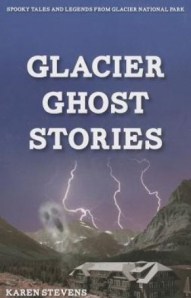
Karen Stevens (“Haunted Montana,” “More Haunted Montana”) has been collecting Montana ghost stories for thirty years and has been visiting Glacier National Park for forty years. Glacier Ghost Stories brings her passions together in a slim, but informative volume that follows her search for strange and inexplicable events at the park’s historic hotels.
Steven’s book is, in one sense, a reporter’s travelogue: she talks about her investigative trips, the weather, the accommodations, and her interviews with hotel personnel. In the process, she includes a fair amount of park history with details for each hotel: Apgar Village Inn, Belton Chalet, Glacier Park Lodge, Lake McDonald Lodge, Many Glacier Hotel, Prince of Wales Hotel and Sperry Chalet.
Glacier Park Lodge celebrated its 100th anniversary this summer. The other hotels are elders in the lodging business as well. The hotels are busy during their short summer seasons. They’re isolated from the world throughout the rest of the year. The schedule and the wild country are, it seems, the perfect recipe for legends, yarns and a long list of things that defy logical explanation.
While they don’t advertise ghosts in travel brochures, hotel managers and long-time employees had a lot to day about things that go bump in the night: people who suddenly disappear, objects that move when nobody’s looking, doors that lock by themselves, music and other sounds from unoccupied rooms, footsteps in the dark. Stevens includes the room numbers where things seem to happen. Take note of these before your next visit.
Glacier Ghost Stories includes legends about Marias Pass, Going-to-the-Sun Road, Two Medicine Valley and the Belly River. In the book’s postscript, Stevens writes that visitors to Glacier and Waterton parks “follow in the footsteps o those who came before us: Native Americans, trappers, hunters, explorers and others whose spirits even today may roam the land they loved so much in life.”
Stevens does not hear about or witness the over-the-top paranormal happenings we associate with Edgar Allan Poe and Stephen King. She did uncover enough to make us wonder and to look over our shoulders the next time we visit any of the park’s hotels. The book is an engaging portrait from a ghostly point of view.
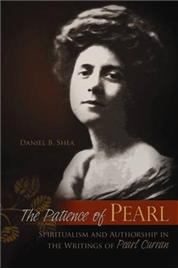
“The Patience of Pearl: Spiritualism and Authorship in the Writings of Pearl Curran,” by Daniel B. Shea, (University of Missouri Press, November 2012), 296pp, 15 illus.
Pearl Lenore Curran, a St. Louis music teacher, wrote (or possibly channeled) multiple novels and hundreds of poems between 1913 and and 1937 under the name Patience Worth. Curran was not a spiritualist. She tried out a friend’s Ouija board and, depending on one’s viewpoint, she began communicating with either her subconscious mind or a discarnate entity who lived in England in the 1600s.
The lure of spiritualism brought many people to Curran’s door, some of who listen to the readings, reported the phenomena in books and newspapers, and even spoke with Patience through Mrs. Curran. Some suggested Patience was a real spirit. Others said Curran was being coached, for she had no educational background for speaking and writing about 17th century England using many words and phrases that were not common in the 20th century United States.
Regardless of the source of the material, it was not only voluminous, but attracted rave reviews. To learn more about Curran and Patience Worth, see the September 2010 “Smithsonian Magazine” article “Patience Worth: Author From the Great Beyond.”
Like books such as Irving Litvag’s Singer in the Shadows: The Strange Story of Patience Worth and Casper Yost’s Patience Worth: A Psychic Mystery, the “Smithsonian” article focuses chiefly on historical facts and the opinions of spiritualists. Professor Shea’s The Patience of Pearl focuses on the works themselves within the scope of Curran’s life and Patience Worth’s literary voice.
In his introduction, Shea writes that “it does seem odd that a woman who wrote with brief but notorious success less than one hundred years ago could still be, as Lucky Jim once put it, so strangely neglected.” He suggests that the way they were written discredited them from the beginning as part of spiritualism’s table tapping and purported revelations from entities from another time or place.
From the Publisher: “The Patience of Pearl uncovers more of Curran’s (and thus Patience Worth’s) biography than has been known before; Daniel B. Shea provides close readings of the Patience-dictated writings and explores the historical and local context, applying current cognitive and neuro-psychology research…Novelistic in its own way, Curran’s life included three husbands and a child adopted on command from Patience Worth. Pearl Curran enjoyed a brief period of celebrity in Los Angeles before her death in 1937. The Patience of Pearl once again brings her the attention she deserves—for her life, her writing, and her place in women’s literary history.”
In one of her poems, Patience/Pearl wrote:
Lo, are my songs like birds
Within a wicker hung, and thou,
Beloved, hast loosed the latch
And let them free!
Glacier Park Lodge: Celebrating 100 Years, byChristine Barnes, photography by Fred Pflughoft, David Morris, and Douglass Dye, Farcountry Press (May 2013), 64 pages.
The Swiss-style Glacier Park Lodge on the eastern side of Montana’s Glacier National Park was built by the Great Northern Railway (now BNSF) one hundred years ago as a tourist destination for railroad passengers. While the railroad sold its lodging facilities in 1957 and ended its passenger service in 1971, the rustic hotel with its central roof supported by massive Douglas firs has endured through the years as the “Gateway to Glacier.”
Christine Barnes has captured the spirit of the historic hotel with an accurate overview of “Big Tree Lodge” accompanied by an extravagant collection of archival and color photographs in GlacierPark Lodge: Celebrating 100 Years.
If the Great Northern Railway’s transcontinental route from Minnesota to Washington was the grand dream of tycoon James J. Hill in the late 1800s, the hotels and chalets built by the railroad at the dawn of the new century were the great vision and legacy of Hill’s son Louis W. Hill.
“Louis had taken over from his father, James J. Hill, in 1907, but temporarily stepped down in December 1911 to devote his time to railway-financed projects in and around Glacier National Park,” writes Barnes. “‘The work is so important I am loath to [entrust] the development to anybody but myself,’ he explained to the press.”
As a book of memories, GlacierPark Lodge: Celebrating 100 Years describes the establishment of the park in 1910, the building of the hotel in 1912 and 1913, the railroad’s back-country chalets, and the area’s mountains and wildlife. The book includes a bibliography of standard Glacier references, recipes from the hotel dining room and travel information.
With the help of three talented photographers, Barnes’ experience as a veteran chronicler of old hotels allows her to distil salient facts and images into this small-format book in an accessible style. Her other books include Great Lodges of the West, Old Faithful Inn at Yellowstone National Park and Great Lodges of the Canadian Rockies. She was the senior consultant and historian on the PBS series Great Lodges in the National Parks which included two companion books.
GlacierPark Lodge: Celebrating 100 Years is a perfect introduction to the hotel for first time visitors and a keepsake for long-time hikers, climbers and other enthusiasts of the Crown of the Continent.
–
In addition to three novels partially set in the park, Malcolm R. Campbell is the author of Bears; Where they fought: Life in Glacier Park’s Swiftcurrent Valley and “High Water in 1964” in the National Park Service’s Glacier centennial volume A View inside Glacier National Park: 100 years, 100 Stories.
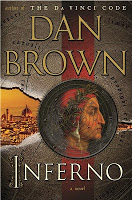
Three things are clear about Dan Brown’s novels: The reviews don’t matter because fans are more addicted to them than drugs. Years from now, his fiction will comprise the body of work most-often associated with the spate of globe-spanning puzzle novels linking historic events to modern day criminal plots, even though the form was pioneered by Katherine Neville in The Eight. And, while his style continues to evolve, every book he writes will forever be chasing the sensation of The Da Vinci Code.
Inferno is another Robert Langdon thriller that mixes exotic locations (Florence and Venice) and ancient symbols and texts (Dante and The Divine Comedy) with a world shaking danger (the threat of a plague). Brown uses an interesting plot device here: Landgon wakes up in a Florence hospital with a head wound and retrograde amnesia. He has no idea why he’s in Florence and who may or may not be trying to kill him. (It becomes clear before he leaves the hospital room that somebody is.)
He must simultaneously solve the puzzle of symbols linking a prospective plague threat from a genetic engineer concerned about reducing the world’s population and the personal puzzle about his nightmarish dreams and how they’re connected to the story’s prospective heroes and villains. While solving the puzzle, Langdon and Dr. Sienna Brooks find numerous secret doorways and panels, life threatening moments and people who are determined to stop them for reasons as yet unknown.
In the past, Brown has been criticized by using endless historical and cultural monologues from Langdon and others to fill secondary characters in on the importance of historical events and their related symbolism. Obviously, this device was used as a way of telling the readers how centuries old stories and symbols played into the solution of an urgent problem of the present day.
Brown has toned down those monologues a great deal in Inferno and provided dialogue that more naturally fits into a story with one chase scene after another. You will no longer find five-hundred-word Langdon lectures being delivered while the bad guys are only seconds away. You will find a lot of Florence and Venice travelogue.
Brown describes the streets, museums, and ancient buildings in exhaustive detail. Imagine being chased across a town by the bad guys while having the luxury to notice every building, monument and street corner along the way, including those that don’t pertain to the story. The descriptions slow down the action but are easy to skip.
The descriptions also serve the plot because they tie into Dante and to the mad scientist who’s a Dante aficionado. The travelogues allow physical time to pass in the novel so that Langdon will have an opportunity to process the symbolism as well as the returning snippets of his fragmented memory.
Brown has done a good job stirring the characters into an ever-changing mix of people who–at any given moment–might be trustworthy or untrustworthy. The characters’ motivations and allegiances aren’t engraved in stone. The novel’s over-arching themes are the dangers of overpopulation to humankind’s survival and whether or not one should use cutting-edge advances in genetic engineering to “fix” the problem before Mother Nature solves it by purging the planet of a lot of people.
Since the themes are real, they add a compelling dose of prospective reality to a story filled with symbols, iconography, Italian art and architecture, and the multiple meanings of Dante’s levels of hell. For Langdon and the other characters, a real or figurative hell may well be the story’s destination. Brown, I suspect, hopes readers will ponder whether hell is also Earth’s destiny.
The fifteen stories in this finely honed and well-polished collection have the power to cut away assumptions and alter a reader’s focus and direction as only a storyteller’s magic can do. Borrowed and reshaped from older folktales out of Anita Endrezze’s heritage and imagination, these stories take on new life in their contemporary settings.
In her author’s note, Endrezze writes, “I hope Butterfly Moon will take you adrift in another world that challenges and transforms your perceptions, yet leads you back home to yourself.”
Reality, the oldest shapeshifter we know, dances lightly on the pages of Butterfly Moon and often gives way to enchantments, supernatural events, and the whims of gods and fate. As prospective blessings for the reader’s journey, these stories don’t necessarily fit the traditional narrative arc of a problem leading to a climax. Endrezze’s tales are often unresolved slice-of-life glimpses into her characters and settings that end with a dire occurrence, an acceptance of fate, a troubling paradox or the workings of karma.
The joy, anger, life, and death in Endrezze’s vision are not bound by time, nor are they distinctly separate from the active and sentient world in which they’re set. “On This Earth” begins with the words, The house was a forest remembering itself. The pine trees that held up the walls dreamed of stars dwelling in their needles. When Desetnica leaves home to roam the world in “The Dragonfly’s Daughter” because she is the tenth child, it’s clear that the forest is watching when The blackberry bushes parted their thickets as I waded through green knots of fruit. After I passed, still following the dragonfly, the vines knitted together again, so that I was lost to the other side of kinship and orphaned into the unnamed forest.
While tightly knit into the stories’ plots, myth and symbolism add depth without intruding into the author’s economy of words, understated approach and matter-of-fact reverence to the cultural origins of her material. Endrezze does not explain or editorialize, but her omniscient care is everywhere through this collection from the paradoxes of “Raven’s Moon” to the grim unfolding of “The Vampire and the Moth Woman” to the humor of “Jay (Devil-may-care!)”
For the lovers of myths, legends, and folktales, this collection is highly recommended and a unique delight.
Malcolm R. Campbell is the author of paranormal short stories and contemporary fantasy novels, including the recently released mix of love and fate called “The Seeker.”

















 Malcolm's Round Table