Review: ‘Firelight of a Different Colour’

Firelight of a Different Colour: The Life and Times of Leslie Cheung Kwok-wing, by Nigel Collett, Signal 8 Press (February 25, 2014), 486pp, bibliography, notes and index
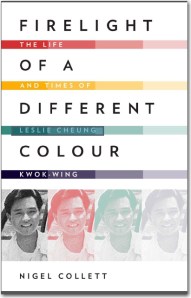
firelightWhile many of Leslie Cheung’s songs, recordings, concerts and films were widely known outside of Southeast Asia during the 1980s and 1990s, the impact of his death by suicide in 2003 on fans in Hong Kong, China, Taiwan, Japan and Korea probably wasn’t deeply understood by most of the English-speaking world.

Yet, in the years leading up to and including the British handover of Kong Kong to China in 1997, Cheung was in many ways the very embodiment of the colony’s film and recording industries.

Collett’s thoroughly researched Firelight of a Different Colour is both a tribute to Leslie and a likely resource for all future biographies and documentaries about the widely respected actor and highly popular Cantopop star.  For many English-speaking readers, the book is a wonderful, in-depth introduction to Leslie, Hong Kong’s entertainment business, and to the difficulties of gay performers within the colony’s compact and often-hostile media environment.

During the months leading up to his death, Leslie was plagued by clinical depression, fatigue and multiple physical ailments that friends and fans couldn’t help but notice. Yet, they were unprepared to lose him to anything other than early retirement. His death created shock waves followed by an outpouring of grief that, even now, suggests Collett has left “the pain still too raw for a full biography” from the viewpoint of the family and many fans.

Collett sees this book as provisional and fully hopes it will be superseded by true biographies and assessments. The strength of the book for those future works comes from its encyclopedic approach to Leslie’s life and career along with the collected footnotes and bibliography. The weakness–which is a small one at that–also comes from a linear and occasionally exhaustive presentation of facts (large and small) that includes lengthy plot summaries of films.

Inasmuch as films, concerts, and other celebrity events are strongly visual events for fans, the book would have been well served with the inclusion of personal and professional photographs of Leslie and other film and recording stars, concert venues, album covers, movie posters and production stills from “Farewell, My Concubine,” “A Better Tomorrow” and other films.

On balance, Firelight of a Different Colour represents the author’s very diligent attempt to re-energize the memories of fans, introduce Leslie to a wider audience, and gather the resources of another era for the writers and researchers of the future. It’s a must read for fans and a heart-felt introduction to those meeting Leslie for the first time within its pages.

Briefly Noted: ‘Badluck Way’ by Bryce Andrews

Badluck Way: A Year on the Ragged Edge of the West, by  Bryce Andrews, Atria Books (January 7, 2014), 256 pages

badluckwayAn “Indies Introduce” selection on the January Indie NEXT List, Badluck Way is a memoir about a 23-year-old Seattle man’s work experiences on the Sun Ranch in southwestern Montana.

Writing in the Missoula Independent, Kate Whittle notes that a lot of “starry-eyed men and women” visit Montana, can’t fit in, and soon leave.

“Author Bryce Andrews,” she says, “is one of these adventurers who found a better fit in the West, and learned to love it for things that even native Montanans might not appreciate…

“He’s become a 21st century kind of cowboy, one who’s studied environmental science and conservation, understands the importance of riparian habitats, and he can ride an ATV, rope a heifer, fix a fence and knock back a few beers at the saloon afterward. He can read landscapes like some of us read a street map; he prefers the habitat of open spaces and jagged peaks.”

From the Publisher

Andrews - Simon & Schuster photo. Click on the photo to see the book video on Andrew's author's page.
Andrews – Simon & Schuster photo. Click on the photo to see the book video on Andrew’s author’s page.

In this gripping memoir of a young man, a wolf, their parallel lives and ultimate collision, Bryce Andrews describes life on the remote, windswept Sun Ranch in southwest Montana. The Sun’s twenty thousand acres of rangeland occupy a still-wild corner of southwest Montana—a high valley surrounded by mountain ranges and steep creeks with portentous names like Grizzly, Dead Man, and Bad Luck. Just over the border from Yellowstone National Park, the Sun holds giant herds of cattle and elk amid many predators—bears, mountain lions, and wolves. In lyrical, haunting language, Andrews recounts marathon days and nights of building fences, riding, roping, and otherwise learning the hard business of caring for cattle, an initiation that changes him from an idealistic city kid into a skilled ranch hand. But when wolves suddenly begin killing the ranch’s cattle, Andrews has to shoulder a rifle, chase the pack, and do what he’d hoped he would never have to do.

From the Book

“On my first morning in the bunkhouse, I woke up shivering and listened to the harsh squalling of magpies. Through a little window, past trim boards cracked and shrunken by age and exposure, a handful of stars still pocked the predawn sky. I lay motionless as they faded into the daylight. An insistent, hissing wind slipped through gaps in the window casing. The Madison wind is pitiless. It is a sandblasting, constant presence, meant for howling around the eaves of broken shacks and the scattered bones of winter-killed cattle. Passing cold and dry across my skin, it reminded me how far I was from Seattle.”

97% of the ranch is protected by conservation easements.

Author Interview

In a Bookselling This Week interview, Andrews talked about the challenge of looking after dumb, slow livestock on a vast range with quick-witted predators.  “I hope that Badluck Way conveys a deep appreciation for the work of ranching and an equally strong sympathy for wild animals, like the wolf,” he said.

This book brings readers lyrical prose, common sense, violence and a growing appreciation for the continuing need for understanding in the co-existing world of rangers and wild animals.

Malcolm

Malcolm R. Campbell’s contemporary fantasy novels, including “The Seeker,” “The Betrayed,” and “The Sun Singer,” are set in northwestern Montana.

Idle thoughts about ‘Sex, Rain, and Cold Fusion’

Sex, Rain, and Cold FusionSex, Rain, and Cold Fusion by A.R. Taylor

My rating: 4 of 5 stars

This book fits into the “clever” and “hoot” genres and/or categories. It rocks and rolls from beginning to end with characters, events and language usage that are off-the-scale nuts.

In many ways, the plot–which is deliciously tangled–doesn’t matter because we’re all along for the ride and where we end up doesn’t matter. . .it’s one of those “the journey is more important than the destination” kind of books, er, in a wry way.

My only cautionary words are these: reading this book is rather like eating a cake that’s 99% frosting. You feel guilty but you keep doing it anyway.

View all my reviews

You can learn more about the author of this book on her website.


Malcolm

Malcolm R. Campbell is the author of “Jock Stewart and the Missing Sea of Fire,” a comedy/satire that is also flat nuts.

Book Note: ‘More Montana Moments,’ by Ellen Baumler

moremontanamomentsHistorian Ellen Baumler (“Montana Moments: History on the Go,” April 2012) returned six months later with another book of Montana vignettes originating from her “History on the Go” radio program in Helena, Montana. Published by Montana Historical Society in October 2012), the 220-page book is available on Kindle and in paperback is aptly titled More Montana Moments.

The cover art, “Laugh Kills Lonesome,” comes from Charlie Russell. The text is supplemented with illustrations.

From the Publisher

Forget dreary dates and boring facts. More Montana Moments serves up a fresh batch of the most funny, bizarre, and interesting stories from Montana’s history. Meet the colorful cast of the famous and not-so-famous desperadoes, vigilantes, madams, and darned good men and women (and a few critters) who made the state’s history. Best of all, each vignette takes about two minutes to read. So have fun exploring Montana—and enjoy a little history as you go.

From the Montana Historical Society Bookstore

When Evelyn Cameron first rode into Miles City in the dark blue divided riding skirt she had ordered from California, oh, the scandal it caused. Ellen Baumler tells that story and more in More Montana Moments, a collection of more of the most funny, bizarre, and interesting stories from Montana’s history.

From the Book

“Artist Charles Marion Russell carefully chose the subjects of his art based on personal experience. He, more than any other western artist, painted what he knew with great longing and nostalgia for the cowboy way of life he lived and loved so well. In 1925, a year before his death, Russell painted “Laugh Kills Lonesome,” a tribute to this vanishing cowboy lifestyle…He painted himself into the picture as an old cowpoke stoppping by the warm and friendly circle fo a cup of coffee by an a hearty laugh at the end of a long day in the saddle.”

You can keep up with Ellen Baumler at her Montana Moments site.

Malcolm

Set in Montana, Malcolm R. Campbell’s contemporary fantasies include “The Seeker.”

‘The Goldfinch’ – total immersion

After reading the reviews of Donna Tartt’s The Goldfinch at The Los Angeles Review of Books and The New York Times, I dare not try to compete with the experts by reviewing the book here.

GoldfinchI liked the book a lot, especially the puzzled-together plot, the symbolism of the painting, and the carefully written prose. I’ll confess that I almost stopped reading the book when I reached the one-hundred page point because I was so thoroughly exasperated with protagonist Theo Decker’s attitude and behavior.

Since I had several review books waiting for reviews, I stopped reading The Goldfinch for several weeks. When I returned to it, I had to remind myself that Decker’s behavior was realistic for a thirteen year old who had just lost his mother in a terrorist explosion. He was suffering a form of post traumatic stress syndrome, and the genius of Tartt is that her Proust-like prose immerses the reader in it.

Tartt has returned to the morbid themes she wrote about so well in her earlier novels. She does it even better this time, though total immersion in such themes isn’t always easy for a reader, especially those of us who have a worldview that contrasts so greatly with Decker’s that we really don’t enjoy being inside his head.

The language is worth the trip. Some reader reviewers think the novel is too long and that Decker is an unsympathetic and reactive character. In an era where books are getting shorter and attention spans are getting shorter, I understand these comments. Early on in the book, I thought it was over-written because I was drowning in Decker’s thoughts. I’ll stipulate that it’s difficult to find sympathy, much less, empathy for the protagonist. But feeling that isn’t a requirement in a novel.

With Tartt’s typical “verbose” approach, Decker, and especially his friend, the amoral Boris, are more real than real. Yet, their reality doesn’t intersect smoothly with the reality most of us experience. This is a slipstream approach and she handles it well. The painting anchors the book in amazing ways again and again and again.

For better or worse, I always felt like I was there while reading about Theo Decker. The prose is exceptional even though you may end up knowing more about Theo Decker than you can bear to know.

Malcolm

Kindle Version
Kindle Version

Malcolm R. Campbell is the author of five contemporary fantasy novels, including “The Sailor.”

Visit me on Google+

Follow my blog with Bloglovin

GoodReads and the year in books

If you’re a regular GoodReads visitor, you probably got an e-mail in the last could of days called See Your Year in Books. Mine began: “Congratulations! You read 21 books this year!”

This told me one thing: I haven’t been very diligent entering the names of the books I’m reading at GoodReads, for that is a fraction of the real number. Nonetheless, it was fun to look back:

2013books

We tend to sum up our yearly joys and sorrows, don’t we, from major news events and all those “best books of the year” lists to our own career and family milestones. I look at all these book covers and realize that authors pulled my imagination in many different ways in 2013. I also see that I forgot to buy some of the books I couldn’t wait to read when I first heard about them.

If you’re an avid reader, perhaps you’re also surprised at some of the books you read and some of the books you forgot about. Perhaps I need to get more organized. Hmm, sounds like a New Year’s resolution, doesn’t it?

Malcolm

FREE (for one more day)

Three folk tales set in the swamps and flatwoods of the Florida Panhandle at the dawn of time. Why doesn’t the Florida Panther roar? Why does the Snake Bird need to dry its wings. And what unlikely food is the black bear’s favorite?

Book Review: ‘A Certain Kind of Freedom,’ edited by Beryl Belsky

A Certain Kind of Freedom: Stories and Poems from the Writer's DrawerA Certain Kind of Freedom: Stories and Poems from the Writer’s Drawer by Beryl Belsky

My rating: 4 of 5 stars

“My objective when choosing the pieces for the anthology was to ensure that they reflected not only literary merit but also the multicultural nature of the website [Writer’s Drawer], as well as universal themes with which we can all identify.” – Beryl Belsky, from the Preface

A Certain Kind of Freedom presents ten stories in Short Fiction, ten first-person essays in Stories from Life, eleven poems in Poetry, and three poems in East Asian Style Poetry. While the short stories comprise the most dynamic section of the book, the anthology as a whole successfully fulfills Belsky’s objectives in the preface.

The title story about two young people who go kayaking in a cove that may or may not be dangerous or cursed, superbly introduces feelings of dread and a finely wrought narrative tension that characterizes most of the stories in Short Fiction. Susan Rogers’ “A Certain Kind of Freedom” employs a technique favored by director Alfred Hitchcock: placing everyday people into an unusual and chilling situation.

Kate and Ryan, who are visiting the Mediterranean coast, are experienced kayakers. The day is beautiful and the seas are calm. Yet Kate is preoccupied with “pink sky in the morning, sailor’s forewarning,” World War II dogfights that occurred in the area, and the unknowns of deep water once they paddle outside the sheltering cove. Rogers builds the tension well, foreshadowing a harrowing conclusion that, while not unexpected, is both surprising and sad.

In “Abigail,” Elizabeth L. Abrey also places an everyday person in an usual situation. While exploring her new house, Ruby Jordan gets locked in the basement. Once she extricates herself, everything seems fine. But then it isn’t–just possibly, getting locked in the basement wasn’t an accident.

Especially poignant is Leandré Grobler’s “Cry of the Fish Eagle”about an elderly aboriginal couple living in a secluded valley far from civilization who discover they are being watched by outsiders whom they do not understand. The watchers are well-intended researchers. As the tension builds, the reader can only wait helplessly for the inevitable clash of cultures that will destroy everyone.

Fans of Beethoven will love Tyger Schonholzer’s “Immortal Beloved,” an exquisite fantasy that re-imagines the circumstances behind the master’s famous “Immortal Beloved” letter to an unknown woman. The letter was never mailed. The intended recipient was never identified by historians. Could Schonholzer’s version be true? The romantic amongst us will want to think so.

All of the stories succeed, though some better than others, because they are tightly written and build toward well-plotted and appropriately foreshadowed conclusions. The essays in Stories From Life are generally informal and, while they introduce interesting characters, themes and settings, have a slice of life quality about them that often lacks unity and direction.

Bryan Clark’s “The Smoke Bird,” about an aboriginal mystic, Carrie King’s “The Ticket,” about an expectant mother barred from boarding a ship, and D. K. Srivastava’s “The Decision That Changed Her Life” about a Hindu bride waiting for her arranged marriage to begin are standouts in this section.

The offerings in Poetry are generally free verse with several of the poems falling into the prose-formatted-into-broken lines category. However, the poets’ passions shine through in such words as these in Syed Asad Ali’s “I Have Been in Love Twice”: …with you and with the idea of you; and maybe the reality of love lingers in between both of these.

Paige Lederman’s, memorable poem called “Fear” shows how a ten year old felt when hurricane Sandy hit New York’s Rockaway Beach in 2012, Dev Pillai’s tautly written “Paradox” looks at a moment in the past that was “incomplete yet content,” and Jane Tarlo’s bittersweet “It” bring strength to this section.

The three poems by Leon Zeldis, Jane Tarlo and Yael Shalev in East Asian Style Poetry comprise the strong final section of A Certain Kind of Freedom. These works clearly demonstrate the style and tone expected in the form, perhaps most effectively in Zeldis’ “Seven Chinese Poems” that begin:

Then,
Before the leaves went wild wind lofted,
The sky darkened
And I sat down crying.

Belsky concludes the book’s preface with the hope that A Certain Kind of Freedom will become the first of a Writer’s Drawer Book Series. Belsky and her contributors have made a strong start with this collection. For authors of future books in the series, this volume sets the bar high; for readers, it offers enjoyable prose and poetry that deserve multiple readings to fully explore.

Malcolm

Malcolm R. Campbell is the author of the contemporary fantasy “The Seeker,” a story about a mountain vision quest, a flood, a girl, a swamp, and a summer romance on the rocks.

99seeker

Jock Stewart’s Holiday Book Buying Guide

Jock Stewart’s Holiday Book Buying Guide

from Morning Satirical News

booksSince many of them (the authors) have bailed me out of jail for various misunderstandings with the local police force, I’m writing this column about local authors’ books that are gathering dust at the Main Street Book Emporium. These are books by people you’ve never heard of, but they’ve put their hearts and souls into these volumes and, what the hell, they (the books) are cheaper than a Happy Meal and make more nutritious stocking stuffers on Christmas Day.

  1. Lust Behind a Motel 6 Billboard on Route 2, by Cane Molasses – a cautionary tale about a young man who lived behind a faded billboard on the road to Prairie View. When it rained, Zeke got wet. When the sun came out, Zeke got warm. When a bus of wayward cheerleaders broke down, Zeek got lucky until he had to start running from the linemen of the county.
  2. Rats in the Birdbath, by T.Z. – Local rapper T.Z. turns his talents for profanity to fiction in this gritty story about a man who discovered that the rats in the birdbath tasted better than the sparrows. This is a dark urban fantasy that should be read primarily by people who believe the end of the world came and went already and that nobody noticed.
  3. My Dustbunnies Don’t Eat Your Carrots, by Sally Hyde – A young man, who thoughtlessly ran out on his upscale family, is accused of murdering his mother-in-law because she purportedly made fun of the dust bunnies in his apartment. Hyde, who claims in the introduction that she was the mother-in-law who was murdered, says it took her years of communicating with wackos with Oui-Ja boards to get the truth into print.
  4. Coffee Tables Without Books, by Lucille Smith-Whitson – A specialist in old furniture shows discouraging evidence that most coffee tables collapse sooner or later under the weight of expensive “coffee table books” that people never read. “People put books like ‘Bombay Harlots’ and ‘The Glaciers of Saudi Arabia’ on their coffee tables to impress their friends. Yet, the dust on those books tips off visitors to the fact the host never cracked the cover,” writes Smith-Whitson. The result: the books pile up even after the cows come home and crack the table tops.
  5. Write this Damn Book Yourself, by Clark Trail – Trail, who believes too many wackos are writing books these days and uploading them to Kindle and CreateSpace, has published a book with multiple cover-art inserts for desperate people who just can’t seem to get published in spite of the fact their writing looks like a theme out of a remedial English class. The secret: blank pages. Clark suggests non-writers pick the most exciting cover art, fill in the blank pages, and display the books on their coffee tables.
  6. The Shooting of Dan McGrew’s Brother, by Joe Smith – At a press conference Smith claimed that even though this book appears to be a ripoff of the famous poem by Robert Service, he (Smith) thought the whole thing up last year when he and a bunch of the boys were whooping it up in the Malamute saloon.
  7. 51 Shades of Purple, by Bambi Hill – This tell-little book by a young woman who claims to have slept with many of the world’s still-living monarchs, shows that most of the kings were drunk or bored when the one-night-lie-downs occurred at a Motel 6 on Route 2. “Kings are not as powerful as you think,” Hill gushes in the introduction.
  8. How to Repair Your Betamax, by Clyde Clinton – After discovering most Radio Shacks and other geeky stores no longer have Betamax repairmen, Clinton uses his own collection of vintage units do demonstrate everything that can possibly go wrong with them. He says that while he has sold only one copy to a Betamax museum, he hopes the thing will one day “go viral.”
  9. Emily Dickinson: The Biker Babe Years, by Norma “Harley Girl” Johnson – Johnson re-imagines the life of the famous poet as a “hot momma taking names and kicking asses vixen who rides with a group of hell raisers called The Cardboard Monkeys.” Johnson pushes the envelope in this novel, especially in the chapter called “Going Down On the Road.”
  10. The Homogenization of the American Family, by Robert Elderberry and James S. Mason – According to Elderberry and Mason, new research charting the DNA of 99% of America’s families, shows that “more children that previously known” were fathered by milkmen who were supposed to be delivering milk rather than babies.” Elderberry told reporters at a Main Street Book Emporium launch party that he got most of the data by hacking into the NSA’s secret database of real and imagined ancestors.

Give the gift of books. Your friends will never forget you for filling up the blank space on their coffee tables because who the hell drinks coffee in the living room these days?

Jock Stewart

Briefly Noted: ‘Chief Mountain: Home of the Thunderbird’

Chief Mountain: Home of the Thunderbird – Physical, Historical, and Spiritual Perspectives, by Dave Shea, Thomas Printing, 2010, Second Edition, 42pp, photographs, maps, charts

ChiefMountainThunderBirdBackcountry ranger, wildlife biologist and botanist Dave Shea worked in Glacier National Park for almost four decades, spending many years at the Belly River Ranger station in the shadow of Chief Mountain. Shea writes that those who have seen that shadow in the valley in March and September call it “the sacred shadow.”

This tightly written, encyclopedic book shows that Shea has come to understand the rock, natural forces, legends and people behind that shadow very well. Without a doubt, Chief Mountain (Nináistuko) is the one of the most distinctive, visible and photographed peaks in Montana.

While Glacier specialists and friends of the park will have seen most of the geological information in the first part of the volume elsewhere, the book is an able summary of Chief’s setting within the Rocky Mountain Front as well as its importance and current status as a sacred site to the Blackfeet Nation. In addition to the spectacular cover photo by B. Riley McClelland, the author’s photographs are a beautiful addition to the book.

From the Publisher

For 36 years, Dave Shea prowled Glacier Park’s wilds as a backcountry ranger, patrolling trails, managing wildlife, leading search and rescue efforts. And for 11 of those years, he and his wife, Genevieve, lived, quite literally, in the shadow of Montana’s most sacred mountain. And so it’s appropriate, perhaps, that when Dave Shea set out to put the peak on the page, he did so in what could be described, in terms of size, as a booklet, but in scope is most decidedly a full-blown book.

Reviewer’s  Comments

“It’s clear Chief has become a character in Shea’s life, a fully animated wonder complete with presence and with moods and with attitude,” writes Michael Jamison in the Missoulian. “In a cave, near the summit, lives Thunderbird and the Thunder-Maker Pipe. The Wind Spirit resides here, as does Old Man Napi. The Sacred Shadow reaches far into the backbone, and each spring and autumn darkens other peaks with the outline of the Chief.”

Shea, described by the Missolian as “one of Glacier Park’s last old-school patrol rangers – a man competent and comfortable and completely content in the backcountry,” is also the author of the NPS field checklists “Mammals of Glacier National Park” and “Birds of Glacier National Park.”

Malcolm

Malcolm R. Campbell, a seasonal employee at Many Glacier Hotel in the park in 1960s, is the author of contemporary fantasy novels including “The Seeker.” “The Seeker” is partially set in Glacier during the historic flood of 1964.

A Glacier Park novel on Kindle

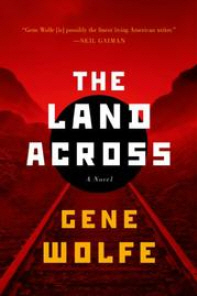
Briefly Noted: ‘The Land Across,’ fantasy by Gene Wolfe

landacrossWith all the high-energy buzz surrounding books like Donna Tartt’s The Goldfinch, Amy Tan’s The Valley of Amazement, and John Grisham’s Sycamore Row, I have to look a little harder to find new fantasy fiction, especially contemporary fantasy.

So, I’m happy to see that Gene Wolfe’s (“The Book of the New Sun” tetralogy) new release from Tor Books will appear a few days before Thanksgiving filled with corruption, supernatural powers and a Kafkaesque flavor. The Land Across unfolds in an imaginary Balkan country that’s difficult to visit and more difficult to leave–in part because of the secret police and in part because of a cult called the Unholy Way.

Teaser Excerpt from the Novel

Like most countries it is accessible by road or railroad, air or sea. Even though all those are possible, they are all tough. Visitors who try to drive get into a tangle of unmarked mountain roads, roads with zits and potholes and lots of landslides. Most drivers who make it through (I talked about it with two of them in New York and another one in London) get turned back at the border. There is something wrong with their passports, or their cars, or their luggage. They have not got visas, which everybody told them they would not need. Some are arrested and their cars impounded. A few of the ones who are arrested never get out. Or anyhow, that is how it seems.

Wolfe
Wolfe

Reviews

  • Kirkus Reviews says The Land Across “seamlessly blends mystery, travelogue, authoritarianism and the supernatural.”
  • Publishers Weekly says “Wolfe evokes Kafka, Bradbury, and The Twilight Zone in combining the implausible, creepy, and culturally alien to create a world where every action is motivated by its own internal logic, driving the story forward through the unexplored and incomprehensible.”
  • According to Library Journal’s starred review, “Wolfe, in masterful mood, builds his characters, explores the puzzles, links the elements together and contrives to render the backdrop both intriguingly attractive and creepily sinister. Sheer enjoyment.”
  • And Booklist writes, “Master fantasist Wolfe feeds into every tourist’s worst fears in this cleverly constructed travelogue though a country figuratively accessed through a looking glass. When an American travel writer, Grafton, sets out to document his experiences traversing a small, exceedingly obscure Eastern European country (the land across the mountains), he winds up in a nightmarish predicament from which there appears to be no escape.”

I like contemporary fantasy because, in blending magic into the real world, it brings us plots and characters that seem somewhat more plausible than swords and dragons on far-away planets. Almost everyone who has traveled has worried about being lost in an unfamiliar and unfriendly place. Wolfe’s protagonist is a travel writer who should know his way around the risks, but he’s nonetheless trapped in a place where mere unfriendliness would be a plus.

Malcolm

Malcolm R. Campbell is the author of contemporary fantasy novels, including “The Seeker,” “The Sailor and “The Betrayed.” Released this month, “The Betrayed” features a young English teacher at a small campus where lies and deceits take precedence over literature, history and science.

betrayedbanner