Banned Books Week – Take the Pledge

One way you can support Banned Books Week this year is by taking the pledge which you will find here. It reads as follows: 

We Condemn Threats to the Freedom to Read.

We are readers — individuals, groups, parents, community advocates — who believe that all young people deserve to see themselves reflected in the pages of books, and that individuals should be trusted to make their own decisions about what they, and their families, read. Access to diverse books is essential to a strong education, a free mind, and a functioning democracy. 

We are in the midst of a book banning crisis. Well-funded pressure groups continue to push state governments to impose educational gag orders on teachers and staff and mandate the removal of books from library and school shelves. These laws silence discussions about race and gender in America, isolate and discriminate against LGBTQ+ students and students of color, and cast a long and shameful shadow of censorship across our schools and libraries.

Yet we have the constitution and public opinion on our side. In state after state, federal courts have rightly blocked these discriminatory laws for violating our First and Fourteenth Amendments. Polling repeatedly shows that communities across our country agree that families should decide for themselves what they can and cannot read. Not another parent. Not a politician. These laws are anti-family, anti-freedom, and anti-American at their core. 

Enough is enough. 

We Pledge to Vote. 

We must use our voices and our votes to make informed decisions demanding our legislators protect students, public servants, and the right to read. That means supporting policymakers who believe our public institutions must serve diverse communities and remain a hallmark of a free people.

Together we stand for freedom, democracy, equality, and the right to read; we stand for the majority. We stand against book bans, and we will lead with our values.

Please join me by taking the pledge.

–Malcolm

Banned Books Week

I suspect that a lot of us feel a great distance between our reading habits and banned books because we don’t go to the library or have children who are impacted by what’s suddenly not available in the classroom or the school library.  We live busy lives. So if a book is banned in Peoria, we have little or no reason to notice it because nobody is stopping us from buying and reading the book.
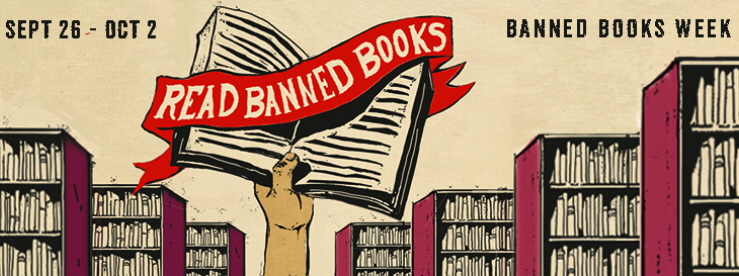
This year, Banned Books Week runs between October 1-7.  According to one of the sponsors, the American Library Association (ALA), “This year’s theme is ‘Let Freedom Read.’ When we ban books, we’re closing off readers to people, places, and perspectives.”

According to Deborah Caldwell-Stone, director of the ALA’s Office for Intellectual Freedom, “This is a dangerous time for readers and the public servants who provide access to reading materials. Readers, particularly students, are losing access to critical information, and librarians and teachers are under attack for doing their jobs.” The number of challenged books and attempted bans is increasing.

You can find a list of Banned Books Week events here, along with book ban data.

We need to be aware of all this,  I think, to protect our freedom to read what we want even if the issues appear to be far away.

Malcolm

Weak, unintelligent people are trying to control the books you and your children read

  • From July 2021 to June 2022, PEN America’s Index of School Book Bans lists 2,532 instances of individual books being banned, affecting 1,648 unique book titles.
  • The 1,648 titles are by 1,261 different authors, 290 illustrators, and 18 translators, impacting the literary, scholarly, and creative work of 1,553 people altogether. —Banned in the USA

PEN America’s “Banned in America” summarizes what many of us have seen more and more often in the news: book bans.
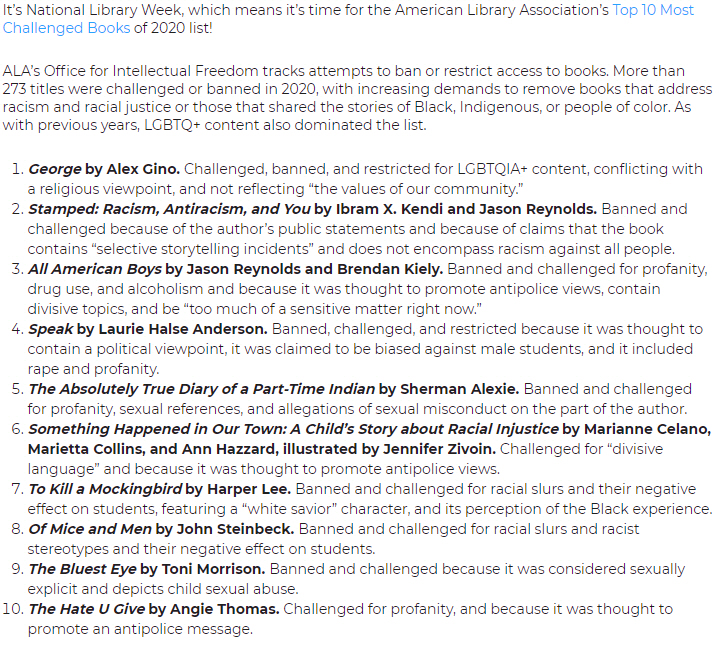
They are a weapon used by weak people and weak groups who have so little confidence in their beliefs, they are fearful of what might happen if people are free to read about alternatives. The German government, controlled by the Nazi party, burnt the books in town squares, a more uncouth version of the book bans.

Book bans in government schools and government libraries are, of course, unconstitutional since they run counter to the Bill of Rights. And yet, how easily people flock to this method of stifling the free flow of ideas when a particular book bothers them.

In a September 22 news release, PEN said, “With free expression and the freedom to read being undermined in America’s schools, Congressman Jamie Raskin today introduced a resolution in the U.S. House of Representatives condemning the spread of book bans in schools nationwide, as Senator Brian Schatz leads a companion resolution in the U.S. Senate. PEN America commends the lawmakers’ efforts, which reaffirm Congress’ commitment to upholding free expression in the classroom and beyond.”

While I think this is good, I doubt that most people will even know that it happened, much less change their gutless, book-banning behavior if they did hear about it. I would like to hear more protests from those who abhor the book bans. Let’s put the banners under a microscope and embarrass the hell out of them for being too weak to admit they are weak.

–Malcolm

Malcolm R. Campbell is the author of the Florida Fok Magic Series.

If your beliefs are weak, ban books with opposing beliefs

One man who challenged the Harry Potter books did so because he believed the spells in the book are actual curses that summon demons. My response to that “logic” is:

  1. Can you prove it?
  2. If these purported demons appear, isn’t your faith sufficient protection?

No, of course he can’t prove it, and one reason he can’t is that he doesn’t know how spells work, and for most people considering his charge, he’s going to need some evidence. Show us the demons.

Suppose he produces the evidence. Can his faith not protect him? Apparently he’s unsure.

Most book challenges sound about this cowardly and absurd. That is, rather than disseminating opposing information to give readers an alternative, people choose to take the offending book off the shelves if they can:

Do you remember a game show called “The Weakest Link”? Banning these books shows that because an individual says, “I don’t like them so we should remove them from the library so that nobody else can read them,” we say, “okay,” and demonstrate the weakest link system of decision making.

We can do better. If we can’t, we’ve let things go too far and the contry is now in the hands of people who can’t think and/or who are scared to think, much less engage in a dialogue about opposing ideas.

You can fight the weakest links by reading everything they don’t like and asking your friends to do the same.

–Malcolm

Malcolm R. Campbell

Publisher: Thomas-Jacob Publishing

Website

Facebook Author’s Page

Amazon Author’s Page

PEN America to Focus on the Right to Read in the Nation’s Prisons 

“America’s prison system implements that largest book ban in the United States. This year, as part of national Banned Books Week (Sept. 22 – 28), the free expression and literary organization PEN America will launch a weeklong initiative to shed light on the practice of banning books in the nation’s prisons and jails. ‘Literature Locked Up: Banned Books Week 2019’ will feature events across the country, online activities, and public education to highlight restrictions of the right to read for the 2.2 million people currently incarcerated in the United States.”

Source: As Part of National Book Banning Week, PEN America to Focus on the Right to Read in the Nation’s Prisons – PEN America

We hear about prisoners’ lack of access to books from time to time, but it always seems isolated to one jail or another. That obscures the issue. Book banning in prisons is worse than all the book challenges in all the school and public libraries put together.

We’re not talking about books with titles like “How to Tunnel out of Sing Sing” or “Bomb Making for Dummies.” I often wonder under what authority does the warden or those he reports to ban the same titles the rest of us are reading.

I hope PEN America’s initiative brings the problem to the attention of more people and shows how pervasive it is.

Malcolm