Ever since I first read Poe’s “To Helen” in high school, I’ve loved the poem’s opening lines–partly because I’m a fan of well-wrought alliteration:
Helen, thy beauty is to me
Like those Nicéan barks of yore,
That gently, o’er a perfumed sea,
The weary, way-worn wanderer bore
To his own native shore.
He was a teenager when he wrote the poem, dedicating it to Jane Stanard, mother of a childhood friend. The poem is about Helen of Troy who, many said, was the most beautiful woman in the world. It first appeared in a 1931 collection, went through various revisions, and then the version we read now appeared in The Raven and Other Poems in 1845.
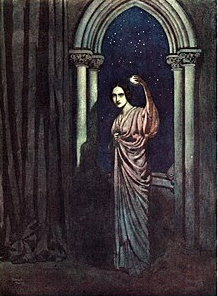
As Wikipedia notes, “Poe also refers to Helen as Psyche, a beautiful princess who became the lover of Cupid. Psyche represented the soul to ancient Greeks, and Poe is comparing Helen to the very soul of “regions which are Holy Land” meaning the soul of Greece from which so much of our ideals of beauty, democracy and learning sprang forth. In ancient Greek, the name Helen literally means “sunlight; bright as the dawn”. Her “agate lamp” may refer to the moment when Psyche discovered the true identity of Cupid by shining a lamp on him at night; it also refers to the enlightened knowledge of the ancient world, which still influences Western culture today.”
While my favorite poem is “Fern Hill” (“Now as I was young and easy under the apple boughs about the lilting house and happy as the grass was green”), by Dylan Thomas, the lines in “To Helen” are the ones that haunt me.
 Malcolm's Round Table
A clear reference to Greek Myths. Poe uses the legendary Helen of Troy as his metaphor. Some argue that this metaphor refers to Jane Stanard, the mother of one of his childhood friends. The metaphor of “Nicean barks” refers to ancient Greek ships that sailed the Mediterranean Seas; associated with both adventure and travel. The Helen metaphor Poe’s poetry likens to these famous sailing ships of yore.
The poem evokes nostalgia, longing, and a sense of returning to a place of comfort and belonging. The agate lamp in the window-niche symbolizes enlightenment and illumination. The mention of Psyche (a figure from Greek mythology) adds depth, suggesting that Helen embodies both physical beauty and inner wisdom.
The poem, a tribute to the enduring impact of beauty and the way it can transport us across time and space. In summary, Poe’s “To Helen” weaves admiration for a woman’s beauty with Greek myths, portraying her as a guiding light akin to Helen of Troy and Psyche. It’s a timeless exploration of longing and memory.
Thanks for adding more background,
This was a poetic treat! Thank you!
You’re welcome.