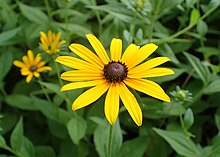
Black-eyed Susan is a member of the Aster/Sunflower Family and is found throughout eastern and central North America. It is also called brown-eyed Susan, hairy coneflower, gloriosa daisy brown Betty, yellow ox-eye daisy coneflower, poor-land daisy, and golden Jerusalem. The prefers full sun and moist to moderately dry soil.” –The Lost Book Of Herbal Remedies
Both an annual (usually) and a perennial the plant is 3-foot tall by 1.5 foot wide with alternate, coarse-haired leaves, branching stems off a single tap root, reproduces by seeds, and displays flowers in the fall with a brown/black center and yellow petals. It is toxic to cats, and probably some farm animals (cattle, sheep, pigs). The seeds are poisonous.
Wikipedia classifies the plant as follows:
| Kingdom: | Plantae |
| Clade: | Tracheophytes |
| Clade: | Angiosperms |
| Clade: | Eudicots |
| Clade: | Asterids |
| Order: | Asterales |
| Family: | Asteraceae |
| Genus: | Rudbeckia |
| Species: |
R. hirta
|
Its primary use is in parks and home gardens.
It has medical uses–taken under a doctor’s consultation, including, (according to Practical Self Reliance) “snakebites, earaches, and get rid of parasitic worms. It has a long history of treating colds and the flu, but fewer people turn to this popular wildflower for anything other than filling a glass vase over the last century.”
Poison Control warns that “it should not be eaten. It can cause allergic skin reactions and asthma attacks in people sensitive to the plant.” Consult a doctor or herbalist before experimenting with slack-eyed susans. This information is provided for historical usage.
–Malcolm
 Malcolm's Round Table