 Was it a lapse in my education or a personality defect that brought me into the theater in 2001 to see the Ron Howard-directed film “A Beautiful Mind” with absolutely no idea who John Forbes Nash (June 13, 1928 – May 23, 2015) was, much less the focus of his work? I suspect my lack of knowledge of Nash came out of the rather thin coverage of subject matter in my university’s general education courses. Since I’d never heard of Nash, I didn’t notice the publication of Sylvia Nasar’s 1998 biography A Beautiful Mind on which the feature film was based. The biography is well written and yet, I missed it until after the film came out
Had I known about Nash, I would have known his philosophy (though not his math) through such quotations as “Rationality of thought imposes a limit on a person’s concept of his relation to the cosmos.” I agree!
 The movie made quite a splash and won many awards, at the Oscars and elsewhere. Some people didn’t like the way schizophrenia, from which Nash recovered. Others thought Nash’s wife Jennifer Connelly was miscast as Alicia Nash who, in reality, came from El Salvador and spoke with an accent. And then, as Wikipedia reports, “According to Nash, the film A Beautiful Mind inaccurately implied he was taking atypical antipsychotics. He attributed the depiction to the screenwriter who was worried about the film encouraging people with mental illness to stop taking their medication.”
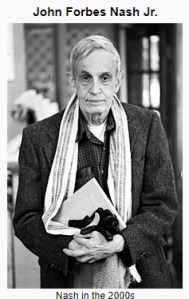
Sad to say, I don’t think the film–as much as I liked it–left me with a strong sense of what Nash’s specialty was. Wikipedia states that “John Forbes Nash, Jr. (June 13, 1928 – May 23, 2015), known and published as John Nash, was an American mathematician who made fundamental contributions to game theory, real algebraic geometry, differential geometry, and partial differential equations. Nash and fellow game theorists John Harsanyi and Reinhard Selten were awarded the 1994 Nobel Memorial Prize in Economics. In 2015, he and Louis Nirenberg were awarded the Abel Prize for their contributions to the field of partial differential equations.”
 In the Oppenheimer biography American Prometheus, Oppenheimer is said to have a “forgiving instinct for the frailty of the human psyche, an awareness of the thin line between insanity and brilliance.” He worked with Nash and saw the issues behind the individual.
Of Nash, Britannica writes, “American mathematician who was awarded the 1994 Nobel Prize for Economics for his landmark work, first begun in the 1950s, on the mathematics of game theory. He shared the prize with John C. Harsanyi and Reinhard Selten. In 2015 Nash won (with Louis Nirenberg) the Abel Prize for his contributions to the study of partial differential equations.”
My thoughts: the book gives readers a better idea of Nash’s work than the movie. I suspect that most of those who watched and enjoyed the movie had no idea who Nash was before the film’s promotions began and probably forgot the little they learnt in the film within a few weeks of watching it.
 Malcolm's Round Table
I saw the movie when it came out – but had absolutely no idea who Nash was. Mathematicians don’t tend to make it into the public domain. It isn’t seen as a sexy subject. And yet it is, conceptually!
I have been a Big Bang Theory fan since the beginning. It doesn’t shy away from these theories. Sometimes it even explains them in lay terms. Nevertheless this sort of maths is still not part of our world, which I think is a shame. Indeed, my brother – a gifted mathematician and nuclear physicist – has never watched BBT! And I don’t think I once heard Sheldon Cooper mention Nash.
It’s a funny ol’ world, innit?
Funny in a sarcastic way. Somehow, I never heard of BBT until it was over. Just another example of me being a day late and a dollar short.