Glacier National Park’s Chief Mountain “(Nináistuko) was formed 100 million years ago when forces of incomprehensible power and magnitude slammed two slabs of the world together thrusting the older proterozoic rock 50 miles eastward up and over the younger cretaceous rock. Many said the great rocks that formed the backbone of the world were piled one upon the other and sculpted into shining mountains by Nápi, the Old Man who created the world from a ball of mud fetched up from the depths of the dark primordial waters by Muskrat.” – Malcolm R. Campbell in Garden of Heaven.
After Old Man and/or the Lewis Overthrust left older rock sitting on top of newer rock, the resulting mountains along Glacier’s eastern side were rootless. That’s how David Rockwell describes the Montana portion of the Rocky Mountain Front. These mountains, he writes in A Natural History Guide: Glacier National Park, are “not anchored, not sunk into the earth like most mountains. Rather they perch on top of it, unconnected except by juxtaposition to the rock beneath.”
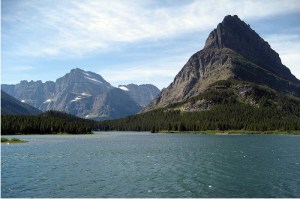
As you hike, notice the rock strata and the colors. Starting from the tops of the peaks and working down, you’ll find the following formations: Shephard, Snowslip, the Diorite Sill, Helena (formerly called Siyeh), Empire, Grinnell, Appekuny, Altyn and Prichard. The oldest rocks in the Park are the light-colored limestone and dolomite of the Altyn formation and the dark argillite of the Prichard formation.
When you drive between Babb, Montana and Waterton, Alberta, you’ll notice that Chief Mountain is an exposed remnant, or “outlier,” of the usually buried Altyn limestone. Contrast this rock with the somewhat greenish silture and argillite of the Appekuny formation which you can see, for example, at Dead Horse Point on Sun Road.
The red rocks of the Grinnell Formation are among the most striking in the park. The oxidation of iron-bearing minerals when the rock was formed created the distinctive color. The Grinnell Formation, with its ripple marks, is especially obvious near the St. Mary Falls trailhead on Sun Road and in the mountains around Many Glacier Hotel.
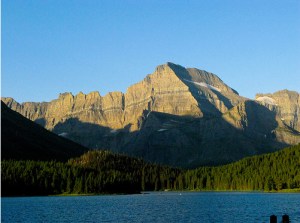
If you would like to learn more about the rock formations within the park, pick up a copy of the self-guided motorist’s tour Geology Along Going-to-the-Sun Road, Glacier National Park, Montana from the Glacier Association. See also, David Rockwell’s Glacier National Park natural history guide. Mountain climbers will find summit routes and other vital details in Gordon Edwards’ A Climber’s Guide to Glacier National Park.

3 thoughts on “Glacier Centennial: Mountains and Rock”
Comments are closed.
 Malcolm's Round Table
Pingback: Tweets that mention Glacier Centennial: Mountains and Rock « Malcolm's Round Table -- Topsy.com
This is an excellent post, Malcolm! Very interesting and informative. Are you sure you don’t want to move up here and spend more time in the park?
Thanks, Montucky. I think it will take more than a free CJ5 to lure my wife away from her work at the local museum. But it’s fun thinking about being there.